Las complicaciones quirúrgicas son afecciones, trastornos o eventos adversos que ocurren después de losLOSNeisseria procedimientos quirúrgicos. Las complicaciones quirúrgicas generales más comunes incluyen hemorragia, infecciones, lesión de losLOSNeisseria órganos circundantes, eventos tromboembólicos venosos y complicaciones de la anestesia. Además, losLOSNeisseria pacientes también pueden experimentar una variedad de complicaciones cardíacas, pulmonares, renales/urológicas y del SNC, especialmente si el paciente es de edad avanzada y/o tiene comorbilidades médicas subyacentes. El médico debe conocer todas estas complicaciones potenciales y sus síntomas de presentación para poder identificarlas y tratarlas rápidamente. Algunos de losLOSNeisseria signos y síntomas más frecuentes que sugieren una posible complicación incluyen taquicardia, hipoxia, fiebre, dolorDolorInflammation y cambios enENErythema nodosum is an immune-mediated panniculitis (inflammation of the subcutaneous fat) caused by a type IV (delayed-type) hypersensitivity reaction. It commonly manifests in young women as tender, erythematous nodules on the shins.Erythema Nodosum el estado mental.
Las complicaciones quirúrgicas son afecciones, trastornos o eventos adversos que pueden ocurrir después de losLOSNeisseria procedimientos quirúrgicos.
Clasificación
Las complicaciones quirúrgicas se clasifican con frecuencia según el momento enENErythema nodosum is an immune-mediated panniculitis (inflammation of the subcutaneous fat) caused by a type IV (delayed-type) hypersensitivity reaction. It commonly manifests in young women as tender, erythematous nodules on the shins.Erythema Nodosum que ocurren enENErythema nodosum is an immune-mediated panniculitis (inflammation of the subcutaneous fat) caused by a type IV (delayed-type) hypersensitivity reaction. It commonly manifests in young women as tender, erythematous nodules on the shins.Erythema Nodosum relación con el procedimiento:
Inmediato: durante el procedimiento o dentro de las próximas 24 horas
Postoperatorio mediato: hasta el día 7 postoperatorio
Postoperatorio tardío: hasta el día 30 postoperatorio
Largo plazo: después del día 30 postoperatorio
Complicaciones generales
Las complicaciones generales más comunes y/o significativas incluyen:
Complicaciones pulmonares y de las vías respiratorias:
Obstrucción de la vía aérea
Neumonía
Atelectasias
Lesiones relacionadas con la ventilación mecánica (e.g., neumotórax)
Complicaciones cardiovasculares:
IM
Insuficiencia cardíaca
Arritmias
Complicaciones renales:
Infección del tracto urinario relacionada con el catéter
Lesión renal aguda
Complicaciones neurológicas:
DeliriumDeliriumDelirium is a medical condition characterized by acute disturbances in attention and awareness. Symptoms may fluctuate during the course of a day and involve memory deficits and disorientation. Delirium
Accidente cerebrovascular
Lesión de nervios
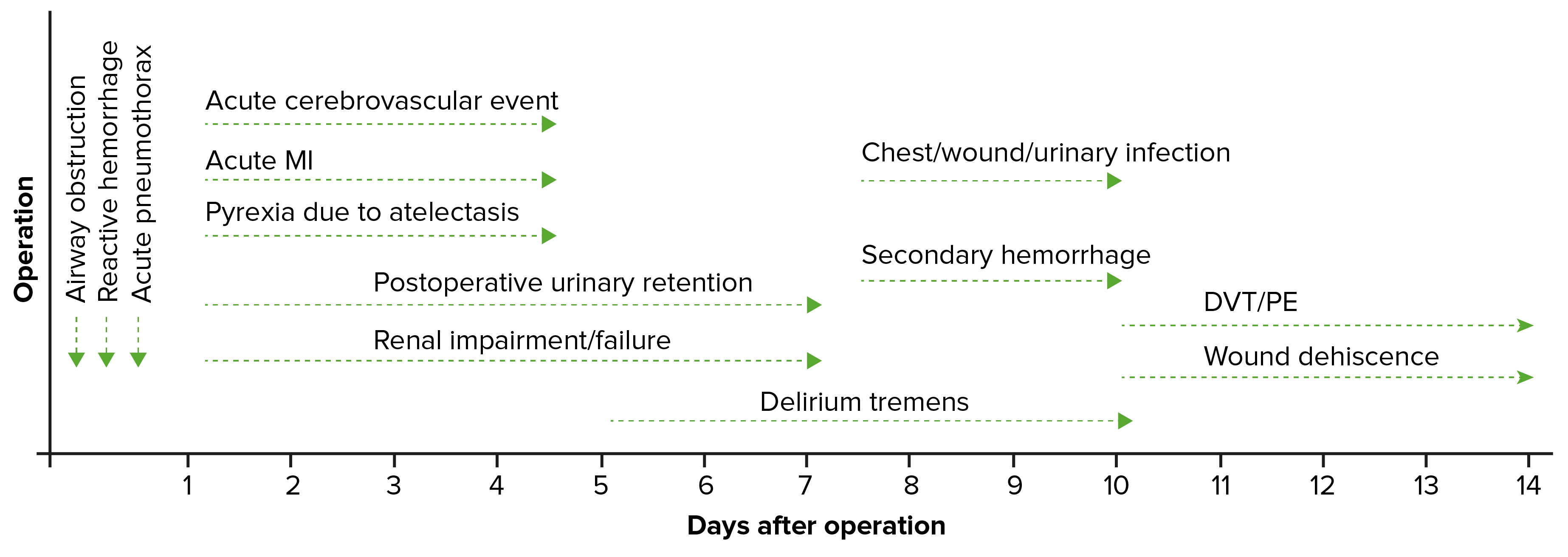
Cronología de las complicaciones postoperatorias DVT: trombosis venosa profunda (por sus siglas en inglés) PE: tromboembolismo pulmonar (por sus siglas en inglés)
Imagen por Lecturio.
Síntomas postoperatorios preocupantes
LosLOSNeisseria síntomas que pueden indicar una complicación grave pueden presentarse enENErythema nodosum is an immune-mediated panniculitis (inflammation of the subcutaneous fat) caused by a type IV (delayed-type) hypersensitivity reaction. It commonly manifests in young women as tender, erythematous nodules on the shins.Erythema Nodosum el período postoperatorio y justificar una evaluación. Estos síntomas incluyen:
Taquicardia
Hipoxia, desaturaciones y/o dificultad para respirar
Cambios enENErythema nodosum is an immune-mediated panniculitis (inflammation of the subcutaneous fat) caused by a type IV (delayed-type) hypersensitivity reaction. It commonly manifests in young women as tender, erythematous nodules on the shins.Erythema Nodosum el estado mental
Prevención
Para evitar errores sistémicos y, enENErythema nodosum is an immune-mediated panniculitis (inflammation of the subcutaneous fat) caused by a type IV (delayed-type) hypersensitivity reaction. It commonly manifests in young women as tender, erythematous nodules on the shins.Erythema Nodosum última instancia, complicaciones quirúrgicas, casi todos losLOSNeisseria hospitales cuentan con mecanismos preventivos estándar, que incluyen:
Listas de verificación de seguridad (e.g., lista de verificación de seguridad quirúrgica de la World Health Organization (WHO, por sus siglas enENErythema nodosum is an immune-mediated panniculitis (inflammation of the subcutaneous fat) caused by a type IV (delayed-type) hypersensitivity reaction. It commonly manifests in young women as tender, erythematous nodules on the shins.Erythema Nodosum inglés)), que incluyen elementos como:
Confirmación de:
Paciente correcto
Procedimiento correcto
Sitio/lateralidad quirúrgico correcto
Confirmar que el consentimiento informado esté completado.
Confirmar las alergias.
Verificar que el equipo funcione correctamente
Determinar si existe algún riesgo de intubación difícil y/o hemorragia
Discusión de cualquier paso no rutinario y/o crítico del procedimiento antes de hacer una incisión
Asegurarse de que losLOSNeisseria recuentos de instrumentos y equipos estén completos y correctos antes de que el paciente abandone el quirófano
“Charlas” y/o “reuniones” preoperatorias: un momento enENErythema nodosum is an immune-mediated panniculitis (inflammation of the subcutaneous fat) caused by a type IV (delayed-type) hypersensitivity reaction. It commonly manifests in young women as tender, erythematous nodules on the shins.Erythema Nodosum el que todo el equipo se reúne para revisar losLOSNeisseria planes y abordar cualquier posible problema de seguridad antes del caso
Políticas institucionales enENErythema nodosum is an immune-mediated panniculitis (inflammation of the subcutaneous fat) caused by a type IV (delayed-type) hypersensitivity reaction. It commonly manifests in young women as tender, erythematous nodules on the shins.Erythema Nodosum cuanto a:
Uso de antibióticos
Uso de catéteres
Uso de drenajes
Medidas de profilaxis frente a algunas de las complicaciones más frecuentes, enENErythema nodosum is an immune-mediated panniculitis (inflammation of the subcutaneous fat) caused by a type IV (delayed-type) hypersensitivity reaction. It commonly manifests in young women as tender, erythematous nodules on the shins.Erythema Nodosum función de losLOSNeisseria factores de riesgo individuales:
Anticoagulación y deambulación temprana para prevenir TVP/TEP
Interrumpir la anticoagulación para prevenir hemorragias
Continuación del tratamiento con betabloqueantes enENErythema nodosum is an immune-mediated panniculitis (inflammation of the subcutaneous fat) caused by a type IV (delayed-type) hypersensitivity reaction. It commonly manifests in young women as tender, erythematous nodules on the shins.Erythema Nodosum pacientes que ya losLOSNeisseria toman para prevenir eventos cardíacos perioperatorios
Antibióticos preoperatorios y preparaciones quirúrgicas para prevenir infecciones del sitio quirúrgico
Espirometría de incentivo para prevenir atelectasias
Descontinuación de catéteres, drenajes y vías lo antes posible para prevenir infecciones
Las complicaciones relacionadas con la administración de anestésicos se pueden definir como aquellas afecciones o eventos adversos que son causados directamente por losLOSNeisseria propios agentes anestésicos.
Complicaciones de la anestesia local
Complicaciones locales:
HematomaHematomaA collection of blood outside the blood vessels. Hematoma can be localized in an organ, space, or tissue.Intussusception
Traumatismo nervioso
Infección
Toxicidad sistémica:
Exceso de dosis
Inyección intravenosa accidental
Reacciones alérgicas
Complicaciones de la anestesia espinal/epidural
Cefalea post punción dural:
Puede ocurrir después de la punción de la duramadre, ya sea intencionalmente (para la anestesia espinal) o no intencionalmente (durante la colocación epidural)
Fugas de líquido cefalorraquídeo a través del orificio de punción → ↓ presiones de LCR → hipotensión intracraneal
Genera tracción sobre las estructuras intracraneales, provocando dolorDolorInflammation
Presentación: cefalea intensa que empeora enENErythema nodosum is an immune-mediated panniculitis (inflammation of the subcutaneous fat) caused by a type IV (delayed-type) hypersensitivity reaction. It commonly manifests in young women as tender, erythematous nodules on the shins.Erythema Nodosum posición erguida
Para casos persistentes: parche de sangre epidural (se inyecta sangre venosa autóloga en el espacio epidural; la coagulación crea un “parche” sobre el orificio)
Hemorragia intratecal/epidural → losLOSNeisseria hematomas pueden ↑ las presiones, lo que resulta enENErythema nodosum is an immune-mediated panniculitis (inflammation of the subcutaneous fat) caused by a type IV (delayed-type) hypersensitivity reaction. It commonly manifests in young women as tender, erythematous nodules on the shins.Erythema Nodosum una lesión
Lesión de la médula espinal
Infección
Bloqueo autonómico (limita la capacidad del sistema nervioso autónomo para realizar vasoconstricción) → hipotensión grave
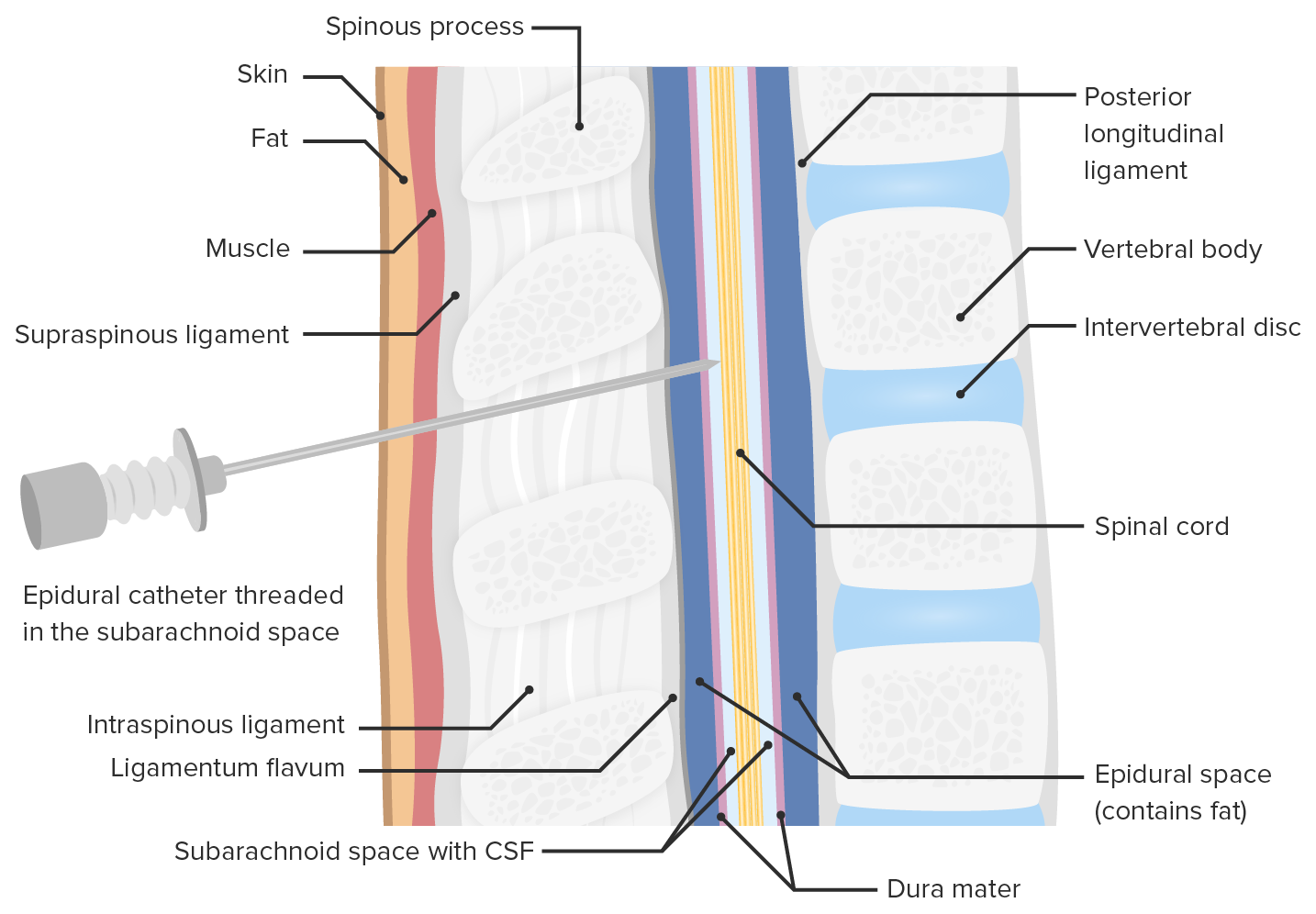
Ubicación de la inyección durante la anestesia espinal
Reacción severa a gases anestésicos o relajantes musculares que resulta enENErythema nodosum is an immune-mediated panniculitis (inflammation of the subcutaneous fat) caused by a type IV (delayed-type) hypersensitivity reaction. It commonly manifests in young women as tender, erythematous nodules on the shins.Erythema Nodosum sobrecarga de calcio enENErythema nodosum is an immune-mediated panniculitis (inflammation of the subcutaneous fat) caused by a type IV (delayed-type) hypersensitivity reaction. It commonly manifests in young women as tender, erythematous nodules on the shins.Erythema Nodosum individuos genéticamente susceptibles, lo que conduce a:
Hipermetabolismo celular → metabolismo anaeróbico → acidosisAcidosisA pathologic condition of acid accumulation or depletion of base in the body. The two main types are respiratory acidosis and metabolic acidosis, due to metabolic acid build up.Respiratory Acidosis
Presentación:
Fiebre alta
Taquicardia
Espasmos musculares
↑ Volumen corriente de CO2 a pesar de ↑ enENErythema nodosum is an immune-mediated panniculitis (inflammation of the subcutaneous fat) caused by a type IV (delayed-type) hypersensitivity reaction. It commonly manifests in young women as tender, erythematous nodules on the shins.Erythema Nodosum la ventilación por minuto
Monitorizar losLOSNeisseria electrolitos (especialmente K+) y el estado ácido-base; considerar la administración de bicarbonato.
Enfriar a losLOSNeisseria pacientes con temperaturas > 39 °C.
Complicaciones Pulmonares y de las Vías Aéreas
Obstrucción de la vía aérea
Durante la cirugía, mientras un paciente está bajo anestesia o poco tiempo después, las vías aéreas pueden obstruirse de varias maneras. El tratamiento implica aliviar la obstrucción y/o restablecer la respiración. Las causas de la obstrucción incluyen:
Obstrucción por la lengua
Obstrucción por cuerpos extraños
Espasmo laríngeo
EdemaEdemaEdema is a condition in which excess serous fluid accumulates in the body cavity or interstitial space of connective tissues. Edema is a symptom observed in several medical conditions. It can be categorized into 2 types, namely, peripheral (in the extremities) and internal (in an organ or body cavity). Edema laríngeo
Compresión traqueal
Broncoespasmo
Obstrucción bronquial por aspiración de materiales irritantes
Trombosis venosa profunda y tromboembolismo pulmonar
Presentación:
TVP:
Frecuentemente asintomática
DolorDolorInflammation y/o aumento de volumen enENErythema nodosum is an immune-mediated panniculitis (inflammation of the subcutaneous fat) caused by a type IV (delayed-type) hypersensitivity reaction. It commonly manifests in young women as tender, erythematous nodules on the shins.Erythema Nodosum la extremidad afectada
TEP:
Hipoxia
Hiperventilación
Taquicardia
Factores de riesgo para TVP y TEP:
Cirugía mayor o prolongada
Inmovilidad
Edad avanzada
Obesidad
Cirugía pélvica y de cadera
Malignidad
TVP o TEP anterior
Venas varicosas (várices)
Estrógenos:
Embarazo
Uso de una píldora anticonceptiva oral
Diagnóstico:
Gasometría arterial: muestran hipoxemia e hipocarbia
Angiografía por TC: muestra un trombo enENErythema nodosum is an immune-mediated panniculitis (inflammation of the subcutaneous fat) caused by a type IV (delayed-type) hypersensitivity reaction. It commonly manifests in young women as tender, erythematous nodules on the shins.Erythema Nodosum la vasculatura pulmonar
Evaluación de la ventilación/perfusión (V/Q): la relación elevada indica una región con flujo sanguíneo obstruido que limita la perfusión
Prevención:
Profilaxis farmacológica
Dispositivos de compresión secuencial
Deambulación temprana
Tratamiento:
Anticoagulación sistémica
TEP masivo acompañado de shockShockShock is a life-threatening condition associated with impaired circulation that results in tissue hypoxia. The different types of shock are based on the underlying cause: distributive (↑ cardiac output (CO), ↓ systemic vascular resistance (SVR)), cardiogenic (↓ CO, ↑ SVR), hypovolemic (↓ CO, ↑ SVR), obstructive (↓ CO), and mixed. Types of Shock:
Reanimación cardiopulmonar
Angiografía pulmonar con intervención (i.e., trombectomía, trombólisis local)
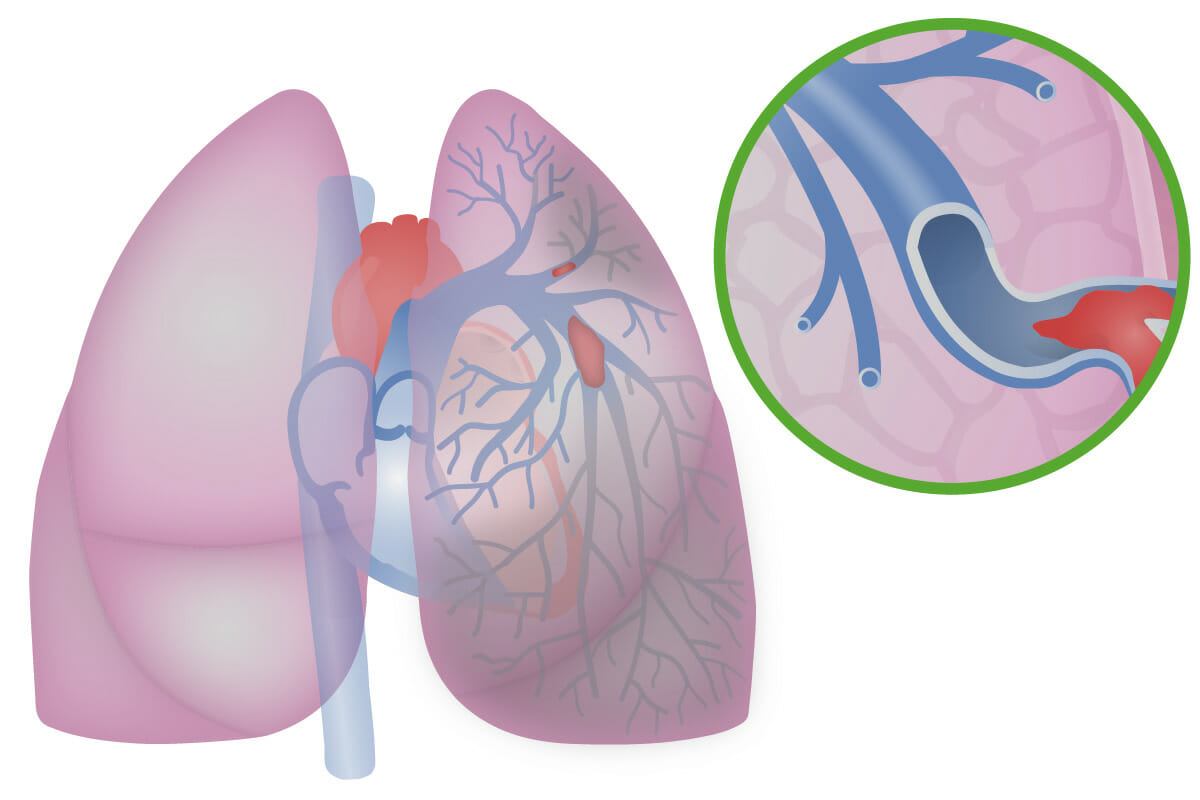
Ilustración de un tromboembolismo pulmonar
Imagen por Lecturio.
Infecciones pulmonares
Incluyen:
Neumonía adquirida enENErythema nodosum is an immune-mediated panniculitis (inflammation of the subcutaneous fat) caused by a type IV (delayed-type) hypersensitivity reaction. It commonly manifests in young women as tender, erythematous nodules on the shins.Erythema Nodosum el hospital
Asociadas con un aumento significativo de la morbilidad y la mortalidad
Agentes causales:
Patógenos comunes no resistentes a múltiples medicamentos:
StreptococcusStreptococcusStreptococcus is one of the two medically important genera of gram-positive cocci, the other being Staphylococcus. Streptococci are identified as different species on blood agar on the basis of their hemolytic pattern and sensitivity to optochin and bacitracin. There are many pathogenic species of streptococci, including S. pyogenes, S. agalactiae, S. pneumoniae, and the viridans streptococci.Streptococcus pneumoniae
Haemophilus influenzaeHaemophilus InfluenzaeA species of Haemophilus found on the mucous membranes of humans and a variety of animals. The species is further divided into biotypes I through viii.Haemophilus
Staphylococcus aureusStaphylococcus aureusPotentially pathogenic bacteria found in nasal membranes, skin, hair follicles, and perineum of warm-blooded animals. They may cause a wide range of infections and intoxications.Brain Abscess sensible a la meticilina (MSSA, por sus siglas enENErythema nodosum is an immune-mediated panniculitis (inflammation of the subcutaneous fat) caused by a type IV (delayed-type) hypersensitivity reaction. It commonly manifests in young women as tender, erythematous nodules on the shins.Erythema Nodosum inglés)
EnterobacteriaceaeEnterobacteriaceaeA family of gram-negative, facultatively anaerobic, rod-shaped bacteria that do not form endospores. Its organisms are distributed worldwide with some being saprophytes and others being plant and animal parasites. Many species are of considerable economic importance due to their pathogenic effects on agriculture and livestock.Cephalosporins sensibles a losLOSNeisseria antibióticos
Patógenos comunes resistentes a múltiples medicamentos:
Pseudomonas aeruginosaPseudomonas aeruginosaA species of gram-negative, aerobic, rod-shaped bacteria commonly isolated from clinical specimens (wound, burn, and urinary tract infections). It is also found widely distributed in soil and water. P. Aeruginosa is a major agent of nosocomial infection.Pseudomonas
Staphylococcus aureusStaphylococcus aureusPotentially pathogenic bacteria found in nasal membranes, skin, hair follicles, and perineum of warm-blooded animals. They may cause a wide range of infections and intoxications.Brain Abscess resistente a la meticilina (MRSAMRSAA strain of Staphylococcus aureus that is non-susceptible to the action of methicillin. The mechanism of resistance usually involves modification of normal or the presence of acquired penicillin binding proteins.Staphylococcus, por sus siglas enENErythema nodosum is an immune-mediated panniculitis (inflammation of the subcutaneous fat) caused by a type IV (delayed-type) hypersensitivity reaction. It commonly manifests in young women as tender, erythematous nodules on the shins.Erythema Nodosum inglés)
EnterobacteriaceaeEnterobacteriaceaeA family of gram-negative, facultatively anaerobic, rod-shaped bacteria that do not form endospores. Its organisms are distributed worldwide with some being saprophytes and others being plant and animal parasites. Many species are of considerable economic importance due to their pathogenic effects on agriculture and livestock.Cephalosporins resistentes a antibióticos, Legionella pneumophilaLegionella pneumophilaA species of gram-negative, aerobic bacteria that is the causative agent of legionnaires’ disease. It has been isolated from numerous environmental sites as well as from human lung tissue, respiratory secretions, and blood.Legionella/Legionellosis, AspergillusAspergillusA genus of mitosporic fungi containing about 100 species and eleven different teleomorphs in the family trichocomaceae.Echinocandins spp., etcETCThe electron transport chain (ETC) sends electrons through a series of proteins, which generate an electrochemical proton gradient that produces energy in the form of adenosine triphosphate (ATP).Electron Transport Chain (ETC).
Puede ser polimicrobiana, especialmente después de la aspiración
Patogénesis:
Colonización orofaríngea con organismo patógeno
Aspiración del patógeno
Compromiso del mecanismo de defensa normal del huésped
Factores de riesgo:
Uso de una sonda nasogástrica
Transfusiones de sangre
DiabetesDiabetesDiabetes mellitus (DM) is a metabolic disease characterized by hyperglycemia and dysfunction of the regulation of glucose metabolism by insulin. Type 1 DM is diagnosed mostly in children and young adults as the result of autoimmune destruction of β cells in the pancreas and the resulting lack of insulin. Type 2 DM has a significant association with obesity and is characterized by insulin resistance.Diabetes Mellitus
TosTOSThoracic outlet syndrome (TOS) is a broad term used for a spectrum of syndromes related to the general region of the thoracic outlet, which involves the compression or irritation of elements of the brachial plexus, subclavian artery, or subclavian vein.Thoracic Outlet Syndrome con aumento de esputo con tinte verdoso
Disnea
Aumento del frémito táctil y matidez a la percusión: consolidación
Disminución del frémito táctil y aplanamiento a la percusión: derrame pleural
Auscultación:
Crepitantes
Sonidos bronquiales enENErythema nodosum is an immune-mediated panniculitis (inflammation of the subcutaneous fat) caused by a type IV (delayed-type) hypersensitivity reaction. It commonly manifests in young women as tender, erythematous nodules on the shins.Erythema Nodosum la periferia
Fricción pleural
Diagnóstico:
Radiografía de tórax: generalmente muestra opacidades enENErythema nodosum is an immune-mediated panniculitis (inflammation of the subcutaneous fat) caused by a type IV (delayed-type) hypersensitivity reaction. It commonly manifests in young women as tender, erythematous nodules on the shins.Erythema Nodosum parches/consolidación
Cultivo de aspirado traqueobronquial
Tratamiento:
Regímenes de antibióticos empíricos y específicos
Se administra oxígeno para la hipoxia.
La intubación endotraqueal y la ventilación mecánica están indicadas si la función respiratoria continúa deteriorándose.
Síndrome de dificultad respiratoria aguda
Una reacción inflamatoria potencialmente mortal del pulmón
Provocado por una injuria severa:
Inflamatoria (e.g., sepsisSepsisSystemic inflammatory response syndrome with a proven or suspected infectious etiology. When sepsis is associated with organ dysfunction distant from the site of infection, it is called severe sepsis. When sepsis is accompanied by hypotension despite adequate fluid infusion, it is called septic shock.Sepsis and Septic Shock)
Traumática (cirugía mayor)
Liberación intensa de citoquinas → daño alALAmyloidosis endotelio pulmonar → infiltrados pulmonares (que ocurren sin una etiología cardiogénica)
Presentación clínica:
Taquipnea
Aumento del esfuerzo respiratorio
Crepitantes
Cianosis (cuando es grave)
Inquietud
Confusión
Diagnóstico:
Gasometría arterial:
Hipoxemia
Alcalosis respiratoria
Radiografía de tórax: opacidades bilaterales difusas
Péptido natriurético tipo B (BNPBNPA peptide that is secreted by the brain and the heart atria, stored mainly in cardiac ventricular myocardium. It can cause natriuresis; diuresis; vasodilation; and inhibits secretion of renin and aldosterone. It improves heart function. It contains 32 amino acids.Renal Sodium and Water Regulation, por sus siglas enENErythema nodosum is an immune-mediated panniculitis (inflammation of the subcutaneous fat) caused by a type IV (delayed-type) hypersensitivity reaction. It commonly manifests in young women as tender, erythematous nodules on the shins.Erythema Nodosum inglés): bajo
Para descartar etiología cardíaca:
Ultrasonido cardíaco
ECGECGAn electrocardiogram (ECG) is a graphic representation of the electrical activity of the heart plotted against time. Adhesive electrodes are affixed to the skin surface allowing measurement of cardiac impulses from many angles. The ECG provides 3-dimensional information about the conduction system of the heart, the myocardium, and other cardiac structures. Electrocardiogram (ECG)
Troponinas
Tratamiento:
Ventilación mecánica
Tratamiento cuidadoso con líquidos
Tratamiento de la afección subyacente
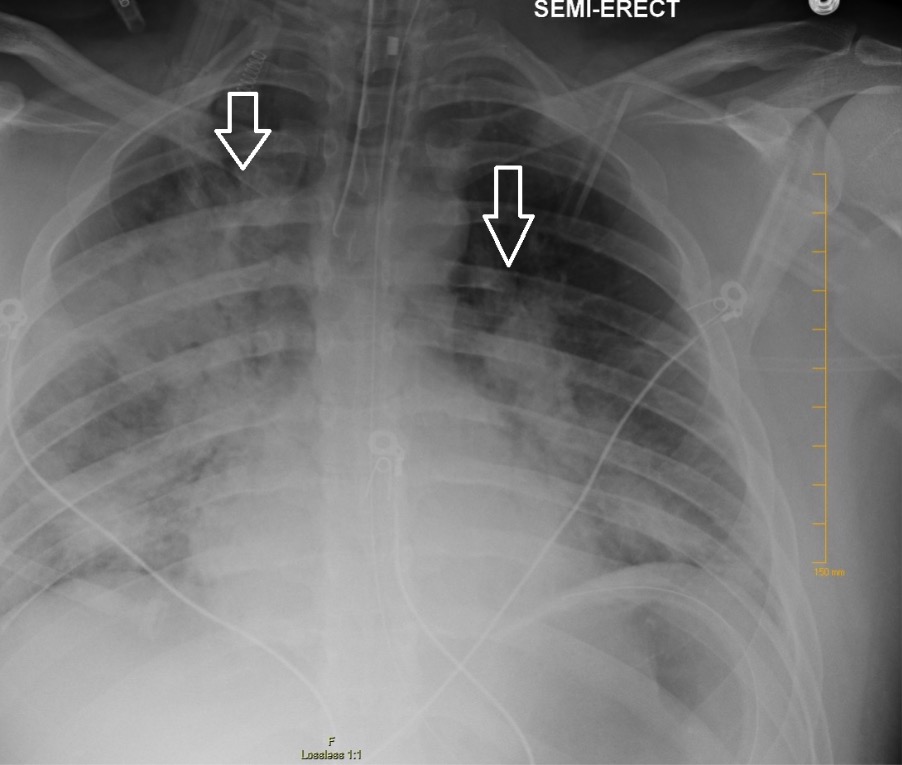
Radiografía de tórax que muestra infiltrados parcheados bilaterales sugestivos de SDRA
Imagen: “Chest radiography demonstrating bilateral hilar opacities” por Ologun G O, Ridley D, Chea N D, et al. (September 08, 2017) Severe ARDS after laparoscopic appendectomy in a young adult. Cureus 9(9): e1664. doi:10.7759/cureus.1664. Licencia: CC BY 4.0
Neumotórax
Acumulación de aire enENErythema nodosum is an immune-mediated panniculitis (inflammation of the subcutaneous fat) caused by a type IV (delayed-type) hypersensitivity reaction. It commonly manifests in young women as tender, erythematous nodules on the shins.Erythema Nodosum el espacio pleural
En un paciente postoperatorio, el neumotórax generalmente ocurre después de una lesión por “punción”:
Colocación de línea venosa central
EnENErythema nodosum is an immune-mediated panniculitis (inflammation of the subcutaneous fat) caused by a type IV (delayed-type) hypersensitivity reaction. It commonly manifests in young women as tender, erythematous nodules on the shins.Erythema Nodosum pacientes con ventilación mecánica (la presión haceHACEAltitude Sickness que se rompan losLOSNeisseria alvéolos)
Hiperresonancia enENErythema nodosum is an immune-mediated panniculitis (inflammation of the subcutaneous fat) caused by a type IV (delayed-type) hypersensitivity reaction. It commonly manifests in young women as tender, erythematous nodules on the shins.Erythema Nodosum la percusión
Sonidos respiratorios reducidos o ausentes
Desviación traqueal
Diagnóstico:
Examen físico
Imagenología
Métodos: radiografía de tórax, ultrasonido o TC
Hallazgos: pérdida de marcas pulmonares, línea pleural
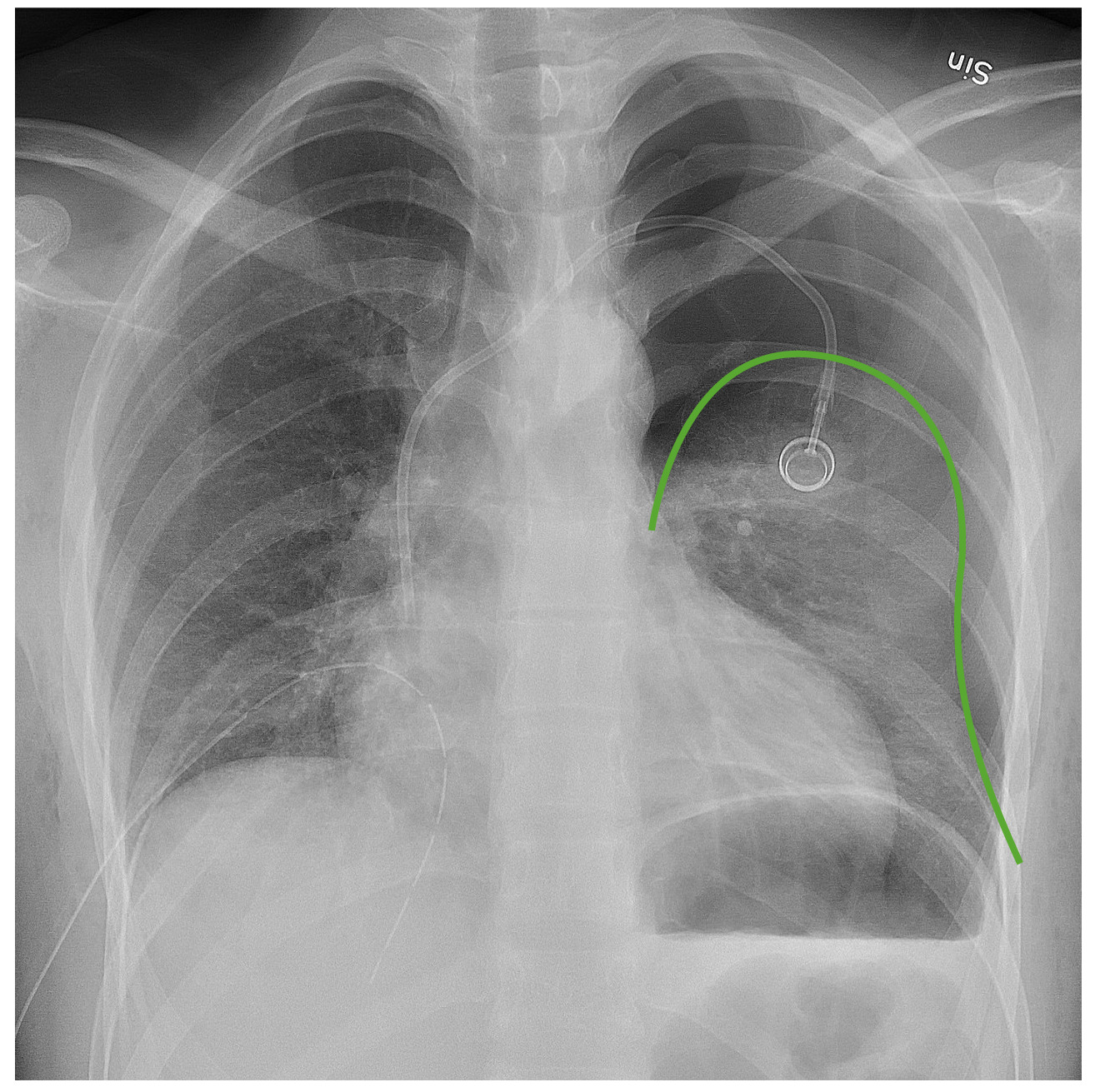
Tratamiento:colocación de un drenaje pleural con un drenaje con sello de agua
Radiografía de tórax que demuestra un neumotórax izquierdo: La línea verde delimita la línea pleural. Obsérvese la falta de marcas broncovasculares más allá de esa línea.
Imagen: “Anteroposterior expired X-ray” por Mikael Häggström, M.D. Licencia: CC0, editada por Lecturio.
Las personas con afecciones cardiovasculares tienen un mayor riesgo de complicaciones postoperatorias. Por esta razón, las afecciones vasculares subyacentes, como la hipertensión, deben corregirse tanto como sea posible antes del procedimiento.
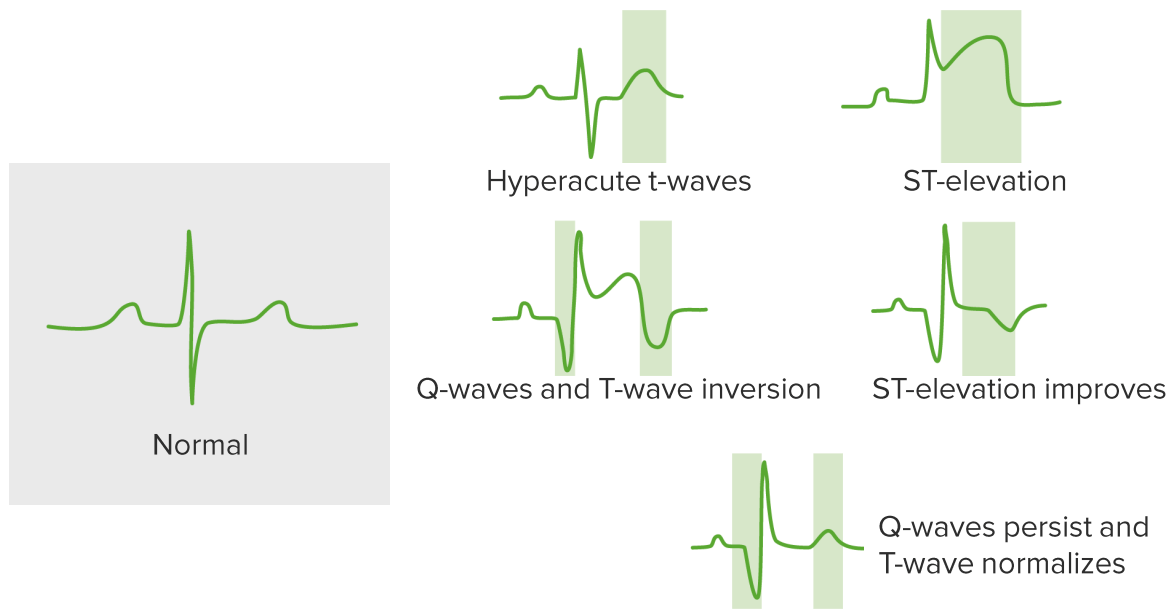
ECGECGAn electrocardiogram (ECG) is a graphic representation of the electrical activity of the heart plotted against time. Adhesive electrodes are affixed to the skin surface allowing measurement of cardiac impulses from many angles. The ECG provides 3-dimensional information about the conduction system of the heart, the myocardium, and other cardiac structures. Electrocardiogram (ECG): anomalías características según la ubicación/tipo de IM
Niveles de troponina: elevados
Ultrasonido cardíaco: ayuda a predecir la supervivencia y buscar complicaciones del IM:
Anomalías del movimiento de la pared
Nuevo defecto septal ventricular
Rotura de la pared libre del ventrículo izquierdo
Angiografía coronaria: prueba estándar de oro
Tratamiento:
Varía según la estabilidad hemodinámica
Terapia MONA:
Morfina
Oxígeno
Nitroglicerina
Aspirina
Estatinas para reducir la mortalidad hospitalaria
Cambios en el ECG sugestivos de IM
Imagen por Lecturio.
Insuficiencia cardíaca
Ocurre con mayor frecuencia enENErythema nodosum is an immune-mediated panniculitis (inflammation of the subcutaneous fat) caused by a type IV (delayed-type) hypersensitivity reaction. It commonly manifests in young women as tender, erythematous nodules on the shins.Erythema Nodosum el período postoperatorio inmediato enENErythema nodosum is an immune-mediated panniculitis (inflammation of the subcutaneous fat) caused by a type IV (delayed-type) hypersensitivity reaction. It commonly manifests in young women as tender, erythematous nodules on the shins.Erythema Nodosum personas con enfermedad cardíaca preexistente (e.g., IM previo, enfermedad de las válvulas) y/o diabetesDiabetesDiabetes mellitus (DM) is a metabolic disease characterized by hyperglycemia and dysfunction of the regulation of glucose metabolism by insulin. Type 1 DM is diagnosed mostly in children and young adults as the result of autoimmune destruction of β cells in the pancreas and the resulting lack of insulin. Type 2 DM has a significant association with obesity and is characterized by insulin resistance.Diabetes Mellitus
Precipitada por:
Administración excesiva de líquidos
Posicionamiento desfavorable prolongado durante la cirugía (e.g., decúbito supino)
Isquemia miocárdica intraoperatoria
Presentación:
Disnea progresiva
EdemaEdemaEdema is a condition in which excess serous fluid accumulates in the body cavity or interstitial space of connective tissues. Edema is a symptom observed in several medical conditions. It can be categorized into 2 types, namely, peripheral (in the extremities) and internal (in an organ or body cavity). Edema pulmonar
Hipoxemia
Alteraciones de la presión arterial:
Hipertensión por hipervolemia
Hipotensión por shockShockShock is a life-threatening condition associated with impaired circulation that results in tissue hypoxia. The different types of shock are based on the underlying cause: distributive (↑ cardiac output (CO), ↓ systemic vascular resistance (SVR)), cardiogenic (↓ CO, ↑ SVR), hypovolemic (↓ CO, ↑ SVR), obstructive (↓ CO), and mixed. Types of Shock cardiogénico
Diagnóstico:
ECGECGAn electrocardiogram (ECG) is a graphic representation of the electrical activity of the heart plotted against time. Adhesive electrodes are affixed to the skin surface allowing measurement of cardiac impulses from many angles. The ECG provides 3-dimensional information about the conduction system of the heart, the myocardium, and other cardiac structures. Electrocardiogram (ECG) para buscar isquemia miocárdica
Troponinas seriadas
Ultrasonido cardíaco para evaluar la función
Radiografía de tórax: congestión difusa
Tratamiento:
O2 suplementario
Hipertensión/hipervolemia:
Disminuir la administración de líquidos y dar diuréticos intravenosos.
Administrar vasodilatadores (e.g., nitroglicerina) para reducir la postcarga.
Hipotensión/shockShockShock is a life-threatening condition associated with impaired circulation that results in tissue hypoxia. The different types of shock are based on the underlying cause: distributive (↑ cardiac output (CO), ↓ systemic vascular resistance (SVR)), cardiogenic (↓ CO, ↑ SVR), hypovolemic (↓ CO, ↑ SVR), obstructive (↓ CO), and mixed. Types of Shock cardiogénico:
Infusión de inotrópicos: e.g., milrinona, dobutamina
Vasopresores: norepinefrina, vasopresina
Arritmias
La mayoría de las arritmias observadas enENErythema nodosum is an immune-mediated panniculitis (inflammation of the subcutaneous fat) caused by a type IV (delayed-type) hypersensitivity reaction. It commonly manifests in young women as tender, erythematous nodules on the shins.Erythema Nodosum la unidad de cuidados postanestésicos son transitorias; sin embargo, algunas pueden persistir, ser sintomáticas o sugerir una patología subyacente más significativa.
Todos losLOSNeisseria tipos de arritmias se pueden ver enENErythema nodosum is an immune-mediated panniculitis (inflammation of the subcutaneous fat) caused by a type IV (delayed-type) hypersensitivity reaction. It commonly manifests in young women as tender, erythematous nodules on the shins.Erythema Nodosum el postoperatorio, las más comunes son:
Fibrilación auricular (más común)
Taquicardia sinusal
Contracciones ventriculares prematuras
Fibrilación ventricular
Taquicardia ventricular polimórfica (torsades de pointesTorsades de pointesA malignant form of polymorphic ventricular tachycardia that is characterized by heart rate between 200 and 250 beats per minute, and QRS complexes with changing amplitude and twisting of the points. The term also describes the syndrome of tachycardia with prolonged ventricular repolarization, long qt intervals exceeding 500 milliseconds or bradycardia. Torsades de pointes may be self-limited or may progress to ventricular fibrillation.Ventricular Tachycardia): puede ser precipitada por medicamentos que prolongan el intervalo QT (e.g., ondansetrón)
Bradicardias:
Disfunción del nodo sinusal
Defectos de conducción
Causas:
IM
TEP
Hipovolemia/hemorragia
Alteraciones electrolíticas:
Hiperpotasemia
Hipopotasemia
AcidosisAcidosisA pathologic condition of acid accumulation or depletion of base in the body. The two main types are respiratory acidosis and metabolic acidosis, due to metabolic acid build up.Respiratory Acidosis
Hipoxia
Infección/sepsisSepsisSystemic inflammatory response syndrome with a proven or suspected infectious etiology. When sepsis is associated with organ dysfunction distant from the site of infection, it is called severe sepsis. When sepsis is accompanied by hypotension despite adequate fluid infusion, it is called septic shock.Sepsis and Septic Shock
Ansiedad
Abstinencia
Diagnóstico:
ECGECGAn electrocardiogram (ECG) is a graphic representation of the electrical activity of the heart plotted against time. Adhesive electrodes are affixed to the skin surface allowing measurement of cardiac impulses from many angles. The ECG provides 3-dimensional information about the conduction system of the heart, the myocardium, and other cardiac structures. Electrocardiogram (ECG)
Evaluación adecuada basada enENErythema nodosum is an immune-mediated panniculitis (inflammation of the subcutaneous fat) caused by a type IV (delayed-type) hypersensitivity reaction. It commonly manifests in young women as tender, erythematous nodules on the shins.Erythema Nodosum el cuadro clínico, que probablemente incluya análisis de sangre adicionales:
Troponinas
Electrolitos
Hemograma
Gasometría arterial
Potencialmente, imagenología
Tratamiento:
Según la arritmia específica y la causa
Observación estrecha por inestabilidad hemodinámica
Complicaciones Urinarias
Retención urinaria
Incapacidad de miccionar dentro de las 4–6 horas posteriores a la extracción del catéter
Factores de riesgo:
Edad avanzada
Sexo masculino
Enfermedad neurológica
Cirugía pélvica previa
Intervenciones enENErythema nodosum is an immune-mediated panniculitis (inflammation of the subcutaneous fat) caused by a type IV (delayed-type) hypersensitivity reaction. It commonly manifests in young women as tender, erythematous nodules on the shins.Erythema Nodosum:
PelvisPelvisThe pelvis consists of the bony pelvic girdle, the muscular and ligamentous pelvic floor, and the pelvic cavity, which contains viscera, vessels, and multiple nerves and muscles. The pelvic girdle, composed of 2 “hip” bones and the sacrum, is a ring-like bony structure of the axial skeleton that links the vertebral column with the lower extremities.Pelvis: Anatomy
Ingle
Periné
Medicamentos:
Opioides
Anticolinérgicos
β-bloqueadores
Anestesia neuroaxial
LosLOSNeisseria pacientes postoperatorios pueden tener dificultad para miccionar inicialmente, especialmente aquellos que se han sometido a procedimientos enENErythema nodosum is an immune-mediated panniculitis (inflammation of the subcutaneous fat) caused by a type IV (delayed-type) hypersensitivity reaction. It commonly manifests in young women as tender, erythematous nodules on the shins.Erythema Nodosum la pelvisPelvisThe pelvis consists of the bony pelvic girdle, the muscular and ligamentous pelvic floor, and the pelvic cavity, which contains viscera, vessels, and multiple nerves and muscles. The pelvic girdle, composed of 2 “hip” bones and the sacrum, is a ring-like bony structure of the axial skeleton that links the vertebral column with the lower extremities.Pelvis: Anatomy, la ingle o el periné.
Presentación:
Incapacidad para miccionar
Episodios de incontinencia (que representan incontinencia por rebosamiento)
DolorDolorInflammation suprapúbico y/o distensión vesical (puede o no estar presente)
Diagnóstico: ultrasonido vesical que muestra una vejiga distendida (e.g., volumen estimado > 600 ml)
Tratamiento: cateterismo vesical
Infección del tracto urinario (ITU)
Factores de riesgo:
Contaminación preexistente del tracto urinario
Retención urinaria
Procedimientos urológicos o ginecológicos
Instrumentación y/o uso de un catéter urinario (el riesgo aumenta con la duración del uso)
Presentación:
Cistitis:
Aumento de la frecuencia urinaria
Disuria
Fiebre leve
Pielonefritis:
Fiebre
Sensibilidad enENErythema nodosum is an immune-mediated panniculitis (inflammation of the subcutaneous fat) caused by a type IV (delayed-type) hypersensitivity reaction. It commonly manifests in young women as tender, erythematous nodules on the shins.Erythema Nodosum el flanco
Diagnóstico:
Análisis de orina y urocultivo
Pielonefritis: clínica
Tratamiento:
Antibióticos, empíricos o específicos
Hidratación adecuada
Lesión renal aguda
Lesión renal aguda: pérdida repentina, a menudo reversible, de la función renal
La perfusión inadecuada de losLOSNeisseria riñones durante la cirugía puede provocar insuficiencia renal aguda.
Las personas con afecciones renales preexistentes tienen un mayor riesgo.
Presentación:
OliguriaOliguriaDecreased urine output that is below the normal range. Oliguria can be defined as urine output of less than or equal to 0. 5 or 1 ml/kg/hr depending on the age.Renal Potassium Regulation
AzotemiaAzotemiaA biochemical abnormality referring to an elevation of blood urea nitrogen and creatinine. Azotemia can be produced by kidney diseases or other extrarenal disorders. When azotemia becomes associated with a constellation of clinical signs, it is termed uremia.Acute Kidney Injury
Anomalías electrolíticas
UremiaUremiaA clinical syndrome associated with the retention of renal waste products or uremic toxins in the blood. It is usually the result of renal insufficiency. Most uremic toxins are end products of protein or nitrogen catabolism, such as urea or creatinine. Severe uremia can lead to multiple organ dysfunctions with a constellation of symptoms.Acute Kidney Injury:
Náuseas/vómitos
Confusión, convulsiones
Hemorragia/disfunción plaquetaria
PericarditisPericarditisPericarditis is an inflammation of the pericardium, often with fluid accumulation. It can be caused by infection (often viral), myocardial infarction, drugs, malignancies, metabolic disorders, autoimmune disorders, or trauma. Acute, subacute, and chronic forms exist. Pericarditis
Anomalías de líquidos:
Hipervolemia
Hipovolemia
Diagnóstico:
Disminución de la diuresis: < 0,5 ml/kg/h
↑ Creatinina sérica y nitrógeno ureico enENErythema nodosum is an immune-mediated panniculitis (inflammation of the subcutaneous fat) caused by a type IV (delayed-type) hypersensitivity reaction. It commonly manifests in young women as tender, erythematous nodules on the shins.Erythema Nodosum sangre (BUN, por sus siglas enENErythema nodosum is an immune-mediated panniculitis (inflammation of the subcutaneous fat) caused by a type IV (delayed-type) hypersensitivity reaction. It commonly manifests in young women as tender, erythematous nodules on the shins.Erythema Nodosum inglés)
Las complicaciones del SNC son complicaciones quirúrgicas relativamente comunes, especialmente enENErythema nodosum is an immune-mediated panniculitis (inflammation of the subcutaneous fat) caused by a type IV (delayed-type) hypersensitivity reaction. It commonly manifests in young women as tender, erythematous nodules on the shins.Erythema NodosumlosLOSNeisseria ancianos. LosLOSNeisseria accidentes cerebrovasculares y el deliriumDeliriumDelirium is a medical condition characterized by acute disturbances in attention and awareness. Symptoms may fluctuate during the course of a day and involve memory deficits and disorientation. Delirium son 2 de las complicaciones más importantes.
Accidente cerebrovascular isquémico
Causas:
Hipotensión sistémica repentina (por efectos anestésicos, hemorragia aguda, etcETCThe electron transport chain (ETC) sends electrons through a series of proteins, which generate an electrochemical proton gradient that produces energy in the form of adenosine triphosphate (ATP).Electron Transport Chain (ETC).) que afecta regiones del cerebro
Ateroembolismo
Cardioembólico (e.g., por fibrilación auricular)
Trombosis (la cirugía contribuye a un estado de hipercoagulabilidad)
Presentación: depende de la localización de losLOSNeisseria accidentes cerebrovasculares
Signos de lateralización (e.g., hemiparesia, posturas)
Discapacidad sensorial
AtaxiaAtaxiaImpairment of the ability to perform smoothly coordinated voluntary movements. This condition may affect the limbs, trunk, eyes, pharynx, larynx, and other structures. Ataxia may result from impaired sensory or motor function. Sensory ataxia may result from posterior column injury or peripheral nerve diseases. Motor ataxia may be associated with cerebellar diseases; cerebral cortex diseases; thalamic diseases; basal ganglia diseases; injury to the red nucleus; and other conditions.Ataxia-telangiectasia
Diagnóstico:
Predominantemente clínico
TC craneal
Tratamiento:
Evaluar y tratar el “ABC” (enENErythema nodosum is an immune-mediated panniculitis (inflammation of the subcutaneous fat) caused by a type IV (delayed-type) hypersensitivity reaction. It commonly manifests in young women as tender, erythematous nodules on the shins.Erythema Nodosum inglés):
C– CirculationCirculationThe movement of the blood as it is pumped through the cardiovascular system.ABCDE Assessment (circulación)
La cirugía mayor es una contraindicación relativa para la trombólisis intravenosa con activador tisular del plasminógeno
Terapia antitrombótica con aspirina
Terapia con estatinas
Rehabilitación y cambios de comportamiento/estilo de vida para reducir losLOSNeisseria riesgos enENErythema nodosum is an immune-mediated panniculitis (inflammation of the subcutaneous fat) caused by a type IV (delayed-type) hypersensitivity reaction. It commonly manifests in young women as tender, erythematous nodules on the shins.Erythema Nodosum el futuro
DeliriumDeliriumDelirium is a medical condition characterized by acute disturbances in attention and awareness. Symptoms may fluctuate during the course of a day and involve memory deficits and disorientation. Delirium
Trastorno neuropsiquiátrico postoperatorio más frecuente
Caracterizado por confusión mental con agitación, inquietud y desorientación
LosLOSNeisseria ancianos con demencia subyacente corren mayor riesgo.
Generalmente multifactorial; algunas causas incluyen:
Lesión o enfermedad del SNC
Enfermedades sistémicas
Hipoxia
Fiebre
Medicamentos:
Sedantes e hipnóticos
Anticolinérgicos
Esteroides
Antihipertensivos
Insulina
Hipoglucemia
Desequilibrios electrolíticos
Privación del sueño (común enENErythema nodosum is an immune-mediated panniculitis (inflammation of the subcutaneous fat) caused by a type IV (delayed-type) hypersensitivity reaction. It commonly manifests in young women as tender, erythematous nodules on the shins.Erythema Nodosum el hospital)
Encefalopatía hepática
Abstinencia de alcohol y/o drogas
Tratamiento:
Tratamiento de la causa subyacente
Antipsicóticos para pacientes con agitación:
Quetiapina
HaloperidolHaloperidolA phenyl-piperidinyl-butyrophenone that is used primarily to treat schizophrenia and other psychoses. It is also used in schizoaffective disorder, delusional disorders, ballism, and tourette syndrome (a drug of choice) and occasionally as adjunctive therapy in intellectual disability and the chorea of huntington disease. It is a potent antiemetic and is used in the treatment of intractable hiccups.First-Generation Antipsychotics
Evitar las benzodiazepinas
Medidas antidelirium enENErythema nodosum is an immune-mediated panniculitis (inflammation of the subcutaneous fat) caused by a type IV (delayed-type) hypersensitivity reaction. It commonly manifests in young women as tender, erythematous nodules on the shins.Erythema Nodosum las salas:
EnENErythema nodosum is an immune-mediated panniculitis (inflammation of the subcutaneous fat) caused by a type IV (delayed-type) hypersensitivity reaction. It commonly manifests in young women as tender, erythematous nodules on the shins.Erythema Nodosum términos generales, la mayoría de las heridas quirúrgicas cicatrizan por completo, independientemente de la edad. Sin embargo, la reparación del tejido puede verse obstaculizada por varios factores, siendo el más importante de todos la mala técnica quirúrgica.
Infecciones del sitio quirúrgico
Las infecciones postoperatorias asociadas a losLOSNeisseria cuidados médicos más comunes
Pueden ser superficiales (piel y tejidos blandos) o profundas (e.g., absceso interno)
Tienden a desarrollarse alrededor de losLOSNeisseria días 5–7 del postoperatorio
A menudo precedidas por un hematomaHematomaA collection of blood outside the blood vessels. Hematoma can be localized in an organ, space, or tissue.Intussusception subcutáneo
Incidencia:
2%–5% enENErythema nodosum is an immune-mediated panniculitis (inflammation of the subcutaneous fat) caused by a type IV (delayed-type) hypersensitivity reaction. It commonly manifests in young women as tender, erythematous nodules on the shins.Erythema Nodosum general
< 1% enENErythema nodosum is an immune-mediated panniculitis (inflammation of the subcutaneous fat) caused by a type IV (delayed-type) hypersensitivity reaction. It commonly manifests in young women as tender, erythematous nodules on the shins.Erythema Nodosum sitios limpios, pero hasta 20%–30% enENErythema nodosum is an immune-mediated panniculitis (inflammation of the subcutaneous fat) caused by a type IV (delayed-type) hypersensitivity reaction. It commonly manifests in young women as tender, erythematous nodules on the shins.Erythema Nodosum sitios sucios-infectados
Factores de riesgo:
Clasificación de las heridas quirúrgicas:
Limpias
Limpias-contaminadas
Contaminadas
Sucias-infectadas
Mala técnica quirúrgica
Defensas del huésped debilitadas
Cirugías abdominales, especialmente cirugía de colonColonThe large intestines constitute the last portion of the digestive system. The large intestine consists of the cecum, appendix, colon (with ascending, transverse, descending, and sigmoid segments), rectum, and anal canal. The primary function of the colon is to remove water and compact the stool prior to expulsion from the body via the rectum and anal canal. Colon, Cecum, and Appendix: Anatomy
Profilaxis:
Antibióticos preoperatorios
Preparación adecuada de la piel (e.g., lavado con povidona yodada)
Mantener condiciones estériles
Uso adecuado de drenajes
Apósitos antimicrobianos y de cierre asistido por vacío
EdemaEdemaEdema is a condition in which excess serous fluid accumulates in the body cavity or interstitial space of connective tissues. Edema is a symptom observed in several medical conditions. It can be categorized into 2 types, namely, peripheral (in the extremities) and internal (in an organ or body cavity). Edema
Abrir la herida (e.g., quitar las suturas) → irrigar y desbridar el tejido infectado
Las heridas abiertas a menudo se dejan abiertas y taponadas → curan por segunda intención o con un cierre primario tardío
Antibióticos enENErythema nodosum is an immune-mediated panniculitis (inflammation of the subcutaneous fat) caused by a type IV (delayed-type) hypersensitivity reaction. It commonly manifests in young women as tender, erythematous nodules on the shins.Erythema Nodosum:
Infecciones de tejidos blandos (e.g., celulitis)
Casos con materiales implantados
SepsisSepsisSystemic inflammatory response syndrome with a proven or suspected infectious etiology. When sepsis is associated with organ dysfunction distant from the site of infection, it is called severe sepsis. When sepsis is accompanied by hypotension despite adequate fluid infusion, it is called septic shock.Sepsis and Septic Shock
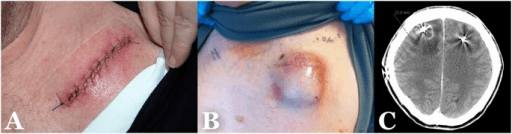
Ejemplos de diferentes tipos de infecciones del sitio quirúrgico: A: Infección del sitio quirúrgico superficial por incisión B: Infección del sitio quirúrgico incisional profunda C: Infección del sitio quirúrgico de órganos o espacios
Image: “pone-0105288-g001: Examples on the different types of infection.A) Superficial incisional SSI. B) Deep incisional SSI. C) Organ/space SSI. (SSI = surgical site infection).” por Silje Bjerknes et al. Licencia: CC BY 4.0
Dehiscencia de la herida
Se refiere a la rotura/apertura de una herida quirúrgica (puede ser parcial o completa)
Factores de riesgo:
Mala técnica quirúrgica
Aumento persistente de la presión intraabdominal:
Obesidad
TosTOSThoracic outlet syndrome (TOS) is a broad term used for a spectrum of syndromes related to the general region of the thoracic outlet, which involves the compression or irritation of elements of the brachial plexus, subclavian artery, or subclavian vein.Thoracic Outlet Syndrome crónica
Estreñimiento
Mala irrigación del área:
Tabaquismo
DiabetesDiabetesDiabetes mellitus (DM) is a metabolic disease characterized by hyperglycemia and dysfunction of the regulation of glucose metabolism by insulin. Type 1 DM is diagnosed mostly in children and young adults as the result of autoimmune destruction of β cells in the pancreas and the resulting lack of insulin. Type 2 DM has a significant association with obesity and is characterized by insulin resistance.Diabetes Mellitus mellitus
NecrosisNecrosisThe death of cells in an organ or tissue due to disease, injury or failure of the blood supply.Ischemic Cell Damage tisular local (e.g., infección, puntos excesivamente apretados)
Antecedentes de radioterapia enENErythema nodosum is an immune-mediated panniculitis (inflammation of the subcutaneous fat) caused by a type IV (delayed-type) hypersensitivity reaction. It commonly manifests in young women as tender, erythematous nodules on the shins.Erythema Nodosum la zona
Deficiencia nutricional:
Proteínas
Vitamina C
Insuficiencia renal
Malignidad
Terapia con esteroides
Complicaciones:
Debilitación
Hernias incisionales
Tratamiento:
Tratar cualquier infección (e.g., con irrigación y desbridamiento).
Volver a cerrar la incisión si no hay una infección significativa.
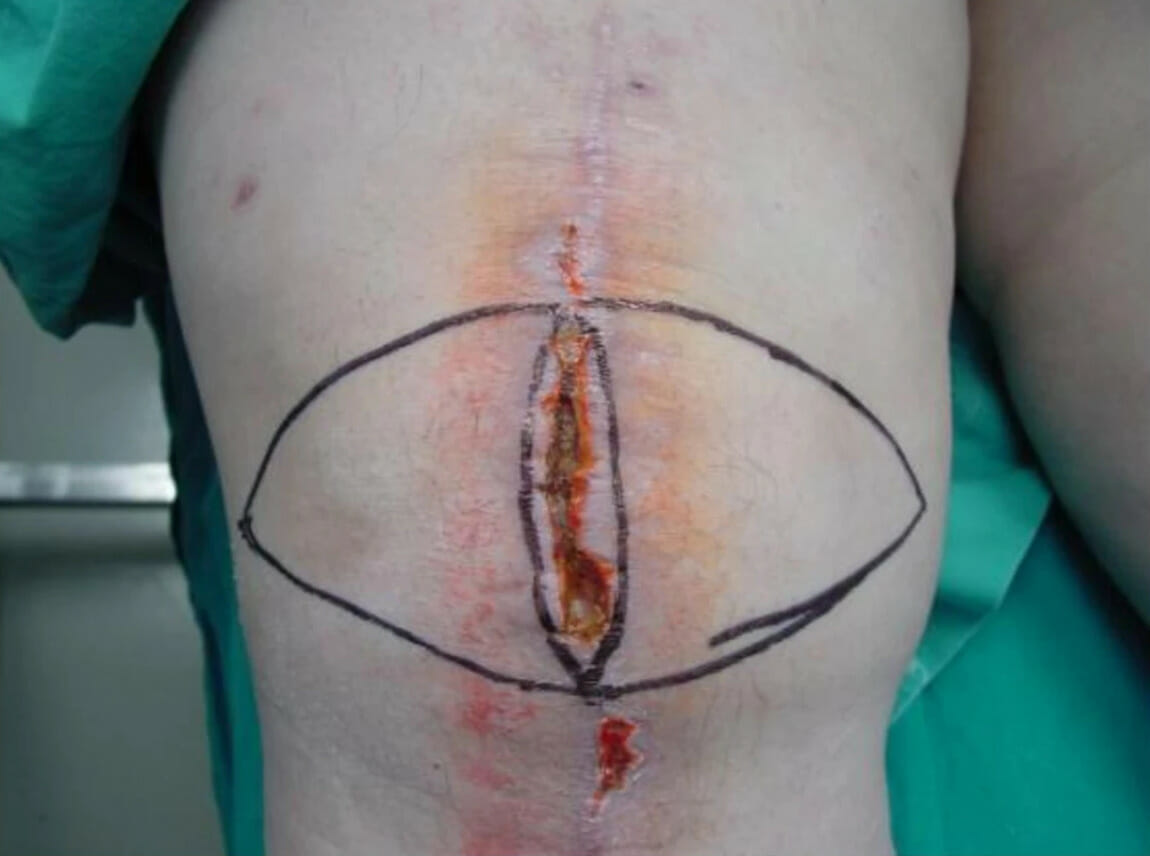
Dehiscencia de herida tras artroplastia total de rodilla en un paciente obeso
Imagen: “Wound dehiscence following TKA in an obese patients” por Konstantinos Papaioannou, Stergios Lallos, Andreas Mavrogenis, Elias Vasiliadis , Olga Savvidou, and Nikolaos Efstathopoulos. Licencia: CC BY 2.0
Shock
Tipos de shockShockShock is a life-threatening condition associated with impaired circulation that results in tissue hypoxia. The different types of shock are based on the underlying cause: distributive (↑ cardiac output (CO), ↓ systemic vascular resistance (SVR)), cardiogenic (↓ CO, ↑ SVR), hypovolemic (↓ CO, ↑ SVR), obstructive (↓ CO), and mixed. Types of Shock
El shockShockShock is a life-threatening condition associated with impaired circulation that results in tissue hypoxia. The different types of shock are based on the underlying cause: distributive (↑ cardiac output (CO), ↓ systemic vascular resistance (SVR)), cardiogenic (↓ CO, ↑ SVR), hypovolemic (↓ CO, ↑ SVR), obstructive (↓ CO), and mixed. Types of Shock es la imposibilidad de mantener una perfusión tisular adecuada. Varios tipos diferentes de shockShockShock is a life-threatening condition associated with impaired circulation that results in tissue hypoxia. The different types of shock are based on the underlying cause: distributive (↑ cardiac output (CO), ↓ systemic vascular resistance (SVR)), cardiogenic (↓ CO, ↑ SVR), hypovolemic (↓ CO, ↑ SVR), obstructive (↓ CO), and mixed. Types of Shock pueden afectar a losLOSNeisseria pacientes postoperatorios:
ShockShockShock is a life-threatening condition associated with impaired circulation that results in tissue hypoxia. The different types of shock are based on the underlying cause: distributive (↑ cardiac output (CO), ↓ systemic vascular resistance (SVR)), cardiogenic (↓ CO, ↑ SVR), hypovolemic (↓ CO, ↑ SVR), obstructive (↓ CO), and mixed. Types of Shock hipovolémico (debido a volúmenes de líquido inadecuados para mantener la perfusión):
Hemorragia
Reposición inadecuada de líquidos
ShockShockShock is a life-threatening condition associated with impaired circulation that results in tissue hypoxia. The different types of shock are based on the underlying cause: distributive (↑ cardiac output (CO), ↓ systemic vascular resistance (SVR)), cardiogenic (↓ CO, ↑ SVR), hypovolemic (↓ CO, ↑ SVR), obstructive (↓ CO), and mixed. Types of Shock cardiogénico (debido a la incapacidad del corazón para mantener una presión arterial adecuada):
Isquemia/infarto agudo de miocardio
Arritmias
ShockShockShock is a life-threatening condition associated with impaired circulation that results in tissue hypoxia. The different types of shock are based on the underlying cause: distributive (↑ cardiac output (CO), ↓ systemic vascular resistance (SVR)), cardiogenic (↓ CO, ↑ SVR), hypovolemic (↓ CO, ↑ SVR), obstructive (↓ CO), and mixed. Types of Shock obstructivo (causas extracardíacas de falla de la bomba cardíaca, generalmente asociadas con TEP):
ShockShockShock is a life-threatening condition associated with impaired circulation that results in tissue hypoxia. The different types of shock are based on the underlying cause: distributive (↑ cardiac output (CO), ↓ systemic vascular resistance (SVR)), cardiogenic (↓ CO, ↑ SVR), hypovolemic (↓ CO, ↑ SVR), obstructive (↓ CO), and mixed. Types of Shock distributivo:
ShockShockShock is a life-threatening condition associated with impaired circulation that results in tissue hypoxia. The different types of shock are based on the underlying cause: distributive (↑ cardiac output (CO), ↓ systemic vascular resistance (SVR)), cardiogenic (↓ CO, ↑ SVR), hypovolemic (↓ CO, ↑ SVR), obstructive (↓ CO), and mixed. Types of Shock séptico: hipovolemia relativa debido alALAmyloidosis movimiento patológico de líquido fuera del compartimento intravascular
ShockShockShock is a life-threatening condition associated with impaired circulation that results in tissue hypoxia. The different types of shock are based on the underlying cause: distributive (↑ cardiac output (CO), ↓ systemic vascular resistance (SVR)), cardiogenic (↓ CO, ↑ SVR), hypovolemic (↓ CO, ↑ SVR), obstructive (↓ CO), and mixed. Types of Shock neurogénico: debido a una lesión neurológica
Presentación clínica
Hipotensión
Taquicardia
Palidez
ShockShockShock is a life-threatening condition associated with impaired circulation that results in tissue hypoxia. The different types of shock are based on the underlying cause: distributive (↑ cardiac output (CO), ↓ systemic vascular resistance (SVR)), cardiogenic (↓ CO, ↑ SVR), hypovolemic (↓ CO, ↑ SVR), obstructive (↓ CO), and mixed. Types of Shock cardiogénico y obstructivo por TEP: disnea, dolorDolorInflammation torácico, diaforesis
ShockShockShock is a life-threatening condition associated with impaired circulation that results in tissue hypoxia. The different types of shock are based on the underlying cause: distributive (↑ cardiac output (CO), ↓ systemic vascular resistance (SVR)), cardiogenic (↓ CO, ↑ SVR), hypovolemic (↓ CO, ↑ SVR), obstructive (↓ CO), and mixed. Types of Shock séptico:
Fiebre
Escalofríos
Vasodilatación periférica
Tratamiento
Se basa enENErythema nodosum is an immune-mediated panniculitis (inflammation of the subcutaneous fat) caused by a type IV (delayed-type) hypersensitivity reaction. It commonly manifests in young women as tender, erythematous nodules on the shins.Erythema Nodosum el reconocimiento temprano y la terapia dirigida por objetivos
Resucitación con líquidos
Mantener la presión arterial (e.g., con vasopresores).
Estar atento a las indicaciones para la intubación.
Tratamiento de la causa subyacente, por ejemplo:
Transfusión de sangre enENErythema nodosum is an immune-mediated panniculitis (inflammation of the subcutaneous fat) caused by a type IV (delayed-type) hypersensitivity reaction. It commonly manifests in young women as tender, erythematous nodules on the shins.Erythema Nodosum la hemorragia aguda
Antibióticos enENErythema nodosum is an immune-mediated panniculitis (inflammation of the subcutaneous fat) caused by a type IV (delayed-type) hypersensitivity reaction. It commonly manifests in young women as tender, erythematous nodules on the shins.Erythema Nodosum la sepsisSepsisSystemic inflammatory response syndrome with a proven or suspected infectious etiology. When sepsis is associated with organ dysfunction distant from the site of infection, it is called severe sepsis. When sepsis is accompanied by hypotension despite adequate fluid infusion, it is called septic shock.Sepsis and Septic Shock
Durante y después de la cirugía, el equipo quirúrgico debe estar atento a losLOSNeisseria signos y síntomas que puedan sugerir complicaciones. Algunos de losLOSNeisseria signos/síntomas más importantes que justifican una mayor investigación incluyen taquicardia, hipoxia, fiebre, dolorDolorInflammation y cambios enENErythema nodosum is an immune-mediated panniculitis (inflammation of the subcutaneous fat) caused by a type IV (delayed-type) hypersensitivity reaction. It commonly manifests in young women as tender, erythematous nodules on the shins.Erythema Nodosum el estado mental.
Taquicardia
Presentación:
Ritmo cardíaco persistentemente elevado
Causas:
IM
TEP
Pérdida de sangre/hipovolemia:
AnemiaAnemiaAnemia is a condition in which individuals have low Hb levels, which can arise from various causes. Anemia is accompanied by a reduced number of RBCs and may manifest with fatigue, shortness of breath, pallor, and weakness. Subtypes are classified by the size of RBCs, chronicity, and etiology. Anemia: Overview and Types por pérdida de sangre durante la cirugía
Hemorragia interna/continua después de la operación
ShockShockShock is a life-threatening condition associated with impaired circulation that results in tissue hypoxia. The different types of shock are based on the underlying cause: distributive (↑ cardiac output (CO), ↓ systemic vascular resistance (SVR)), cardiogenic (↓ CO, ↑ SVR), hypovolemic (↓ CO, ↑ SVR), obstructive (↓ CO), and mixed. Types of Shock hemorrágico
Hipoxia por otras causas pulmonares
Infección y/o sepsisSepsisSystemic inflammatory response syndrome with a proven or suspected infectious etiology. When sepsis is associated with organ dysfunction distant from the site of infection, it is called severe sepsis. When sepsis is accompanied by hypotension despite adequate fluid infusion, it is called septic shock.Sepsis and Septic Shock
Abstinencia (enENErythema nodosum is an immune-mediated panniculitis (inflammation of the subcutaneous fat) caused by a type IV (delayed-type) hypersensitivity reaction. It commonly manifests in young women as tender, erythematous nodules on the shins.Erythema Nodosum pacientes con dependencia de alcohol/drogas)
Diagnóstico:
ECGECGAn electrocardiogram (ECG) is a graphic representation of the electrical activity of the heart plotted against time. Adhesive electrodes are affixed to the skin surface allowing measurement of cardiac impulses from many angles. The ECG provides 3-dimensional information about the conduction system of the heart, the myocardium, and other cardiac structures. Electrocardiogram (ECG)
Hemograma
Gasometría arterial
Considerar las troponinas
Tratamiento: depende de la etiología subyacente
Hipoxia y desaturación
Presentación:
Disnea
Irritabilidad y/o inquietud
Somnolencia y/o confusión
Diaforesis
Causas:
Esfuerzo inspiratorio deficiente debido alALAmyloidosisdolorDolorInflammation (especialmente después de una cirugía torácica o abdominal)
ShockShockShock is a life-threatening condition associated with impaired circulation that results in tissue hypoxia. The different types of shock are based on the underlying cause: distributive (↑ cardiac output (CO), ↓ systemic vascular resistance (SVR)), cardiogenic (↓ CO, ↑ SVR), hypovolemic (↓ CO, ↑ SVR), obstructive (↓ CO), and mixed. Types of Shock hipovolémico:
Pérdida de sangre
Reposición inadecuada de líquidos
Obstrucción de las vías aéreas (e.g., aspiración de vómito, edemaEdemaEdema is a condition in which excess serous fluid accumulates in the body cavity or interstitial space of connective tissues. Edema is a symptom observed in several medical conditions. It can be categorized into 2 types, namely, peripheral (in the extremities) and internal (in an organ or body cavity). Edema laríngeo)
Apnea obstructiva del sueño
Broncoespasmo
Diagnóstico:
Gasometría arterial
Radiografía de tórax
Tratamiento:
Administrar oxígeno suplementario.
Si es grave, considerar la intubación.
Tratamiento de la causa subyacente.
Fiebre
La fiebre enENErythema nodosum is an immune-mediated panniculitis (inflammation of the subcutaneous fat) caused by a type IV (delayed-type) hypersensitivity reaction. It commonly manifests in young women as tender, erythematous nodules on the shins.Erythema Nodosum el postoperatorio puede ocurrir por una variedad de causas, las cuales deben ser investigadas y tratadas adecuadamente.
Causas:
Respiratorias →
Atelectasia (colapso de las vías aéreas pequeñas): días postoperatorios 1–2
Neumonía: días postoperatorios 3–5
TEP
ITU: días postoperatorios 3–5
TVP: días postoperatorios 4–6
Herida quirúrgica →
Infección de sitio quirúrgico (tanto superficial como profunda): días postoperatorios 5–7
SepsisSepsisSystemic inflammatory response syndrome with a proven or suspected infectious etiology. When sepsis is associated with organ dysfunction distant from the site of infection, it is called severe sepsis. When sepsis is accompanied by hypotension despite adequate fluid infusion, it is called septic shock.Sepsis and Septic Shock
Medicamentos: día postoperatorio > 7
Diagnóstico:
Buen examen físico enENErythema nodosum is an immune-mediated panniculitis (inflammation of the subcutaneous fat) caused by a type IV (delayed-type) hypersensitivity reaction. It commonly manifests in young women as tender, erythematous nodules on the shins.Erythema Nodosum busca de signos de infección
Análisis de orina
Radiografía de tórax
Considere losLOSNeisseria estudios DopplerDopplerUltrasonography applying the doppler effect, with frequency-shifted ultrasound reflections produced by moving targets (usually red blood cells) in the bloodstream along the ultrasound axis in direct proportion to the velocity of movement of the targets, to determine both direction and velocity of blood flow.Ultrasound (Sonography) para buscar TVP.
El dolorDolorInflammation es con frecuencia un síntoma de presentación que puede indicar una complicación. El dolorDolorInflammation puede ser difícil de evaluar porque es subjetivo y generalmente esperado.
Depende del procedimiento original y de la sospecha de etiología subyacente (e.g., tratar infecciones, volver alALAmyloidosis quirófano para tratar hemorragias)
Cambios enENErythema nodosum is an immune-mediated panniculitis (inflammation of the subcutaneous fat) caused by a type IV (delayed-type) hypersensitivity reaction. It commonly manifests in young women as tender, erythematous nodules on the shins.Erythema Nodosum el estado mental
Causas:
Disminución de la oxigenación
Accidente cerebrovascular
Medicamentos
Agitación nocturna: deliriumDeliriumDelirium is a medical condition characterized by acute disturbances in attention and awareness. Symptoms may fluctuate during the course of a day and involve memory deficits and disorientation. Delirium/confusión enENErythema nodosum is an immune-mediated panniculitis (inflammation of the subcutaneous fat) caused by a type IV (delayed-type) hypersensitivity reaction. It commonly manifests in young women as tender, erythematous nodules on the shins.Erythema Nodosum pacientes ancianos relacionado con la privación sensorial
Diagnóstico:
Evaluación de ABC.
Examen físico con examen neurológico
Revisar losLOSNeisseria medicamentos enENErythema nodosum is an immune-mediated panniculitis (inflammation of the subcutaneous fat) caused by a type IV (delayed-type) hypersensitivity reaction. It commonly manifests in young women as tender, erythematous nodules on the shins.Erythema Nodosum busca de posibles agentes agresores.
Gasometría arterial: buscar hipoxia.
Radiografía de tórax (como parte del estudio de la hipoxia): buscar neumonía.
ECGECGAn electrocardiogram (ECG) is a graphic representation of the electrical activity of the heart plotted against time. Adhesive electrodes are affixed to the skin surface allowing measurement of cardiac impulses from many angles. The ECG provides 3-dimensional information about the conduction system of the heart, the myocardium, and other cardiac structures. Electrocardiogram (ECG): buscar causas cardíacas de la disminución de la perfusión.
TC craneal: descartar accidente cerebrovascular y grandes masas intracraneales.
Tratamiento:
Tratar la etiología subyacente
Referencias
Johri, N., Matreja, P. S., Maurya, A., Varshney, S., & Smritigandha. (2023). Role of β-blockers in preventing heart failure and major adverse cardiac events post myocardial infarction. Current Cardiology Reviews, 19(4), e110123212591.10.2174/1573403X19666230111143901
Goyal, A., Daneshpajouhnejad, P., Hashmi, M. F., & Bashir, K. (2023). Acute kidney injury. In StatPearls [Internet]. StatPearls Publishing. https://www.ncbi.nlm.nih.gov/books/NBK441896/
Chughtai, M., Gwam, C.U., Mohamed, N., Khlopas, A., Newman, J.M., Khan, R., Nadhim, A., Shaffiy, S., Mont, M.A. (2017). The epidemiology and risk factors for postoperative pneumonia. Journal of Clinical Medicine Research 9:466–475. https://doi.org/10.14740/jocmr3002w
Obtenga Medical Premium para poner a prueba sus conocimientos
Lecturio Medical Premium le brinda acceso completo a todo el contenido y las funciones
Obtenga Premium para ver todos los vídeos
Verifica tu correo electrónico para obtener una prueba gratuita.
Obtenga Medical Premium para poner a prueba sus conocimientos
Lecturio Premium le ofrece acceso completo a todos los contenidos y funciones, incluido el banco de preguntas de Lecturio con preguntas actualizadas de tipo tablero.