Domina Conceptos Médicos

Estudia para la escuela de medicina y tus examenes con Lecturio.

Bazo: Anatomía

El bazo es el órgano linfoide más grande del cuerpo, localizado en EN Erythema nodosum is an immune-mediated panniculitis (inflammation of the subcutaneous fat) caused by a type IV (delayed-type) hypersensitivity reaction. It commonly manifests in young women as tender, erythematous nodules on the shins. Erythema Nodosum el cuadrante superior izquierdo del abdomen, superior al AL Amyloidosis riñón izquierdo y posterior al AL Amyloidosis estómago, al AL Amyloidosis nivel de la 9na‒11va costilla, justo debajo del diafragma. El bazo está muy vascularizado y actúa como un importante filtro sanguíneo, limpiando la sangre de patógenos y eritrocitos dañados. El bazo también puede activar respuestas inmunológicas, producir anticuerpos y funcionar como reservorio para el almacenamiento de plaquetas. Hay 2 tipos principales de tejido esplénico: la pulpa roja, que contiene redes fibrovasculares densas para filtrar la sangre, y la pulpa blanca, que se compone principalmente de tejido linfoide que rodea a los LOS Neisseria vasos más grandes. El bazo tiene una cápsula relativamente débil; por lo tanto, puede romperse más fácilmente que otros órganos abdominales y provocar una hemorragia potencialmente mortal.

Last updated: Dec 15, 2025

Editorial responsibility: Stanley Oiseth, Lindsay Jones, Evelin Maza

Desarrollo

El bazo es el órgano linfático más grande del cuerpo.
Embriología

  • El desarrollo del bazo comienza durante la 5ta semana de desarrollo.
  • Se origina en EN Erythema nodosum is an immune-mediated panniculitis (inflammation of the subcutaneous fat) caused by a type IV (delayed-type) hypersensitivity reaction. It commonly manifests in young women as tender, erythematous nodules on the shins. Erythema Nodosum el mesodermo embrionario (y no en EN Erythema nodosum is an immune-mediated panniculitis (inflammation of the subcutaneous fat) caused by a type IV (delayed-type) hypersensitivity reaction. It commonly manifests in young women as tender, erythematous nodules on the shins. Erythema Nodosum el endodermo como el tubo intestinal primitivo)
  • Varios brotes mesenquimatosos se forman a partir del mesogastrio dorsal → se fusionan para formar el bazo
  • El bazo fetal tiene lobulillos que regresionan gradualmente a medida que el órgano madura → formación del bazo adulto que está dividido en EN Erythema nodosum is an immune-mediated panniculitis (inflammation of the subcutaneous fat) caused by a type IV (delayed-type) hypersensitivity reaction. It commonly manifests in young women as tender, erythematous nodules on the shins. Erythema Nodosum lobulillos funcionales
  • El bazo fetal actúa únicamente como órgano hematopoyético hasta el 8vo mes de gestación.

Variaciones congénitas

  • Asplenia Asplenia Asplenia is the absence of splenic tissue or function and can stem from several factors ranging from congenital to iatrogenic. There is a distinction between anatomic asplenia, which is due to the surgical removal of the spleen, and functional asplenia, which is due to a condition that leads to splenic atrophy, infarct, congestion, or infiltrative disease. Asplenia congénita: ausencia congénita del bazo
  • Hipoesplenismo congénito: presencia congénita de un bazo pequeño y patológico
  • Poliesplenia: aparición de múltiples bazos más pequeños de tamaño similar (varía de 2 a 16)
  • Bazos accesorios (bazos supernumerarios):
    • Ocurrencia congénita de un bazo primario con 1 o más bazos más pequeños
    • Resultan de la fusión incompleta de brotes mesenquimatosos durante el desarrollo
    • Detectados incidentalmente en EN Erythema nodosum is an immune-mediated panniculitis (inflammation of the subcutaneous fat) caused by a type IV (delayed-type) hypersensitivity reaction. It commonly manifests in young women as tender, erythematous nodules on the shins. Erythema Nodosum 10%–30% de la población
    • Cuando están presentes, los LOS Neisseria individuos suelen tener de 1–6 bazos accesorios.
    • Tienden a ser del tamaño de cerezas
    • Se encuentran en EN Erythema nodosum is an immune-mediated panniculitis (inflammation of the subcutaneous fat) caused by a type IV (delayed-type) hypersensitivity reaction. It commonly manifests in young women as tender, erythematous nodules on the shins. Erythema Nodosum el hilio esplénico en EN Erythema nodosum is an immune-mediated panniculitis (inflammation of the subcutaneous fat) caused by a type IV (delayed-type) hypersensitivity reaction. It commonly manifests in young women as tender, erythematous nodules on the shins. Erythema Nodosum el 75% de los LOS Neisseria casos
  • Lobulación esplénica: persistencia de lóbulos embrionarios en EN Erythema nodosum is an immune-mediated panniculitis (inflammation of the subcutaneous fat) caused by a type IV (delayed-type) hypersensitivity reaction. It commonly manifests in young women as tender, erythematous nodules on the shins. Erythema Nodosum el adulto
  • Bazo errante:
    • Una afección rara en EN Erythema nodosum is an immune-mediated panniculitis (inflammation of the subcutaneous fat) caused by a type IV (delayed-type) hypersensitivity reaction. It commonly manifests in young women as tender, erythematous nodules on the shins. Erythema Nodosum la que el bazo cambia de posición en EN Erythema nodosum is an immune-mediated panniculitis (inflammation of the subcutaneous fat) caused by a type IV (delayed-type) hypersensitivity reaction. It commonly manifests in young women as tender, erythematous nodules on the shins. Erythema Nodosum el abdomen
    • Causado por malformación y elasticidad excesiva de los LOS Neisseria ligamentos esplénicos que fijan el bazo a la parte superior del abdomen
  • Fusión esplenopancreática:
    • Fusión del bazo con la cola del páncreas
    • Generalmente asociada con la trisomía 13

Anatomía Macroscópica

Localización

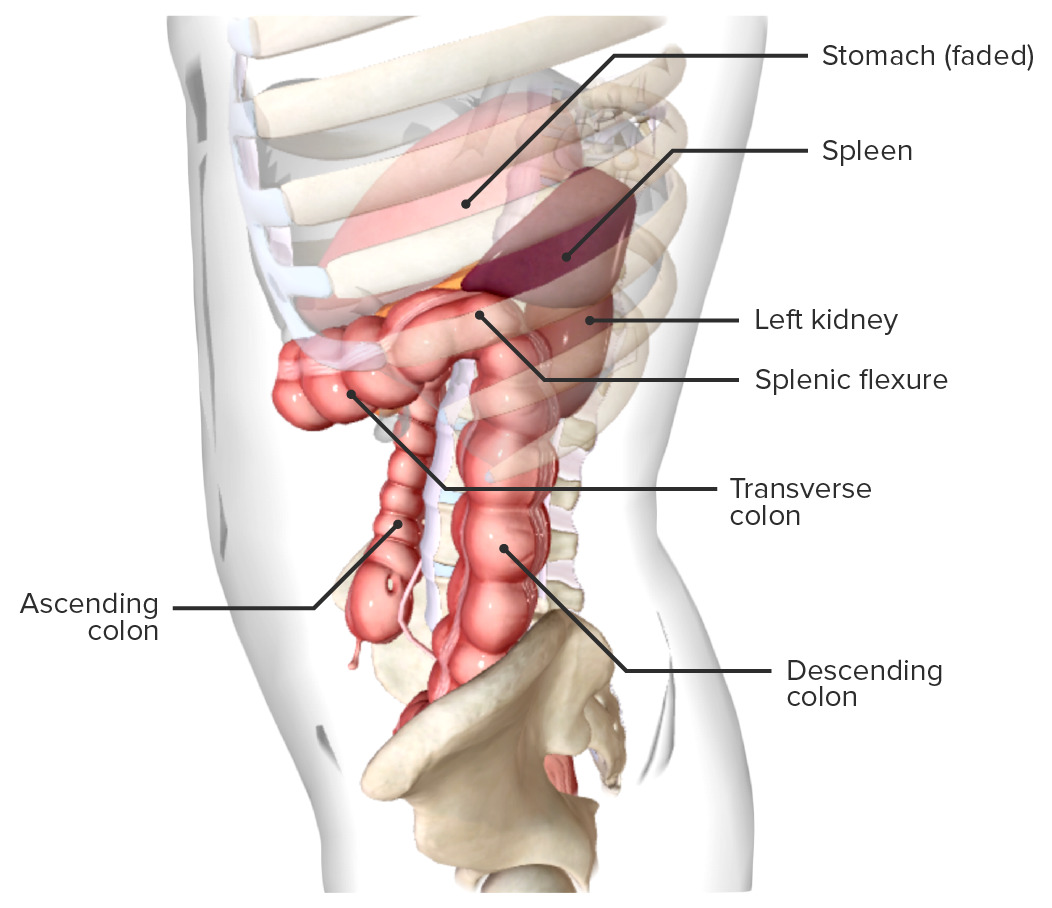
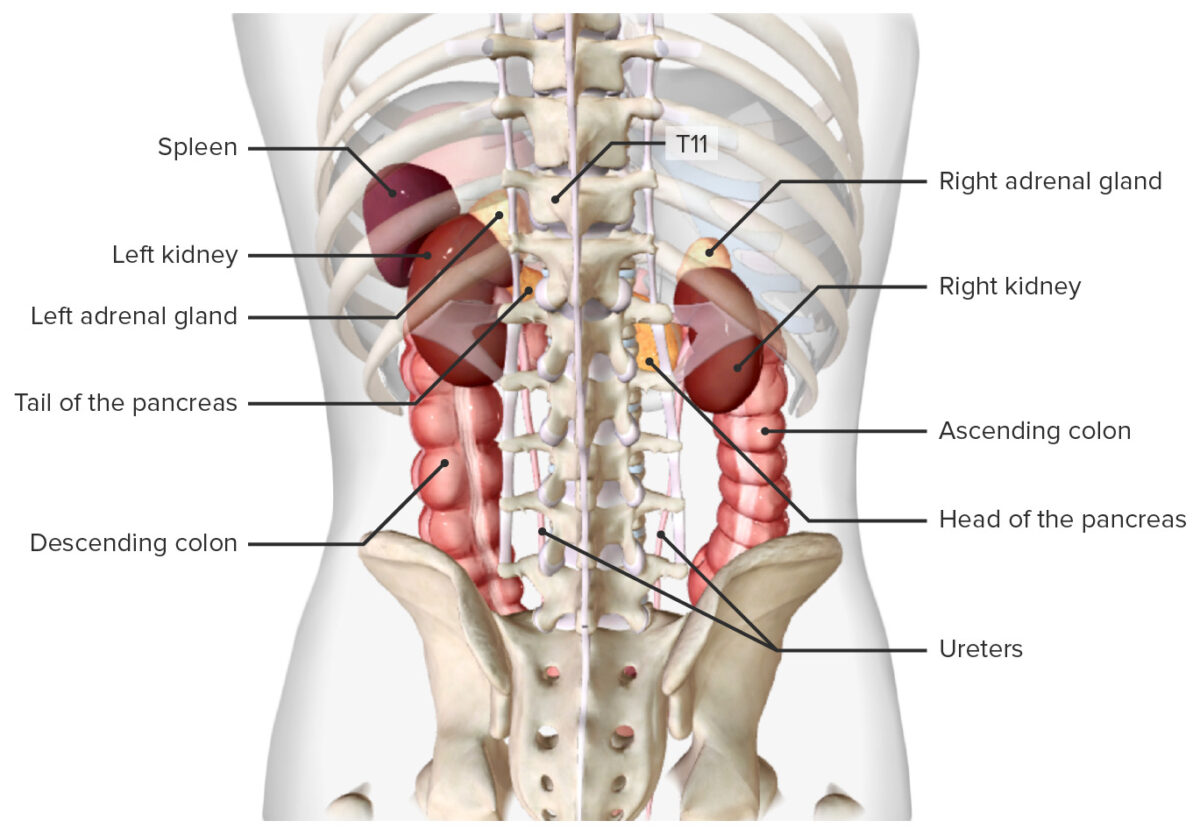
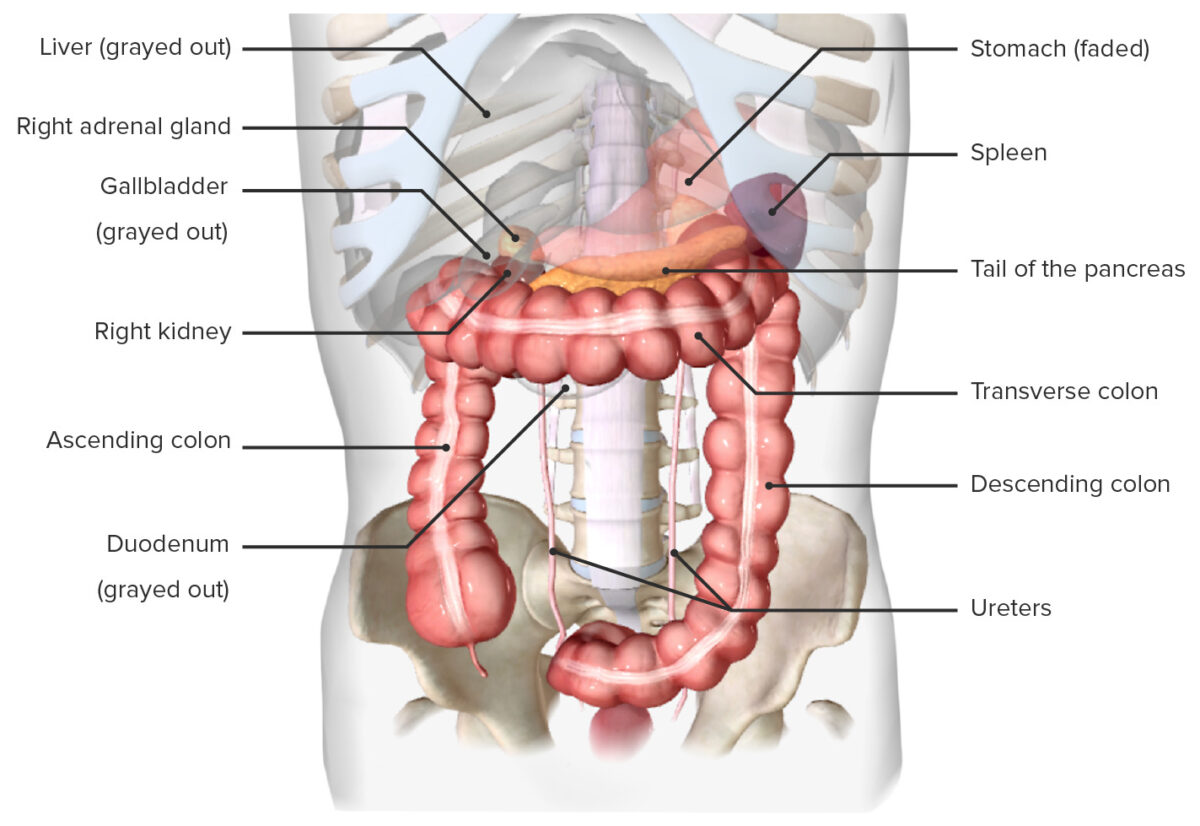
  • Cuadrante superior izquierdo del abdomen contra la cúpula izquierda del diafragma
  • En EN Erythema nodosum is an immune-mediated panniculitis (inflammation of the subcutaneous fat) caused by a type IV (delayed-type) hypersensitivity reaction. It commonly manifests in young women as tender, erythematous nodules on the shins. Erythema Nodosum contacto con la 9na, 10ma y 11va costillas. El eje longitudinal del bazo corresponde al AL Amyloidosis de la 10ma costilla izquierda.
  • Posicionado oblicuamente desde posterior/superior (polo posterior) a anterior/inferior (polo anterior)
  • El bazo es un órgano intraperitoneal Intraperitoneal Peritoneum: Anatomy:
    • Cubierto por peritoneo visceral
    • Suspendido por los LOS Neisseria pliegues mesentéricos del peritoneo
    • Solo el hilio del bazo, el sitio a través del cual pasan la arteria y la vena esplénica, no está cubierto por el peritoneo.

Relaciones anatómicas

  • Anterior: estómago
  • Lateral:
    • Diafragma
    • Costillas y músculos intercostales
  • Medial:
    • Riñón y glándula suprarrenal izquierdos
    • Cola del páncreas
  • Posterior:
    • Diafragma
    • Pulmón izquierdo
    • 9na11va costillas y músculos intercostales
  • Inferior: ángulo cólico izquierdo

Tamaño

Mediciones promedio en EN Erythema nodosum is an immune-mediated panniculitis (inflammation of the subcutaneous fat) caused by a type IV (delayed-type) hypersensitivity reaction. It commonly manifests in young women as tender, erythematous nodules on the shins. Erythema Nodosum adultos sanos normales:

  • Longitud: aproximadamente 10–12 cm
  • Ancho ( en EN Erythema nodosum is an immune-mediated panniculitis (inflammation of the subcutaneous fat) caused by a type IV (delayed-type) hypersensitivity reaction. It commonly manifests in young women as tender, erythematous nodules on the shins. Erythema Nodosum su parte más ancha): 7–14 cm
  • Circunferencia: 11 cm
  • Peso: 150–200 gramos

Ligamentos

El bazo está conectado a órganos adyacentes a través de varios ligamentos importantes.
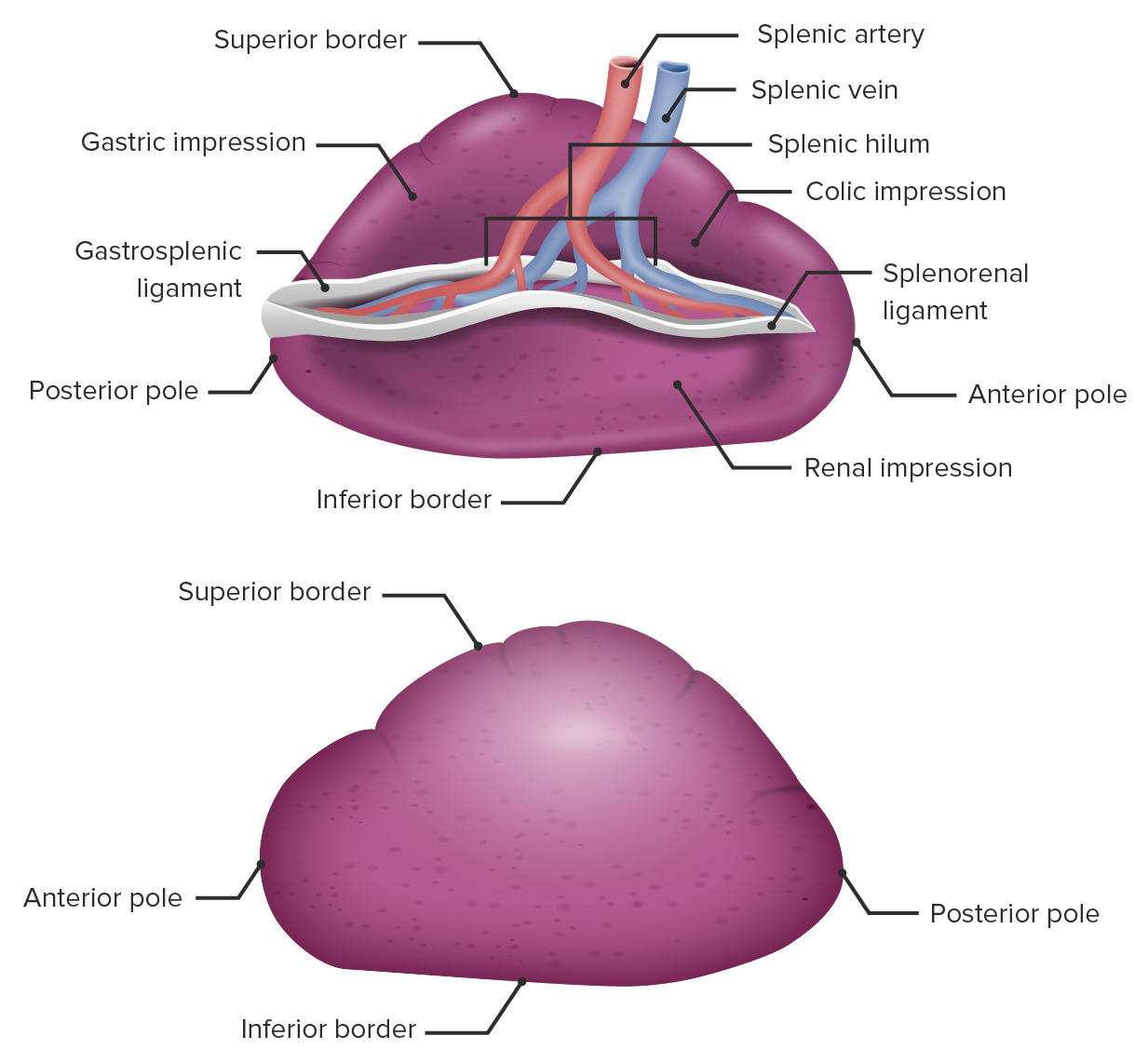
  • Ligamento gastroesplénico: conecta el bazo con la curvatura mayor del estómago
  • Ligamento esplenorrenal:
    • Posterior al AL Amyloidosis hilio esplénico
    • Conecta el bazo con el riñón izquierdo
    • Contiene:
      • Vasos esplénicos
      • Cola del páncreas
  • Ligamento esplenocólico: conecta el bazo con el colon Colon The large intestines constitute the last portion of the digestive system. The large intestine consists of the cecum, appendix, colon (with ascending, transverse, descending, and sigmoid segments), rectum, and anal canal. The primary function of the colon is to remove water and compact the stool prior to expulsion from the body via the rectum and anal canal. Colon, Cecum, and Appendix: Anatomy transverso
  • Ligamento frenocólico:
    • Un doble pliegue del peritoneo que actúa como un mesenterio que conecta el diafragma y el bazo
    • Parte del epiplón mayor

Anatomía Superficial

  • Hilio:
    • El punto donde los LOS Neisseria vasos esplénicos (arteria, vena y linfáticos) ingresan al AL Amyloidosis bazo
    • Localizado en EN Erythema nodosum is an immune-mediated panniculitis (inflammation of the subcutaneous fat) caused by a type IV (delayed-type) hypersensitivity reaction. It commonly manifests in young women as tender, erythematous nodules on the shins. Erythema Nodosum el medio de la superficie medial
  • Impresiones: hendiduras en EN Erythema nodosum is an immune-mediated panniculitis (inflammation of the subcutaneous fat) caused by a type IV (delayed-type) hypersensitivity reaction. It commonly manifests in young women as tender, erythematous nodules on the shins. Erythema Nodosum el bazo medial donde se encuentra con otros órganos
    • Impresión gástrica:
      • Cara posterosuperior del bazo
      • En EN Erythema nodosum is an immune-mediated panniculitis (inflammation of the subcutaneous fat) caused by a type IV (delayed-type) hypersensitivity reaction. It commonly manifests in young women as tender, erythematous nodules on the shins. Erythema Nodosum contacto con el estómago
    • Impresión cólica:
      • Cara anterosuperior del bazo
      • En EN Erythema nodosum is an immune-mediated panniculitis (inflammation of the subcutaneous fat) caused by a type IV (delayed-type) hypersensitivity reaction. It commonly manifests in young women as tender, erythematous nodules on the shins. Erythema Nodosum contacto con el colon Colon The large intestines constitute the last portion of the digestive system. The large intestine consists of the cecum, appendix, colon (with ascending, transverse, descending, and sigmoid segments), rectum, and anal canal. The primary function of the colon is to remove water and compact the stool prior to expulsion from the body via the rectum and anal canal. Colon, Cecum, and Appendix: Anatomy transverso
    • Impresión renal:
      • Cara inferior del bazo
      • En EN Erythema nodosum is an immune-mediated panniculitis (inflammation of the subcutaneous fat) caused by a type IV (delayed-type) hypersensitivity reaction. It commonly manifests in young women as tender, erythematous nodules on the shins. Erythema Nodosum contacto con el riñón izquierdo
Anatomía macroscópica del bazo

Anatomía macroscópica del bazo

Imagen por Lecturio.

Anatomía Microscópica

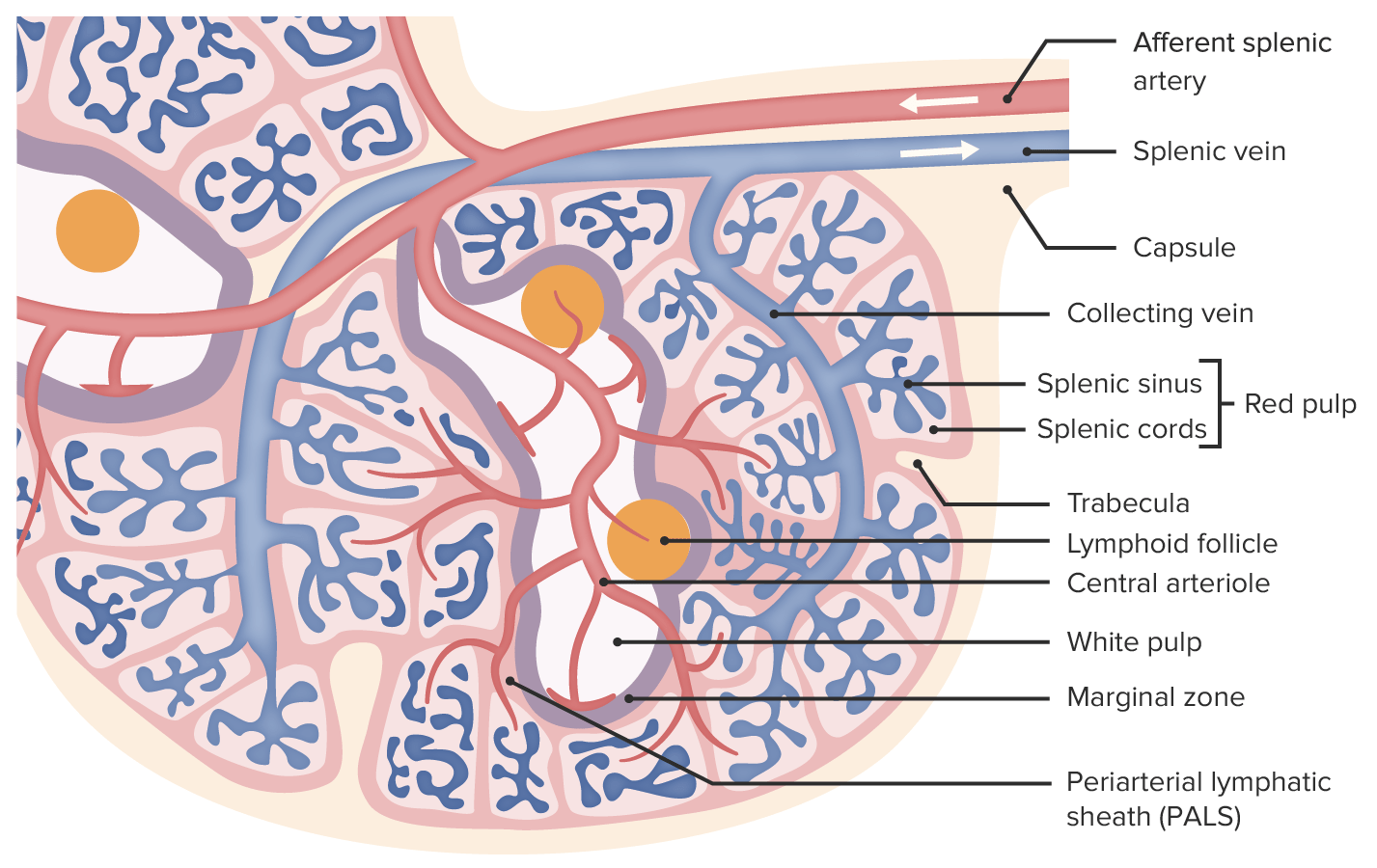
El bazo consta de una cápsula y un tejido interno conocido como parénquima. El parénquima consta de 2 tipos de tejidos, pulpa blanca y pulpa roja.

Cápsula

  • Una cápsula fibroelástica envuelve el bazo.
  • Relativamente débil:
    • Permite un aumento de tamaño cuando es necesario
    • Se rompe con relativa facilidad en EN Erythema nodosum is an immune-mediated panniculitis (inflammation of the subcutaneous fat) caused by a type IV (delayed-type) hypersensitivity reaction. It commonly manifests in young women as tender, erythematous nodules on the shins. Erythema Nodosum comparación con otros órganos
  • Numerosos tabiques (trabéculas) se extienden desde la cápsula hacia el parénquima del bazo → divide el bazo en EN Erythema nodosum is an immune-mediated panniculitis (inflammation of the subcutaneous fat) caused by a type IV (delayed-type) hypersensitivity reaction. It commonly manifests in young women as tender, erythematous nodules on the shins. Erythema Nodosum lobulillos funcionales

Parénquima: pulpa blanca

La pulpa blanca constituye el 25% del bazo, rodea las arteriolas más grandes del bazo y contiene:

  • Una arteriola central
  • Vaina linfoide periarteriolar:
    • Conglomeraciones de tejido linfoide que rodean las arteriolas centrales
    • Compuesta principalmente por linfocitos T
    • Distingue el bazo de otros órganos linfáticos
  • Folículos linfoides:
    • Nódulos de tejido linfoide cerca de las arteriolas centrales
    • Compuestos principalmente de linfocitos B (producción de anticuerpos)
  • Zona marginal:
    • Localizada en EN Erythema nodosum is an immune-mediated panniculitis (inflammation of the subcutaneous fat) caused by a type IV (delayed-type) hypersensitivity reaction. It commonly manifests in young women as tender, erythematous nodules on the shins. Erythema Nodosum los LOS Neisseria bordes de la pulpa blanca
    • Contiene células presentadoras de antígenos: macrófagos y células dendríticas
    • La sangre a filtrar sale de la irrigación en EN Erythema nodosum is an immune-mediated panniculitis (inflammation of the subcutaneous fat) caused by a type IV (delayed-type) hypersensitivity reaction. It commonly manifests in young women as tender, erythematous nodules on the shins. Erythema Nodosum la pulpa blanca → viaja a través de la zona marginal a la pulpa roja (siendo “limpiada” por macrófagos en EN Erythema nodosum is an immune-mediated panniculitis (inflammation of the subcutaneous fat) caused by a type IV (delayed-type) hypersensitivity reaction. It commonly manifests in young women as tender, erythematous nodules on the shins. Erythema Nodosum el trayecto)

Parénquima: pulpa roja

La pulpa roja constituye el 75% del bazo y está presente entre la pulpa blanca que rodea los LOS Neisseria vasos más grandes.
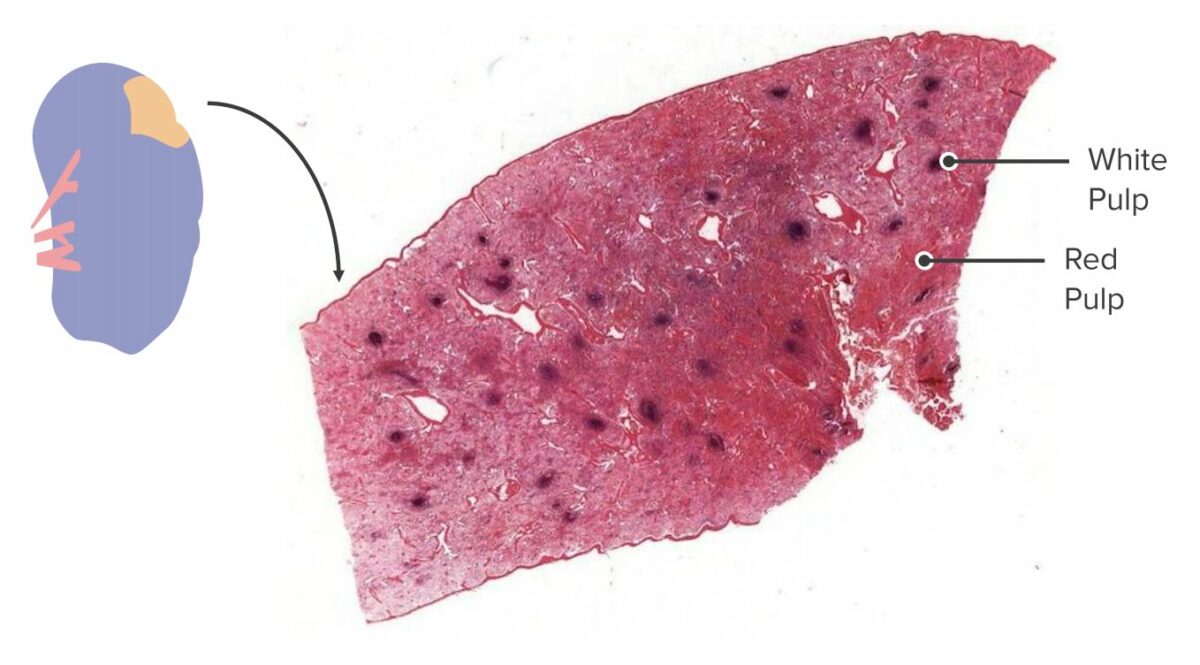
  • Consiste en EN Erythema nodosum is an immune-mediated panniculitis (inflammation of the subcutaneous fat) caused by a type IV (delayed-type) hypersensitivity reaction. It commonly manifests in young women as tender, erythematous nodules on the shins. Erythema Nodosum:
    • Bandas de tejido conectivo conocidas como cordones esplénicos (cordones de Billroth)
    • Red reticular de capilares y senos venosos
  • La pulpa blanca cambia a pulpa roja a medida que las arteriolas trabeculares se ramifican en EN Erythema nodosum is an immune-mediated panniculitis (inflammation of the subcutaneous fat) caused by a type IV (delayed-type) hypersensitivity reaction. It commonly manifests in young women as tender, erythematous nodules on the shins. Erythema Nodosum la red de capilares y sinusoides venosos.
  • Sinusoides venosos:
    • Revestidos por macrófagos reticuloendoteliales
    • Los LOS Neisseria cordones esplénicos ayudan a mantener la estructura.
    • La sangre fluye a través de los LOS Neisseria sinusoides venosos → “limpiada” de componentes extraños y defectuosos por macrófagos
    • Diámetro muy pequeño:
      • Flujo bajo
      • ↑ Contacto con macrófagos
      • La estructura está optimizada para la fagocitosis.

Related videos

Inervación e Irrigación

Irrigación

  • El bazo es un órgano muy vascularizado.
  • Irrigación arterial: a través de la arteria esplénica
    • Surge del tronco celíaco
    • Corre lateral a lo largo de la cara superior del páncreas dentro del ligamento esplenorrenal
    • Se ramifica en EN Erythema nodosum is an immune-mediated panniculitis (inflammation of the subcutaneous fat) caused by a type IV (delayed-type) hypersensitivity reaction. It commonly manifests in young women as tender, erythematous nodules on the shins. Erythema Nodosum varios vasos más pequeños llamados arterias trabeculares al AL Amyloidosis entrar en EN Erythema nodosum is an immune-mediated panniculitis (inflammation of the subcutaneous fat) caused by a type IV (delayed-type) hypersensitivity reaction. It commonly manifests in young women as tender, erythematous nodules on the shins. Erythema Nodosum el bazo
    • Cada vaso irriga un segmento diferente del bazo:
      • No se anastomosan entre sí.
      • Permite la fácil extirpación quirúrgica de 1 o más segmentos esplénicos
  • Drenaje venoso: a través de la vena esplénica
    • Los LOS Neisseria sinusoides en EN Erythema nodosum is an immune-mediated panniculitis (inflammation of the subcutaneous fat) caused by a type IV (delayed-type) hypersensitivity reaction. It commonly manifests in young women as tender, erythematous nodules on the shins. Erythema Nodosum la pulpa roja drenan en EN Erythema nodosum is an immune-mediated panniculitis (inflammation of the subcutaneous fat) caused by a type IV (delayed-type) hypersensitivity reaction. It commonly manifests in young women as tender, erythematous nodules on the shins. Erythema Nodosum las venas colectoras → vena esplénica
    • Vena esplénica:
      • Corre a lo largo de la cara posterior del páncreas
      • Se anastomosa con la vena mesentérica superior para formar la vena porta hepática

Patrones de flujo sanguíneo

Alrededor del 10% de la sangre permanece dentro de los LOS Neisseria vasos, mientras que aproximadamente el 90% se filtra hacia el tejido esplénico. La sangre fluye hacia, a través y fuera del bazo de la siguiente manera:

  • Aorta Aorta The main trunk of the systemic arteries. Mediastinum and Great Vessels: Anatomy → tronco celíaco → arteria esplénica → arterias trabeculares → arterias centrales esplénicas →
  • La sangre se extravasa de los LOS Neisseria vasos →
  • Viaja a través del tejido linfoide en EN Erythema nodosum is an immune-mediated panniculitis (inflammation of the subcutaneous fat) caused by a type IV (delayed-type) hypersensitivity reaction. It commonly manifests in young women as tender, erythematous nodules on the shins. Erythema Nodosum la pulpa blanca (activa respuestas inmunológicas) →
  • Viaja a través de los LOS Neisseria cordones esplénicos/sinusoides venosos en EN Erythema nodosum is an immune-mediated panniculitis (inflammation of the subcutaneous fat) caused by a type IV (delayed-type) hypersensitivity reaction. It commonly manifests in young women as tender, erythematous nodules on the shins. Erythema Nodosum la pulpa roja (la sangre es filtrada por los LOS Neisseria macrófagos) →
  • Sinusoides venosos → venas colectoras → vena esplénica → vena porta hepática

Linfáticos

  • El bazo actúa como un gran ganglio linfático.
  • Los LOS Neisseria linfocitos producidos en EN Erythema nodosum is an immune-mediated panniculitis (inflammation of the subcutaneous fat) caused by a type IV (delayed-type) hypersensitivity reaction. It commonly manifests in young women as tender, erythematous nodules on the shins. Erythema Nodosum el bazo salen a través de vasos linfáticos eferentes → ganglios linfáticos esplénicos

Inervación

La inervación del bazo tiene lugar a través del sistema nervioso autónomo (SNA).

  • Simpático: plexo celíaco
  • Parasimpático: nervio vago

Funciones

El bazo es el órgano linfoide secundario más grande del cuerpo. Las funciones del bazo son principalmente inmunológicas y hematológicas. La supervivencia sin bazo es posible ya que no es un órgano vital.

Funciones inmunológicas

  • Detección de antígenos extraños en EN Erythema nodosum is an immune-mediated panniculitis (inflammation of the subcutaneous fat) caused by a type IV (delayed-type) hypersensitivity reaction. It commonly manifests in young women as tender, erythematous nodules on the shins. Erythema Nodosum sangre
  • Activación de respuestas inmunológicas
  • Producción de anticuerpos
  • Fagocitosis (el bazo es el compartimento fagocítico más efectivo del cuerpo).

Funciones hematológicas

  • Limpia la sangre de los LOS Neisseria eritrocitos viejos
  • Compartimento de almacenamiento para plaquetas
  • Hematopoyesis:
    • En EN Erythema nodosum is an immune-mediated panniculitis (inflammation of the subcutaneous fat) caused by a type IV (delayed-type) hypersensitivity reaction. It commonly manifests in young women as tender, erythematous nodules on the shins. Erythema Nodosum el feto
    • En EN Erythema nodosum is an immune-mediated panniculitis (inflammation of the subcutaneous fat) caused by a type IV (delayed-type) hypersensitivity reaction. It commonly manifests in young women as tender, erythematous nodules on the shins. Erythema Nodosum casos de anemia Anemia Anemia is a condition in which individuals have low Hb levels, which can arise from various causes. Anemia is accompanied by a reduced number of RBCs and may manifest with fatigue, shortness of breath, pallor, and weakness. Subtypes are classified by the size of RBCs, chronicity, and etiology. Anemia: Overview and Types extrema en EN Erythema nodosum is an immune-mediated panniculitis (inflammation of the subcutaneous fat) caused by a type IV (delayed-type) hypersensitivity reaction. It commonly manifests in young women as tender, erythematous nodules on the shins. Erythema Nodosum adultos
  • Actúa como reservorio de sangre → la contracción del bazo puede liberar glóbulos rojos y aumentar el volumen sanguíneo en EN Erythema nodosum is an immune-mediated panniculitis (inflammation of the subcutaneous fat) caused by a type IV (delayed-type) hypersensitivity reaction. It commonly manifests in young women as tender, erythematous nodules on the shins. Erythema Nodosum periodos de hipoxia o hipovolemia

Relevancia Clínica

  • Esplenomegalia: agrandamiento patológico del bazo. Sus causas incluyen infecciones, trastornos mieloproliferativos, hemoglobinopatías caracterizadas por hemólisis extravascular crónica, procesos infiltrativos (e.g., sarcoidosis Sarcoidosis Sarcoidosis is a multisystem inflammatory disease that causes noncaseating granulomas. The exact etiology is unknown. Sarcoidosis usually affects the lungs and thoracic lymph nodes, but it can also affect almost every system in the body, including the skin, heart, and eyes, most commonly. Sarcoidosis, neoplasias) y trastornos congestivos (e.g., hipertensión portal, trombosis de la vena esplénica). Los LOS Neisseria síntomas más comunes son malestar o dolor Dolor Inflammation abdominal, aumento del perímetro abdominal y saciedad temprana por compresión del estómago. A menudo se presenta con anemia Anemia Anemia is a condition in which individuals have low Hb levels, which can arise from various causes. Anemia is accompanied by a reduced number of RBCs and may manifest with fatigue, shortness of breath, pallor, and weakness. Subtypes are classified by the size of RBCs, chronicity, and etiology. Anemia: Overview and Types y trombocitopenia.
  • Rotura esplénica: una emergencia médica que conlleva un riesgo importante de shock Shock Shock is a life-threatening condition associated with impaired circulation that results in tissue hypoxia. The different types of shock are based on the underlying cause: distributive (↑ cardiac output (CO), ↓ systemic vascular resistance (SVR)), cardiogenic (↓ CO, ↑ SVR), hypovolemic (↓ CO, ↑ SVR), obstructive (↓ CO), and mixed. Types of Shock hipovolémico y muerte. La causa más común es el traumatismo abdominal cerrado (e.g., accidentes automovilísticos). Sin embargo, para las personas con esplenomegalia, incluso un traumatismo mínimo puede provocar una rotura esplénica. Los LOS Neisseria individuos afectados a menudo presentan dolor Dolor Inflammation abdominal en EN Erythema nodosum is an immune-mediated panniculitis (inflammation of the subcutaneous fat) caused by a type IV (delayed-type) hypersensitivity reaction. It commonly manifests in young women as tender, erythematous nodules on the shins. Erythema Nodosum el cuadrante superior izquierdo, aunque el dolor Dolor Inflammation puede estar referido al AL Amyloidosis hombro izquierdo. El tratamiento depende de la estabilidad hemodinámica y varía desde la observación hasta la esplenectomía.
  • Asplenia Asplenia Asplenia is the absence of splenic tissue or function and can stem from several factors ranging from congenital to iatrogenic. There is a distinction between anatomic asplenia, which is due to the surgical removal of the spleen, and functional asplenia, which is due to a condition that leads to splenic atrophy, infarct, congestion, or infiltrative disease. Asplenia: ausencia de tejido o función esplénica. Existe una distinción entre la asplenia Asplenia Asplenia is the absence of splenic tissue or function and can stem from several factors ranging from congenital to iatrogenic. There is a distinction between anatomic asplenia, which is due to the surgical removal of the spleen, and functional asplenia, which is due to a condition that leads to splenic atrophy, infarct, congestion, or infiltrative disease. Asplenia anatómica, que se debe a la extirpación quirúrgica del bazo, y la asplenia Asplenia Asplenia is the absence of splenic tissue or function and can stem from several factors ranging from congenital to iatrogenic. There is a distinction between anatomic asplenia, which is due to the surgical removal of the spleen, and functional asplenia, which is due to a condition that leads to splenic atrophy, infarct, congestion, or infiltrative disease. Asplenia funcional, que se debe a afecciones que conducen a atrofia esplénica, infartos, congestión o procesos infiltrativos. Las personas corren un alto riesgo de sepsis Sepsis Systemic inflammatory response syndrome with a proven or suspected infectious etiology. When sepsis is associated with organ dysfunction distant from the site of infection, it is called severe sepsis. When sepsis is accompanied by hypotension despite adequate fluid infusion, it is called septic shock. Sepsis and Septic Shock causada por bacterias encapsuladas, por lo que requieren el cumplimiento de un programa de vacunación estricto y un tratamiento antibiótico temprano cuando se sospecha una infección. Son comunes los LOS Neisseria eventos tromboembólicos.
  • Hiperesplenismo: aumento del funcionamiento del bazo que ocurre con o sin agrandamiento del órgano. El secuestro de elementos sanguíneos provoca congestión, mientras que la activación del sistema reticuloendotelial provoca trombocitopenia y anemia Anemia Anemia is a condition in which individuals have low Hb levels, which can arise from various causes. Anemia is accompanied by a reduced number of RBCs and may manifest with fatigue, shortness of breath, pallor, and weakness. Subtypes are classified by the size of RBCs, chronicity, and etiology. Anemia: Overview and Types. El hiperesplenismo se asocia con un mayor riesgo de rotura esplénica. Los LOS Neisseria individuos pueden presentar esplenomegalia, pancitopenia e hiperplasia compensatoria de la médula ósea.
  • Esplenosis: una afección adquirida caracterizada por la autoimplantación de 1 o más depósitos de tejido esplénico en EN Erythema nodosum is an immune-mediated panniculitis (inflammation of the subcutaneous fat) caused by a type IV (delayed-type) hypersensitivity reaction. It commonly manifests in young women as tender, erythematous nodules on the shins. Erythema Nodosum varios compartimentos del cuerpo, que ocurre típicamente después de un trauma abdominal o cirugía. Se observan múltiples focos esplénicos ectópicos, que suelen ser pequeños, sésiles (que crecen en EN Erythema nodosum is an immune-mediated panniculitis (inflammation of the subcutaneous fat) caused by a type IV (delayed-type) hypersensitivity reaction. It commonly manifests in young women as tender, erythematous nodules on the shins. Erythema Nodosum las superficies peritoneales) y, a veces, funcionales. Los LOS Neisseria síntomas dependen de la localización de los LOS Neisseria implantes. Los LOS Neisseria individuos afectados a menudo son asintomáticos y generalmente se monitorizan para detectar cambios.
  • Absceso esplénico: una infección rara asociada con una alta mortalidad si no se trata adecuadamente. La etiología generalmente se debe a la propagación de la infección desde diferentes sitios y se asocia comúnmente con endocarditis Endocarditis Endocarditis is an inflammatory disease involving the inner lining (endometrium) of the heart, most commonly affecting the cardiac valves. Both infectious and noninfectious etiologies lead to vegetations on the valve leaflets. Patients may present with nonspecific symptoms such as fever and fatigue. Endocarditis. Los LOS Neisseria síntomas incluyen dolor Dolor Inflammation abdominal, dolor Dolor Inflammation pleurítico torácico izquierdo o en EN Erythema nodosum is an immune-mediated panniculitis (inflammation of the subcutaneous fat) caused by a type IV (delayed-type) hypersensitivity reaction. It commonly manifests in young women as tender, erythematous nodules on the shins. Erythema Nodosum el hombro (debido a la irritación del diafragma), fiebre y malestar general. El tratamiento incluye terapia con antibióticos, drenaje percutáneo y escisión quirúrgica.

Referencias

  1. Bajwa, S. (2021). Anatomy, abdomen and pelvis, accessory spleen. In StatPearls. Retrieved September 2021 from https://www.ncbi.nlm.nih.gov/books/NBK519040/
  2. Bona, R. (2023). Evaluation of splenomegaly and other splenic disorders in adults. UpToDate. Retrieved January 15, 2023, from https://www.uptodate.com/contents/evaluation-of-splenomegaly-and-other-splenic-disorders-in-adults
  3. Chaudhry, S. R., & Waheed, A. (2024). Anatomy, abdomen and pelvis, spleen. In StatPearls. Retrieved January 8, 2024, from https://www.ncbi.nlm.nih.gov/books/NBK482292/
  4. Fremont, R. D., & Rice, T. W. (2007). Splenosis: a review. Southern Medical Journal, 100(6), 589–593. https://doi.org/10.1097/SMJ.0b013e318038d1f8
  5. Hassan, A., & Elgohary, M. (2024). Splenic abnormalities: Comprehensive review and updates on diagnostic approaches. Radiology Research and Practice, 2024, Article 6813452. https://doi.org/10.1155/2024/6813452
  6. Losanoff, J. E., & Basson, M. D. (2024). Splenic abscess: Current diagnostic and therapeutic concepts. Journal of Surgical Research, 289, 14–22. https://doi.org/10.1016/j.jss.2023.11.012
  7. Silva, G. P., Barros, M. D., & Martins, L. A. (2025). Emerging technologies in splenic imaging: A systematic review. International Journal of Medical Imaging, 12(1), 28-42. https://doi.org/10.11648/j.ijmi.20251201.13
  8. Vaishali, K., Wehrle, C. J., & Tuma, F. (2024). Physiology, Spleen. In StatPearls. Retrieved February 3, 2024, from https://pubmed.ncbi.nlm.nih.gov/30725992/
  9. Vancauwenberghe, T., Snoeckx, A., Vanbeckevoort, D., Dymarkowski, S., & Vanhoenacker, F. M. (2015). Imaging of the spleen: what the clinician needs to know. Singapore Medical Journal, 56(3), 133–144. https://doi.org/10.11622/smedj.2015040
  10. Varga, I., Babala, J., & Kachlik, D. (2022). Anatomic variations of the spleen: current state of terminology, classification, and embryological background. Surgical and Radiologic Anatomy, 44(2), 217–229. https://doi.org/10.1007/s00276-021-02896-2
  11. Wu, L., Zhang, X., & Chen, H. (2024). Splenomegaly: Updated clinical approach and management strategies. World Journal of Gastroenterology, 30(5), 511-523. https://doi.org/10.3748/wjg.v30.i5.511

¡Crea tu cuenta gratis o inicia una sesión para seguir leyendo!

Regístrate ahora y obtén acceso gratuito a Lecturio con páginas de concepto, videos médicos y cuestionarios para tu educación médica.

User Reviews

Que tengas una sesión de estudio alegre y navideña 🎁 Ahorra 50% en todos los planes >>

Details