


Eletrocardiograma (ECG)

Um eletrocardiograma ( ECG ECG An electrocardiogram (ECG) is a graphic representation of the electrical activity of the heart plotted against time. Adhesive electrodes are affixed to the skin surface allowing measurement of cardiac impulses from many angles. The ECG provides 3-dimensional information about the conduction system of the heart, the myocardium, and other cardiac structures. Electrocardiogram (ECG)) é uma representação gráfica da atividade elétrica do coração em função do tempo. Os eletrocardiogramas são simples, baratos, não invasivos e de fácil obtenção. Os elétrodos adesivos são fixados na superfície da pele, permitindo a medição dos impulsos cardíacos de vários ângulos. O ECG ECG An electrocardiogram (ECG) is a graphic representation of the electrical activity of the heart plotted against time. Adhesive electrodes are affixed to the skin surface allowing measurement of cardiac impulses from many angles. The ECG provides 3-dimensional information about the conduction system of the heart, the myocardium, and other cardiac structures. Electrocardiogram (ECG) fornece informações tridimensionais sobre o sistema de condução do coração, o miocárdio e outras estruturas cardíacas. No estado saudável, um ECG ECG An electrocardiogram (ECG) is a graphic representation of the electrical activity of the heart plotted against time. Adhesive electrodes are affixed to the skin surface allowing measurement of cardiac impulses from many angles. The ECG provides 3-dimensional information about the conduction system of the heart, the myocardium, and other cardiac structures. Electrocardiogram (ECG) regista ondas e complexos previsíveis e reprodutíveis, que correspondem a eventos fisiológicos eletromecanicamente acoplados no coração. Sob condições patológicas, o ECG ECG An electrocardiogram (ECG) is a graphic representation of the electrical activity of the heart plotted against time. Adhesive electrodes are affixed to the skin surface allowing measurement of cardiac impulses from many angles. The ECG provides 3-dimensional information about the conduction system of the heart, the myocardium, and other cardiac structures. Electrocardiogram (ECG) pode detetar arritmias, isquemia, inflamação e muito mais MAIS Androgen Insensitivity Syndrome.

Last updated: Dec 15, 2025

Editorial responsibility: Stanley Oiseth, Lindsay Jones, Evelin Maza

Descrição Geral

Em 1902, o eletrocardiograma ( ECG ECG An electrocardiogram (ECG) is a graphic representation of the electrical activity of the heart plotted against time. Adhesive electrodes are affixed to the skin surface allowing measurement of cardiac impulses from many angles. The ECG provides 3-dimensional information about the conduction system of the heart, the myocardium, and other cardiac structures. Electrocardiogram (ECG)) foi inventado por Willem Einthoven, um médico holandês. Einthoven recebeu o Prémio Nobel de Fisiologia ou Medicina de 1924 por esta invenção.

Terminologia

O eletrocardiograma é abreviado/referido como:
  • ECG ECG An electrocardiogram (ECG) is a graphic representation of the electrical activity of the heart plotted against time. Adhesive electrodes are affixed to the skin surface allowing measurement of cardiac impulses from many angles. The ECG provides 3-dimensional information about the conduction system of the heart, the myocardium, and other cardiac structures. Electrocardiogram (ECG): ortografia americana
  • EKG: ortografia europeia
  • Os termos podem ser usados alternadamente.
  • Clinicamente referido como um ECG ECG An electrocardiogram (ECG) is a graphic representation of the electrical activity of the heart plotted against time. Adhesive electrodes are affixed to the skin surface allowing measurement of cardiac impulses from many angles. The ECG provides 3-dimensional information about the conduction system of the heart, the myocardium, and other cardiac structures. Electrocardiogram (ECG) de 12 derivações

Elétrodos e derivações de ECG ECG An electrocardiogram (ECG) is a graphic representation of the electrical activity of the heart plotted against time. Adhesive electrodes are affixed to the skin surface allowing measurement of cardiac impulses from many angles. The ECG provides 3-dimensional information about the conduction system of the heart, the myocardium, and other cardiac structures. Electrocardiogram (ECG)

  • Os elétrodos condutores estão fixados na pele com adesivo.
  • São necessários 10 elétrodos para produzir um ECG ECG An electrocardiogram (ECG) is a graphic representation of the electrical activity of the heart plotted against time. Adhesive electrodes are affixed to the skin surface allowing measurement of cardiac impulses from many angles. The ECG provides 3-dimensional information about the conduction system of the heart, the myocardium, and other cardiac structures. Electrocardiogram (ECG) de 12 derivações:
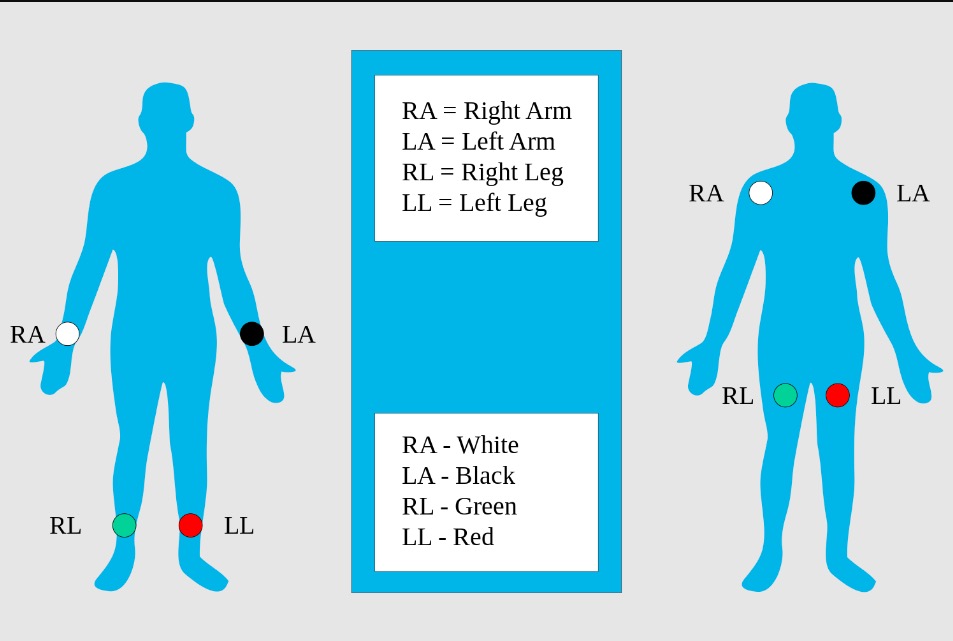
    • 1 elétrodo é fixado em cada membro:
      • Historicamente, um ECG ECG An electrocardiogram (ECG) is a graphic representation of the electrical activity of the heart plotted against time. Adhesive electrodes are affixed to the skin surface allowing measurement of cardiac impulses from many angles. The ECG provides 3-dimensional information about the conduction system of the heart, the myocardium, and other cardiac structures. Electrocardiogram (ECG) em repouso era fixado ao membro distal.
      • Num cenário clínico, um ECG ECG An electrocardiogram (ECG) is a graphic representation of the electrical activity of the heart plotted against time. Adhesive electrodes are affixed to the skin surface allowing measurement of cardiac impulses from many angles. The ECG provides 3-dimensional information about the conduction system of the heart, the myocardium, and other cardiac structures. Electrocardiogram (ECG) em repouso é fixado ao tórax próximo ao membro correspondente.
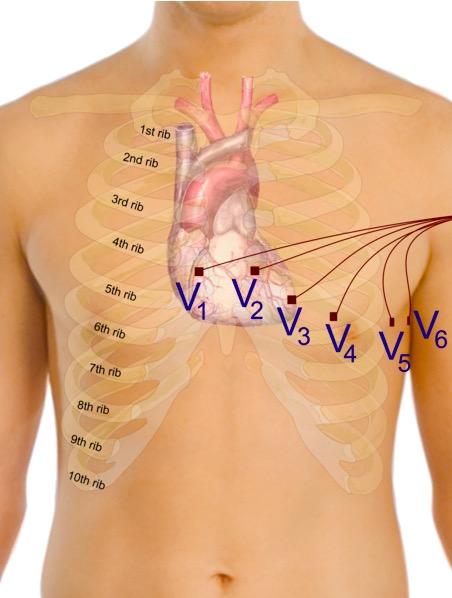
    • 6 elétrodos são colocados no precórdio:
      • V1: 4º espaço intercostal (ICS, pela sigla em inglês), margem DIREITA do esterno
      • V2: 4º ICS, margem ESQUERDA do esterno
      • V4: 5º ICS, linha médio-clavicular
      • V3: linha média entre V2 e V4
      • V5: 5º ICS, linha axilar anterior
      • V6: 5º ICS, linha axilar média
  • 12 derivações são criadas pelas voltagens da máquina/software do ECG ECG An electrocardiogram (ECG) is a graphic representation of the electrical activity of the heart plotted against time. Adhesive electrodes are affixed to the skin surface allowing measurement of cardiac impulses from many angles. The ECG provides 3-dimensional information about the conduction system of the heart, the myocardium, and other cardiac structures. Electrocardiogram (ECG) transmitidas pelos elétrodos:
    • 3 derivações bipolares de membros (registo obtido por pares de elétrodos dos membros):
      • I: elétrodos do braço direito (-) e do braço esquerdo (+)
      • II: elétrodos do braço direito (-) e perna esquerda (+)
      • III: elétrodos do braço esquerdo (-) e perna esquerda (+)
      • Triângulo de Einthoven: triângulo esquemático feito com 3 elétrodos envolvidos na criação das derivações I, II e III.
    • 3 derivações de membro unipolares aumentadas (registo obtido de um elétrodo de membro e terminal central):
      • Augmented Vector Right ( aVR AVR Aortic Stenosis): elétrodo do braço direito (+) e o terminal central (-)
      • Augmented Vector Left (aVL): elétrodo do braço esquerdo (+) e o terminal central (-)
      • Augmented Vector Foot Foot The foot is the terminal portion of the lower limb, whose primary function is to bear weight and facilitate locomotion. The foot comprises 26 bones, including the tarsal bones, metatarsal bones, and phalanges. The bones of the foot form longitudinal and transverse arches and are supported by various muscles, ligaments, and tendons. Foot: Anatomy (aVF): elétrodo da perna esquerda (+) e o terminal central (-)
    • 6 derivações precordiais (registo obtido do elétrodo torácico correspondente e do terminal central):
      • V1, V2: derivações septais
      • V3, V4: derivações anteriores
      • V5, V6: derivações laterais

Traçado de ECG ECG An electrocardiogram (ECG) is a graphic representation of the electrical activity of the heart plotted against time. Adhesive electrodes are affixed to the skin surface allowing measurement of cardiac impulses from many angles. The ECG provides 3-dimensional information about the conduction system of the heart, the myocardium, and other cardiac structures. Electrocardiogram (ECG)

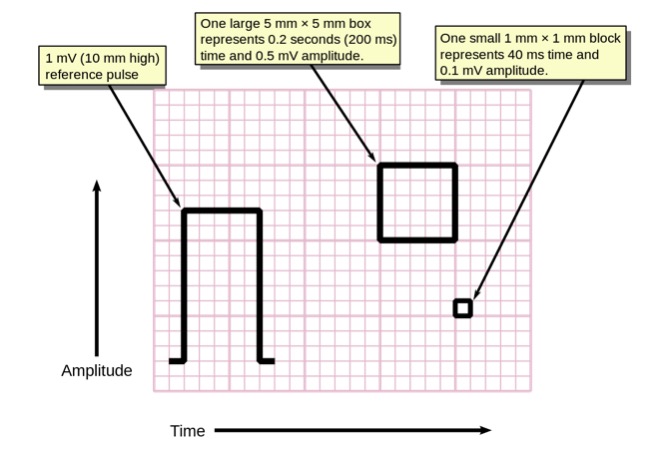
  • Organizado como um gráfico em caixas:
    • Caixa pequena = 1 x 1 mm MM Multiple myeloma (MM) is a malignant condition of plasma cells (activated B lymphocytes) primarily seen in the elderly. Monoclonal proliferation of plasma cells results in cytokine-driven osteoclastic activity and excessive secretion of IgG antibodies. Multiple Myeloma
    • Caixa grande = 5 x 5 mm MM Multiple myeloma (MM) is a malignant condition of plasma cells (activated B lymphocytes) primarily seen in the elderly. Monoclonal proliferation of plasma cells results in cytokine-driven osteoclastic activity and excessive secretion of IgG antibodies. Multiple Myeloma (5 caixas pequenas)
  • Eixos X e Y:
    • Eixo X = tempo em segundos
    • Eixo Y = voltagem em mV
  • Utilidade do eixo X:
    • Velocidade do traçado de ECG ECG An electrocardiogram (ECG) is a graphic representation of the electrical activity of the heart plotted against time. Adhesive electrodes are affixed to the skin surface allowing measurement of cardiac impulses from many angles. The ECG provides 3-dimensional information about the conduction system of the heart, the myocardium, and other cardiac structures. Electrocardiogram (ECG) = 25 mm MM Multiple myeloma (MM) is a malignant condition of plasma cells (activated B lymphocytes) primarily seen in the elderly. Monoclonal proliferation of plasma cells results in cytokine-driven osteoclastic activity and excessive secretion of IgG antibodies. Multiple Myeloma/segundo (25 caixas pequenas/segundo ou 5 caixas grandes/segundo)
    • 1 caixa pequena = 0,04 segundo
    • 1 caixa grande = 0,2 segundo
    • Permite o cálculo da frequência cardíaca e a determinação do ritmo:
    • Permite a medição de intervalos e durações clinicamente relevantes
  • Utilidade do eixo Y:
    • 1 caixa pequena = 0,1 mV
    • Permite a determinação da amplitude de voltagem das formas de onda do ECG ECG An electrocardiogram (ECG) is a graphic representation of the electrical activity of the heart plotted against time. Adhesive electrodes are affixed to the skin surface allowing measurement of cardiac impulses from many angles. The ECG provides 3-dimensional information about the conduction system of the heart, the myocardium, and other cardiac structures. Electrocardiogram (ECG)
    • A amplitude correlaciona-se com eventos acoplados eletromecanicamente no ciclo cardíaco:
      • Sem deflexão = sem condução ou contração cardíaca (por exemplo, linha de base isoelétrica)
      • Pequena deflexão = baixa voltagem associada a miocárdio fino (átrios) e contração modesta (por exemplo, onda P)
      • Grande deflexão = alta voltagem associada a miocárdio espesso (ventrículo) e contração forçada (por exemplo, complexo QRS)
Medição de tempo e tensão com papel gráfico de ECG

Pulso de voltagem do ECG e tamanho dos quadrados

Imagem : “Measuring time and voltage with ECG graph paper” por Markus Kuhn. Licença: Public Domain

Componentes

Um traçado de ECG ECG An electrocardiogram (ECG) is a graphic representation of the electrical activity of the heart plotted against time. Adhesive electrodes are affixed to the skin surface allowing measurement of cardiac impulses from many angles. The ECG provides 3-dimensional information about the conduction system of the heart, the myocardium, and other cardiac structures. Electrocardiogram (ECG) normal terá vários componentes previsíveis e reprodutíveis correspondentes a eventos eletromecânicos no ciclo cardíaco.
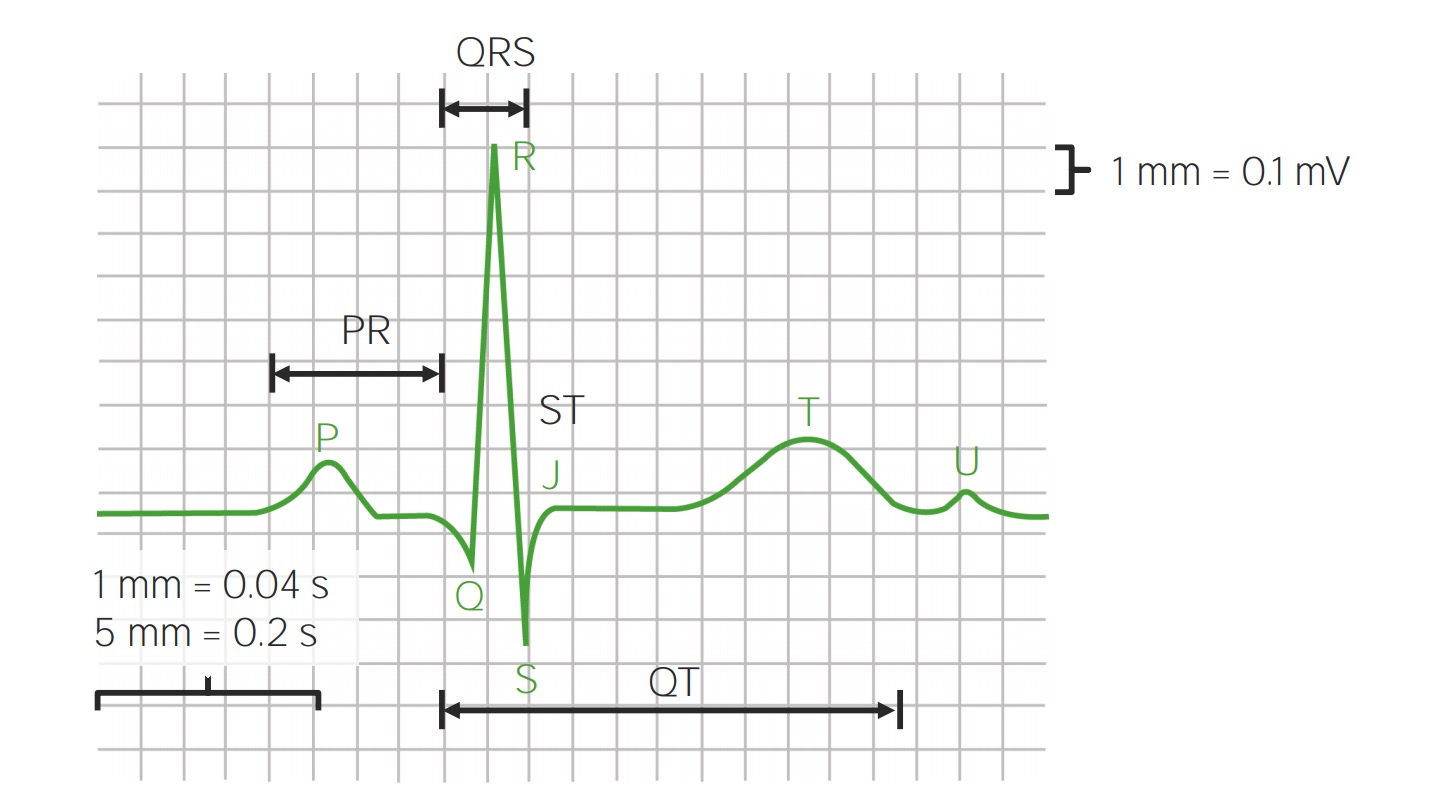
Impulso elétrico da contração cardíaca

  • Linha de base isoelétrica:
    • Traçado plano livre de deflexões positivas ou negativas entre ondas e/ou complexos
    • Representa períodos de inatividade elétrica no ciclo cardíaco
  • Ondas:
    • Onda P:
      • Representa a despolarização auricular
      • Deflexão positiva nas derivações inferiores/laterais
    • Onda T:
      • Representa a repolarização ventricular
      • Deflexão positiva
  • Intervalos:
    • Intervalo PR:
      • Desde o início da onda P até a defleção inicial do complexo QRS
      • Representa o tempo necessário para o impulso elétrico viajar do nó sinusal (SA, pela sigla em inglês) para o nó auriculoventricular (AV, pela sigla em inglês)
    • Intervalo QT:
      • Desde o início do complexo QRS até ao final da onda T
      • Representa a despolarização, contração e repolarização ventricular
    • Intervalo RR RR Relative risk (RR) is the risk of a disease or condition occurring in a group or population with a particular exposure relative to a control (unexposed) group. Measures of Risk:
      • O tempo entre 2 complexos QRS sucessivos
      • Usado para calcular a frequência cardíaca
  • Segmentos:
    • Segmento PQ: segmento isoelétrico entre a onda P e a deflexão inicial do complexo QRS
    • Segmento ST: segmento isoelétrico entre a onda S e a deflexão inicial da onda T
    • Segmento TP: linha de base isoelétrica entre a onda T e a deflexão inicial da onda P
  • Complexo QRS:
    • Representa a despolarização ventricular
    • Composto por 3 ondas:
      • Onda Q: deflexão negativa
      • Onda R: deflexão positiva
      • Onda S: deflexão negativa
  • Dependendo da derivação de ECG ECG An electrocardiogram (ECG) is a graphic representation of the electrical activity of the heart plotted against time. Adhesive electrodes are affixed to the skin surface allowing measurement of cardiac impulses from many angles. The ECG provides 3-dimensional information about the conduction system of the heart, the myocardium, and other cardiac structures. Electrocardiogram (ECG) monitorizada:
    • Onda QS: A deflexão positiva pode não ser aparente (ou seja, sem onda R).
    • Onda RS: A deflexão negativa pode não ser aparente (ou seja, sem onda Q).
    • Complexo QRS: Despolarização ventricular coletiva independente da presença ou ausência de todos os componentes.
Partes de formas de onda e intervalos de ECG

Partes do formato da onda no ECG e intervalos

Imagem por Lecturio. Licença: CC BY-NC-SA 4.0
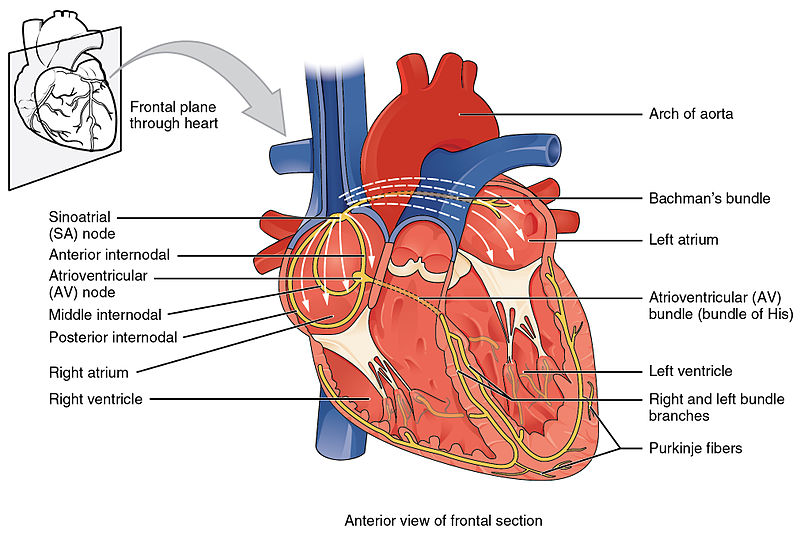
Correlação com acoplamento eletromecânico

  • O ciclo elétrico cardíaco começa espontaneamente no nó SA da aurícula direita:
    • ECG ECG An electrocardiogram (ECG) is a graphic representation of the electrical activity of the heart plotted against time. Adhesive electrodes are affixed to the skin surface allowing measurement of cardiac impulses from many angles. The ECG provides 3-dimensional information about the conduction system of the heart, the myocardium, and other cardiac structures. Electrocardiogram (ECG): fim do segmento TP, início da onda P
    • Mecânica: aurículas preenchidas por sangue do enchimento venoso passivo:
      • Veia cava: preenche a aurícula direita
      • Veias pulmonares: preenchem a aurícula esquerda
  • O impulso elétrico de despolarização espalha-se pelas aurículas através das vias internodais e chega ao nó AV localizado no septo AV:
    • ECG ECG An electrocardiogram (ECG) is a graphic representation of the electrical activity of the heart plotted against time. Adhesive electrodes are affixed to the skin surface allowing measurement of cardiac impulses from many angles. The ECG provides 3-dimensional information about the conduction system of the heart, the myocardium, and other cardiac structures. Electrocardiogram (ECG): conclusão da onda P:
      • Os átrios repolarizam-se eletricamente durante as porções ventriculares do ciclo elétrico cardíaco.
      • A repolarização auricular é ocultada pelo complexo QRS no traçado do ECG ECG An electrocardiogram (ECG) is a graphic representation of the electrical activity of the heart plotted against time. Adhesive electrodes are affixed to the skin surface allowing measurement of cardiac impulses from many angles. The ECG provides 3-dimensional information about the conduction system of the heart, the myocardium, and other cardiac structures. Electrocardiogram (ECG).
  • A atividade elétrica é consideravelmente retardada por células condutoras especializadas nas porções centrais do nó AV:
    • ECG ECG An electrocardiogram (ECG) is a graphic representation of the electrical activity of the heart plotted against time. Adhesive electrodes are affixed to the skin surface allowing measurement of cardiac impulses from many angles. The ECG provides 3-dimensional information about the conduction system of the heart, the myocardium, and other cardiac structures. Electrocardiogram (ECG): segmento PQ (linha de base isoelétrica)
    • Mecânica: os ventrículos enchem-se de sangue da contração auricular, as aurículas relaxam e enchem-se passivamente de sangue
  • A atividade elétrica é retomada à medida que o impulso cardíaco chega às vias de condução rápida no septo interventricular (feixe auriculoventricular ou feixe de His):
    • ECG ECG An electrocardiogram (ECG) is a graphic representation of the electrical activity of the heart plotted against time. Adhesive electrodes are affixed to the skin surface allowing measurement of cardiac impulses from many angles. The ECG provides 3-dimensional information about the conduction system of the heart, the myocardium, and other cardiac structures. Electrocardiogram (ECG): início da onda Q
    • Mecânica: o septo ventricular contrai, continua o enchimento auricular passivo:
      • Válvulas tricúspide/mitral fechadas, cordas tendinosas tensas
      • Os músculos papilares contraem isometricamente para manter a integridade do aparelho tricúspide/mitral
  • A atividade elétrica espalha-se em direção ao ápice do coração ao longo dos ramos direito e esquerdo que atravessam as porções mais MAIS Androgen Insensitivity Syndrome espessas do miocárdio:
    • ECG ECG An electrocardiogram (ECG) is a graphic representation of the electrical activity of the heart plotted against time. Adhesive electrodes are affixed to the skin surface allowing measurement of cardiac impulses from many angles. The ECG provides 3-dimensional information about the conduction system of the heart, the myocardium, and other cardiac structures. Electrocardiogram (ECG): onda R
    • Mecânica: continuação da contração da parede livre ventricular, enchimento auricular passivo:
      • Válvulas tricúspide/mitral “balão” de volta às aurículas
      • Válvulas pulmonares/aórticas abertas
  • A atividade elétrica termina nas fibras de Purkinje, penetrando nas porções mais MAIS Androgen Insensitivity Syndrome profundas do miocárdio próximo ao endocárdio:
    • ECG ECG An electrocardiogram (ECG) is a graphic representation of the electrical activity of the heart plotted against time. Adhesive electrodes are affixed to the skin surface allowing measurement of cardiac impulses from many angles. The ECG provides 3-dimensional information about the conduction system of the heart, the myocardium, and other cardiac structures. Electrocardiogram (ECG): onda S
    • Mecânica: conclusão da contração ventricular, continuação do enchimento auricular passivo
  • A atividade elétrica cardíaca-se estabiliza por um período breve:
    • ECG ECG An electrocardiogram (ECG) is a graphic representation of the electrical activity of the heart plotted against time. Adhesive electrodes are affixed to the skin surface allowing measurement of cardiac impulses from many angles. The ECG provides 3-dimensional information about the conduction system of the heart, the myocardium, and other cardiac structures. Electrocardiogram (ECG): segmento ST
    • Mecânica: os ventrículos começam a relaxar, o enchimento auricular passivo continua:
      • Válvulas tricúspide/mitral fechadas
      • Válvulas pulmonares/aórticas fechadas
  • Repolarização ventricular:
    • ECG ECG An electrocardiogram (ECG) is a graphic representation of the electrical activity of the heart plotted against time. Adhesive electrodes are affixed to the skin surface allowing measurement of cardiac impulses from many angles. The ECG provides 3-dimensional information about the conduction system of the heart, the myocardium, and other cardiac structures. Electrocardiogram (ECG): onda T e segmento TP
    • Mecânica: relaxamento ventricular, enchimento auricular passivo continua:
      • Existe um gradiente de pressão entre o enchimento das aurículas e o esvaziamento dos ventrículos
      • Os ventrículos começam a encher passivamente
      • Válvulas tricúspide/mitral parcialmente abertas
  • Começa outro ciclo cardíaco

Interpretação Sistemática

  1. Calibração (voltagem e velocidade): padrão:
    • Velocidade do papel/traçado = 25 mm MM Multiple myeloma (MM) is a malignant condition of plasma cells (activated B lymphocytes) primarily seen in the elderly. Monoclonal proliferation of plasma cells results in cytokine-driven osteoclastic activity and excessive secretion of IgG antibodies. Multiple Myeloma/segundo
    • 1 mm MM Multiple myeloma (MM) is a malignant condition of plasma cells (activated B lymphocytes) primarily seen in the elderly. Monoclonal proliferation of plasma cells results in cytokine-driven osteoclastic activity and excessive secretion of IgG antibodies. Multiple Myeloma (horizontal) = 0,04 segundo
    • 1 mm MM Multiple myeloma (MM) is a malignant condition of plasma cells (activated B lymphocytes) primarily seen in the elderly. Monoclonal proliferation of plasma cells results in cytokine-driven osteoclastic activity and excessive secretion of IgG antibodies. Multiple Myeloma (vertical) = 0,1 mV
  2. Calcular a frequência cardíaca:
    • Cálculo: dividir 300 pelo número de quadrados grandes entre os intervalos RR RR Relative risk (RR) is the risk of a disease or condition occurring in a group or population with a particular exposure relative to a control (unexposed) group. Measures of Risk
    • Frequência cardíaca normal: 60-100/min
  3. Determinar o ritmo: critérios de ritmo sinusal normal:
    • Morfologia normal da onda P
    • Um complexo QRS regular Regular Insulin após cada onda P
    • Intervalos PR/ RR RR Relative risk (RR) is the risk of a disease or condition occurring in a group or population with a particular exposure relative to a control (unexposed) group. Measures of Risk normais e constantes
  4. Determinar os intervalos de tempo (PR, QRS, QTC):
    • Cálculo manual medindo blocos horizontais
    • Cálculo eletrónico por máquina/software (geralmente listado no canto superior esquerdo)
    • Intervalo PR 0.12-0,2 segundos
    • Complexo QRS < 0.12 segundos
    • Intervalo QTC 0.30–0.46 segundos
  5. Determinar o eixo QRS médio:
    • Direção da deflexão do QRS:
      • Positivo: O vetor elétrico médio viaja em direção ao elétrodo positivo numa determinada derivação.
      • Negativo: O vetor elétrico médio afasta-se do elétrodo positivo numa determinada derivação.
    • Normal: -30°–100°
    • Normalmente positivo na derivação II e derivação aVF
  6. Avaliar a morfologia da onda P por tamanho de voltagem e deflexão:
    • Tempo normal < 0,12 segundo
    • Normalmente vertical na derivação II e derivação aVF
  7. Avaliar a morfologia e/ou voltagem do QRS:
  8. Avaliar a morfologia do segmento ST e da onda T:
    • Segmento ST:
      • Segmento plano e isoelétrico após o complexo QRS, mas antes da onda T
      • Normalmente sem depressão ou elevação
    • Onda T: normalmente concordante com o complexo QRS
  9. Comparar com traçados anteriores, se disponíveis.
Interpretação de ECG

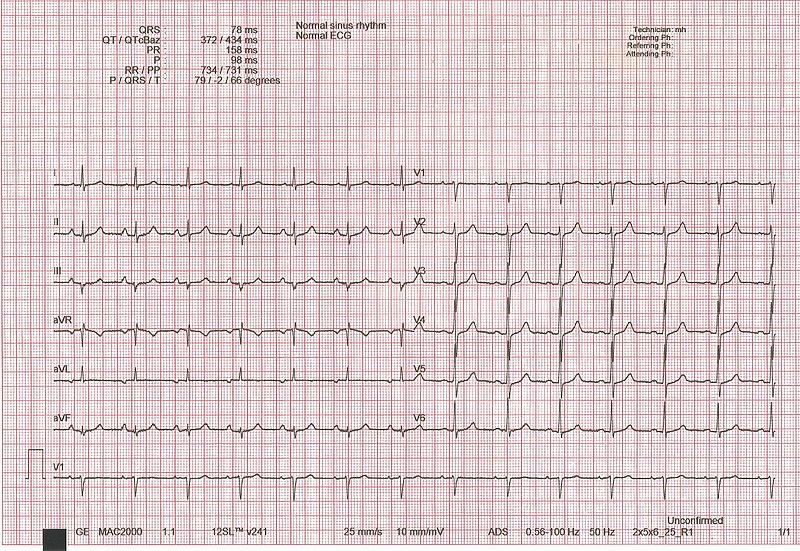
ECG normal: traçado de 12 derivações com uma faixa de ritmo V1 exibida na parte inferior

Imagem : “ECG interpretation” por Rodhullandemu. Licença: Public Domain

Referências

  1. Sattar Y, Chhabra L. Electrocardiogram. [Updated 2020 Nov 26]. In: StatPearls [Internet]. Treasure Island (FL): StatPearls Publishing; 2021 Jan-. https://www.ncbi.nlm.nih.gov/books/NBK549803/
  2. Prutkin, J. (2019). ECG tutorial: Basic principles of ECG analysis. Retrieved June 6, 2021, from https://www.uptodate.com/contents/ecg-tutorial-basic-principles-of-ecg-analysis
  3. Prutkin, J. (2019). ECG tutorial: Electrical components of the ECG. Retrieved June 6, 2021, from https://www.uptodate.com/contents/ecg-tutorial-electrical-components-of-the-ecg

Crie sua conta gratuita ou faça login para continuar lendo!

Cadastre-se agora e tenha acesso grátis ao Lecturio, com páginas de conceitos, vídeos de medicina e questões para sua educação médica.

Aprende mais com a Lecturio:

Multiple devices displaying human anatomy and health education content.

Complementa o teu estudo da faculdade com o companheiro de estudo tudo-em-um da Lecturio, através de métodos de ensino baseados em evidência.

Estuda onde quiseres

Two iPhones display medical education apps, one showing anatomy, the other Bookmatcher.

A Lecturio Medical complementa o teu estudo através de métodos de ensino baseados em evidência, vídeos de palestras, perguntas e muito mais – tudo combinado num só lugar e fácil de usar.

User Reviews

Have a holly, jolly study session 🎁 Save 50% on all plans now >>

Que tengas una sesión de estudio alegre y navideña 🎁 Ahorra 50% en todos los planes >>

Details