


Anemia Sideroblástica

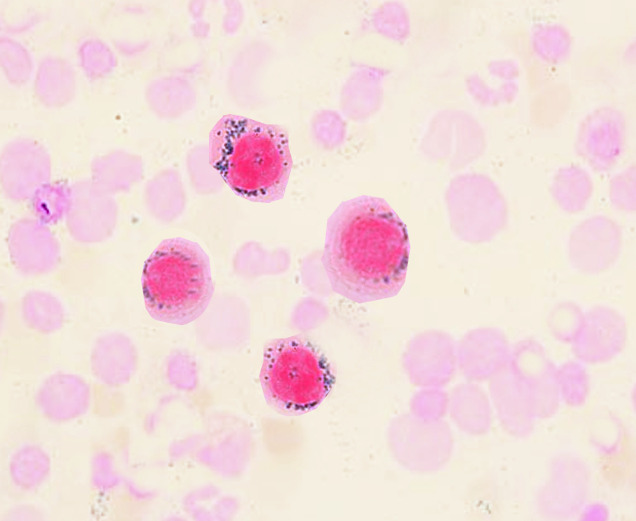
As anemias sideroblásticas são um grupo heterogéneo de distúrbios da medula óssea caracterizados pela acumulação anormal de ferro nas mitocôndrias dos precursores eritróides. O ferro acumulado aparece como grânulos numa distribuição em forma de anel à volta do núcleo, dando origem à característica morfológica de um sideroblasto em anel. As anemias sideroblásticas podem resultar de defeitos hereditários na síntese do heme ou podem ser adquiridas no caso do alcoolismo, envenenamento por chumbo, fármacos ou deficiência de vitaminas. A anemia Anemia Anemia is a condition in which individuals have low Hb levels, which can arise from various causes. Anemia is accompanied by a reduced number of RBCs and may manifest with fatigue, shortness of breath, pallor, and weakness. Subtypes are classified by the size of RBCs, chronicity, and etiology. Anemia: Overview and Types é comumente microcítica com contagem de reticulócitos baixa a normal. Os níveis séricos de ferro estão geralmente elevados. Um exame de medula óssea que mostre sideroblastos em anel estabelece o diagnóstico. O tratamento envolve a getsão da doençs subjacente, evitando fármacos e/ou toxinas causadoras e flebotomia em casos de sobrecarga de ferro.

Last updated: Dec 15, 2025

Editorial responsibility: Stanley Oiseth, Lindsay Jones, Evelin Maza

Descrição Geral

Definição

As anemias sideroblásticas são um grupo heterogéneo de distúrbios da medula óssea caracterizados pela acumulação anormal de ferro nas mitocôndrias dos precursores eritróides.

A distribuição do ferro é em forma de anel em volta do núcleo, manifestada pelos precursores (sideroblastos em anel) na medula óssea.

Epidemiologia

  • Uma doença rara → a incidência e a prevalência não estão bem caracterizadas
  • Homens > mulheres
  • Sem predominância racial
  • As formas hereditárias geralmente manifestam-se antes dos 30 anos.
  • A forma adquirida é frequentemente vista aos 65 anos ou depois.

Etiologia

Distúrbios Congénitos:

  • Sindrómico: com manifestações não hematológicas concomitantes
  • Não sindrímico:
    • Presente com anemia Anemia Anemia is a condition in which individuals have low Hb levels, which can arise from various causes. Anemia is accompanied by a reduced number of RBCs and may manifest with fatigue, shortness of breath, pallor, and weakness. Subtypes are classified by the size of RBCs, chronicity, and etiology. Anemia: Overview and Types, sem outras manifestações clínicas
    • Maioria dos casos

Adquirido:

  • Distúrbios hematopoiéticos clonais:
    • Síndromes mielodisplásicas (SMD)
    • Neoplasias mieloproliferativas (NMP)
  • Causas reversíveis:
    • Álcool
    • Deficiência vitamínica (vitamina B 6, cofator para a síntese de protoporfirina)
    • Intoxicação por chumbo (inibe a conversão de protoporfirinas)
    • Fármacos (isoniazida, cloranfenicol, linezolida)
    • Deficiência de cobre
    • Intoxicação por zinco
    • Hipotermia

Fisiopatologia

Síntese de heme

  • Heme:
    • Contém porfirina, sintetizado através de uma via enzimática que ocorre nas mitocôndrias e no citoplasma
    • A maior parte da produção ocorre na medula óssea.
  • Na mitocôndria:
    • Succinil-CoA + glicina → ácido aminolevulínico (ALA)
    • A reação é catalisada pela sintase do ácido aminolevulínico (ALAS2 nos eritrócitos).
    • ALA → sai para o citoplasma
  • No citoplasma:
    • 2 moléculas de ALA condensam-se para produzir porfobilinogénio.
    • Porfobilinogénio → uroporfirinogénio III → coproporfirinogénio III
    • O coproporfirinogênio III é transportado de volta para a mitocôndria.
  • Na mitocôndria:
    • Coproporfirinogénio III → protoporfirinogénio III, que então é convertido em protoporfirina IX
    • O ferro ferroso é inserido na protoporfirina IX (catalisada pela ferroquelatase), formando o heme.
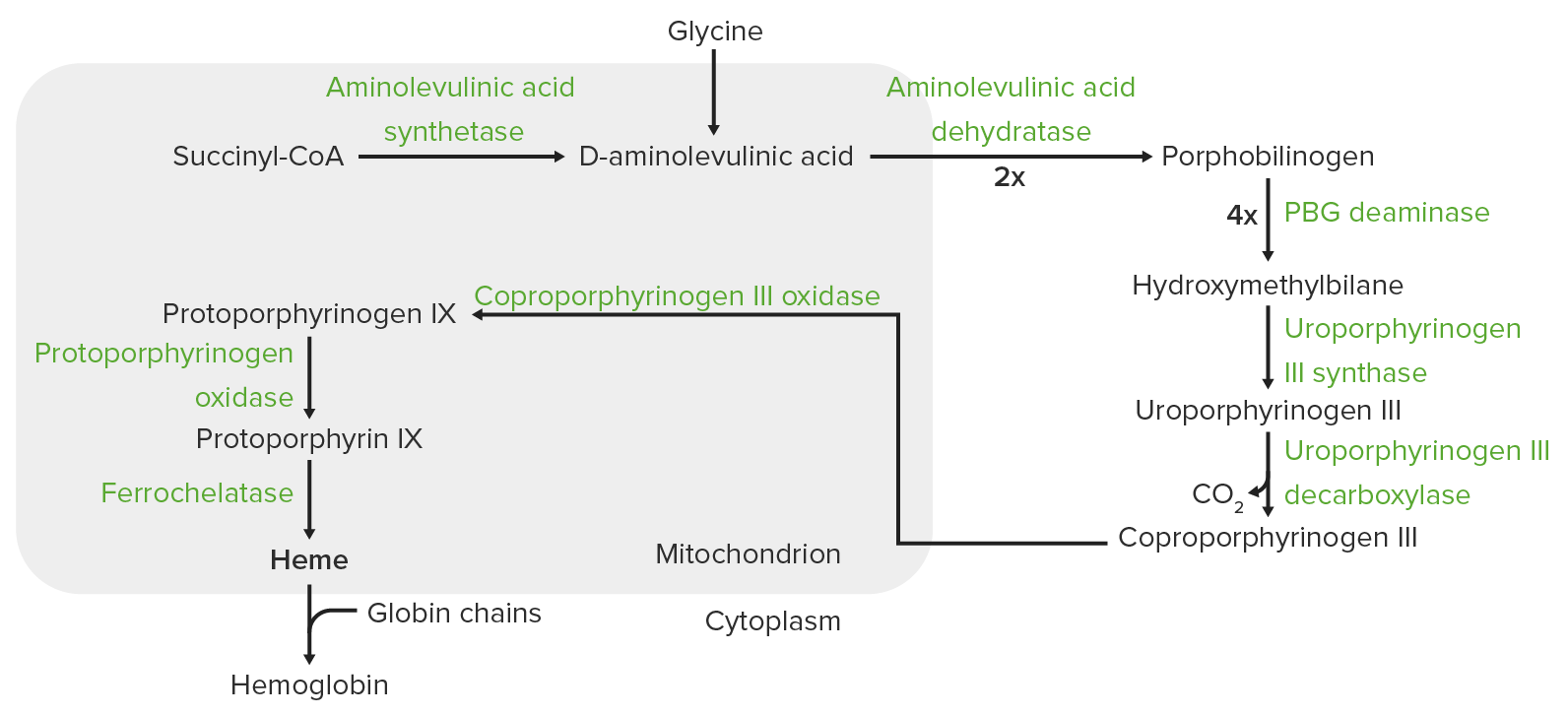
Heme synthesis

Síntese do grupo Heme:
A síntese do heme é um processo que ocorre nas mitocôndrias e no citoplasma.
Na mitocôndria, a succinil-CoA combina-se com a glicina para formar o ácido aminolevulínico (ALA).
Esta reação é catalisada pela sintase do ácido aminolevulínico (ALAS2 nos eritrócitos). O ALA sai para o citoplasma, onde 2 moléculas de ALA condensam-se para produzir porfobilinogênio (PB). As etapas subsequentes levam à formação do coproporfirinogênio III, que é transportado de volta para a mitocôndria. A oxidase facilita a conversão do coproporfirinogênio III em protoporfirinogênio IX, que então é convertido em protoporfirina IX. O ferro ferroso é inserido na protoporfirina IX, formando o heme (catalisado pela ferroquelatase).

Imagem por Lecturio.

Patogénese

Defeitos na síntese do heme:

  • Anemia Anemia Anemia is a condition in which individuals have low Hb levels, which can arise from various causes. Anemia is accompanied by a reduced number of RBCs and may manifest with fatigue, shortness of breath, pallor, and weakness. Subtypes are classified by the size of RBCs, chronicity, and etiology. Anemia: Overview and Types sideroblástica ligada ao X (XLSA):
    • Mutações no gene Gene A category of nucleic acid sequences that function as units of heredity and which code for the basic instructions for the development, reproduction, and maintenance of organisms. Basic Terms of Genetics ALAS2 , que codifica a ácido aminolevulínico sintase, a enzima limitante da velocidade na síntese do heme
    • Frequentemente (> 50% dos casos) responsivo à suplementação de B 6
  • Anemia Anemia Anemia is a condition in which individuals have low Hb levels, which can arise from various causes. Anemia is accompanied by a reduced number of RBCs and may manifest with fatigue, shortness of breath, pallor, and weakness. Subtypes are classified by the size of RBCs, chronicity, and etiology. Anemia: Overview and Types sideroblástica autossómica recessiva:
    • Mutação SLC25A38 : afeta o transportador de glicina para o interior da mitocôndria
    • Mutação FECH : afeta a ferroquelatase
  • Adquirido:
    • Isoniazida (INH): causa comprometimento da função do gene Gene A category of nucleic acid sequences that function as units of heredity and which code for the basic instructions for the development, reproduction, and maintenance of organisms. Basic Terms of Genetics ALAS2
    • Álcool

Defeitos na biogénese do cluster ferro-enxofre (CFE):

  • Os CFE estão envolvidos em múltiplas funções biológicas, incluindo transporte de eletrões, regulação do ferro e reparação de DNA DNA A deoxyribonucleotide polymer that is the primary genetic material of all cells. Eukaryotic and prokaryotic organisms normally contain DNA in a double-stranded state, yet several important biological processes transiently involve single-stranded regions. DNA, which consists of a polysugar-phosphate backbone possessing projections of purines (adenine and guanine) and pyrimidines (thymine and cytosine), forms a double helix that is held together by hydrogen bonds between these purines and pyrimidines (adenine to thymine and guanine to cytosine). DNA Types and Structure.
  • A disfunção na transferência dos CFE para dentro e para fora das mitocôndrias desativa a eritropoiese.
  • Visto em mutações como:
    • ABCB7 : associado à ataxia Ataxia Impairment of the ability to perform smoothly coordinated voluntary movements. This condition may affect the limbs, trunk, eyes, pharynx, larynx, and other structures. Ataxia may result from impaired sensory or motor function. Sensory ataxia may result from posterior column injury or peripheral nerve diseases. Motor ataxia may be associated with cerebellar diseases; cerebral cortex diseases; thalamic diseases; basal ganglia diseases; injury to the red nucleus; and other conditions. Ataxia-telangiectasia (sindrómico)
    • HSPA9
    • GLRX5

Defeitos na síntese de proteínas mitocondriais:

  • As etiologias congénitas afetam proteínas multifuncionais, por isso estão associadas a sinais sistémicos (sindrómicos) como:
    • Síndrome de Pearson medula-pâncreas
    • Miopatia, acidose láctica e anemia Anemia Anemia is a condition in which individuals have low Hb levels, which can arise from various causes. Anemia is accompanied by a reduced number of RBCs and may manifest with fatigue, shortness of breath, pallor, and weakness. Subtypes are classified by the size of RBCs, chronicity, and etiology. Anemia: Overview and Types sideroblástica (MLASA)
    • Mutação TRNT1 (imunodeficiência, febres recorrentes, atraso no desenvolvimento)
  • Adquirido:
    • Cloranfenicol
    • Linezolide

Disfunção na eritropoiese:

  • GV incapazes de amadurecer
  • Leva à morte celular na medula (hemólise intramedular)
  • ↑ Absorção inadequada de ferro → sobrecarga de ferro
  • Visto em:
    • XLSA
    • Mutação SLC25A38
    • MDS MDS Myelodysplastic syndromes (MDS) are a group of clonal neoplasms with maturation defects characterized by dysplasia, cytopenia, and immature bone marrow precursors. Myelodysplastic syndromes can be idiopathic, or secondary to various injurious exposures such as cytotoxic chemotherapy, ionizing radiation, or environmental toxins. Myelodysplastic Syndromes/MPN

Apresentação Clínica

A apresentação clínica varia de acordo com a doença de base.

Características gerais da anemia Anemia Anemia is a condition in which individuals have low Hb levels, which can arise from various causes. Anemia is accompanied by a reduced number of RBCs and may manifest with fatigue, shortness of breath, pallor, and weakness. Subtypes are classified by the size of RBCs, chronicity, and etiology. Anemia: Overview and Types:

  • Atraso no crescimento em crianças
  • Fadiga e fraqueza muscular
  • Hipotermia
  • Fotossensibilidade

Pacientes com deficiência de vitamina B 6 podem apresentar:

  • Neuropatia periférica
  • Ataxia Ataxia Impairment of the ability to perform smoothly coordinated voluntary movements. This condition may affect the limbs, trunk, eyes, pharynx, larynx, and other structures. Ataxia may result from impaired sensory or motor function. Sensory ataxia may result from posterior column injury or peripheral nerve diseases. Motor ataxia may be associated with cerebellar diseases; cerebral cortex diseases; thalamic diseases; basal ganglia diseases; injury to the red nucleus; and other conditions. Ataxia-telangiectasia
  • Dermatite
  • Glossite

Pacientes com intoxicação por chumbo podem apresentar:

  • Dor abdominal
  • Linhas de chumbo na dentição
  • Neuropatia periférica (adultos)
  • Ataxia Ataxia Impairment of the ability to perform smoothly coordinated voluntary movements. This condition may affect the limbs, trunk, eyes, pharynx, larynx, and other structures. Ataxia may result from impaired sensory or motor function. Sensory ataxia may result from posterior column injury or peripheral nerve diseases. Motor ataxia may be associated with cerebellar diseases; cerebral cortex diseases; thalamic diseases; basal ganglia diseases; injury to the red nucleus; and other conditions. Ataxia-telangiectasia
  • Encefalopatia
  • Atraso mental e de crescimento (crianças)

Outros:

  • Urina corada com porfirinas
  • Aqueles com anemias sideroblásticas sindrómicas terão outras manifestações não hematológicas.

Diagnóstico

História médica

  • História familiar de anemia Anemia Anemia is a condition in which individuals have low Hb levels, which can arise from various causes. Anemia is accompanied by a reduced number of RBCs and may manifest with fatigue, shortness of breath, pallor, and weakness. Subtypes are classified by the size of RBCs, chronicity, and etiology. Anemia: Overview and Types
  • Presença de características clínicas concomitantes (nas formas sindrómicas)
  • Possibilidade de deficiência de cobre:
    • História da cirurgia gastrointestinal
    • Nutrição entérica ou parentérica sem cobre
    • Ingestão excessiva de zinco
  • Hábitos alcoólicos
  • História de exposição a chumbo
  • Fármacos
  • Diálise de longa duração

Achados laboratoriais

  • Hemograma completo:
    • Microcitose (VCM < 80)
    • ↑ Amplitude de distribuição RBC (RDW)
    • Significado clínico: em crianças, nem a anemia Anemia Anemia is a condition in which individuals have low Hb levels, which can arise from various causes. Anemia is accompanied by a reduced number of RBCs and may manifest with fatigue, shortness of breath, pallor, and weakness. Subtypes are classified by the size of RBCs, chronicity, and etiology. Anemia: Overview and Types microcítica sem deficiência de ferro, nem a talassemia são sugestivas de XLSA.
  • Contagem de reticulócitos normal a baixa
  • Estudos de ferro:
    • ↑ Ferro sérico
    • ↑ Níveis de ferritina
    • Capacidade de fixação de ferro total normal ou ↓ (CFFT)
    • ↑ Saturação da transferrina
  • Esfregaço de sangue periférico anormal:
    • Anisocitose, poiquilocitose
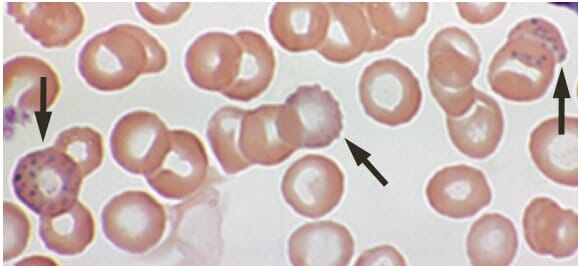
    • Siderócitos: eritrócitos hipocrómicos com granulos basófilos com coloração positiva para ferro
  • O diagnóstico é baseado no aspirado de medula óssea (em esfregaço corado com azul da Prússia): sideroblastos em anel

Diferenciação entre anemia Anemia Anemia is a condition in which individuals have low Hb levels, which can arise from various causes. Anemia is accompanied by a reduced number of RBCs and may manifest with fatigue, shortness of breath, pallor, and weakness. Subtypes are classified by the size of RBCs, chronicity, and etiology. Anemia: Overview and Types sideroblástica e outras anemias microcíticas

Tabela: Diferenciação entre anemia Anemia Anemia is a condition in which individuals have low Hb levels, which can arise from various causes. Anemia is accompanied by a reduced number of RBCs and may manifest with fatigue, shortness of breath, pallor, and weakness. Subtypes are classified by the size of RBCs, chronicity, and etiology. Anemia: Overview and Types sideroblástica e outras anemias microcíticas (MCV < 80)
Achados no hemograma Diagnóstico Nível de ferro Historial médico
Anemia Anemia Anemia is a condition in which individuals have low Hb levels, which can arise from various causes. Anemia is accompanied by a reduced number of RBCs and may manifest with fatigue, shortness of breath, pallor, and weakness. Subtypes are classified by the size of RBCs, chronicity, and etiology. Anemia: Overview and Types com MCV < 80 Anemia Anemia Anemia is a condition in which individuals have low Hb levels, which can arise from various causes. Anemia is accompanied by a reduced number of RBCs and may manifest with fatigue, shortness of breath, pallor, and weakness. Subtypes are classified by the size of RBCs, chronicity, and etiology. Anemia: Overview and Types sideroblástica ↑ Nível de ferro Alcoolismo, SMD
Anemia Anemia Anemia is a condition in which individuals have low Hb levels, which can arise from various causes. Anemia is accompanied by a reduced number of RBCs and may manifest with fatigue, shortness of breath, pallor, and weakness. Subtypes are classified by the size of RBCs, chronicity, and etiology. Anemia: Overview and Types por deficiência de ferro ↓ Nível de ferro Perda de sangue
Talassemia Nível normal de ferro Dependente da gravidade ( anemia Anemia Anemia is a condition in which individuals have low Hb levels, which can arise from various causes. Anemia is accompanied by a reduced number of RBCs and may manifest with fatigue, shortness of breath, pallor, and weakness. Subtypes are classified by the size of RBCs, chronicity, and etiology. Anemia: Overview and Types assintomática a grave)
SMD: síndromes mielodisplásicas

Exames adicionais

  • Se indicado com base no histórico:
    • Níveis de cobre e ceruloplasmina
    • Nível de chumbo
  • Testagem genética:
    • Necessário para estabelecer um diagnóstico específico
    • Realizado em leucócitos do sangue periférico

Tratamento

Objetivos

  • Prevenir danos nos órgãos por sobrecarga de ferro.
  • Controlar os sintomas associados à anemia Anemia Anemia is a condition in which individuals have low Hb levels, which can arise from various causes. Anemia is accompanied by a reduced number of RBCs and may manifest with fatigue, shortness of breath, pallor, and weakness. Subtypes are classified by the size of RBCs, chronicity, and etiology. Anemia: Overview and Types.

Opções de tratamento

As opções de tratamento dependem da etiologia e incluem:

  • Induzida por fármacos: cessar a medicação
  • Induzido por álcool ou toxina: abstinência de álcool, remoção dos agentes tóxicos
  • Tratamento da condição subjacente, ou seja, SMD/SMP
  • No caso de ingestão de INH: É necessária a coadministração de B 6.
  • Para XLSA: suplementos de vitamina B 6 (piridoxina)
  • Para anemia Anemia Anemia is a condition in which individuals have low Hb levels, which can arise from various causes. Anemia is accompanied by a reduced number of RBCs and may manifest with fatigue, shortness of breath, pallor, and weakness. Subtypes are classified by the size of RBCs, chronicity, and etiology. Anemia: Overview and Types megaloblástica responsiva à tiamina: vitamina B 1
  • Para anemia Anemia Anemia is a condition in which individuals have low Hb levels, which can arise from various causes. Anemia is accompanied by a reduced number of RBCs and may manifest with fatigue, shortness of breath, pallor, and weakness. Subtypes are classified by the size of RBCs, chronicity, and etiology. Anemia: Overview and Types sintomática: transfusão se indicado
  • Sobrecarga de ferro: flebotomia, quelação de ferro
  • Para algumas anemias sideroblásticas hereditárias: possível transplante alogénico de células-estaminais hematopoiéticas

Relevância Clínica

  • Intoxicação por chumbo: o chumbo inibe a ferroquelatase e a ALA desidratase (enzimas na via de síntese do heme), resultando na diminuição da síntese do heme. Clinicamente apresentam-se com sintomas gastrointestinais e manifestações neurológicas. Os achados laboratoriais incluem anemia Anemia Anemia is a condition in which individuals have low Hb levels, which can arise from various causes. Anemia is accompanied by a reduced number of RBCs and may manifest with fatigue, shortness of breath, pallor, and weakness. Subtypes are classified by the size of RBCs, chronicity, and etiology. Anemia: Overview and Types, pontilhado basófilo nos eritrócitos no esfregaço de sangue periférico e sideroblastos em anel na medula óssea. O diagnóstico é por medição do nível de chumbo.
  • Síndrome mielodisplásica: um grupo de doenças malignas das células-estaminais mieloides caracterizadas por produção displásica e ineficaz de células da linha mieloide na medula óssea e um risco aumentado de transformação em leucemia aguda. A síndrome mielodisplásica geralmente se apresenta em pacientes mais MAIS Androgen Insensitivity Syndrome velhos, com mais MAIS Androgen Insensitivity Syndrome de 60 anos. A síndrome manifesta-se com trombocitopenia, anemia Anemia Anemia is a condition in which individuals have low Hb levels, which can arise from various causes. Anemia is accompanied by a reduced number of RBCs and may manifest with fatigue, shortness of breath, pallor, and weakness. Subtypes are classified by the size of RBCs, chronicity, and etiology. Anemia: Overview and Types e neutropenia Neutropenia Neutrophils are an important component of the immune system and play a significant role in the eradication of infections. Low numbers of circulating neutrophils, referred to as neutropenia, predispose the body to recurrent infections or sepsis, though patients can also be asymptomatic. Neutropenia com granulócitos disfuncionais, apesar de uma medula óssea hipercelular.
  • Deficiência de vitamina B 6: causada porfármacos inativadoros da piridoxina (p. ex., isoniazida), desnutrição protéico-energética, má absorção, alcoolismo ou perda excessiva devido à hemodiálise. A deficiência pode causar neuropatia periférica, convulsões, dermatite seborreica, glossite, queilose e anemia Anemia Anemia is a condition in which individuals have low Hb levels, which can arise from various causes. Anemia is accompanied by a reduced number of RBCs and may manifest with fatigue, shortness of breath, pallor, and weakness. Subtypes are classified by the size of RBCs, chronicity, and etiology. Anemia: Overview and Types sideroblástica.

Referências

  1. Ashorobi D, Chhabra A. (2020). Sideroblastic Anemia. StatPearls: StatPearls Publishing. Retrieved April 6, 2021, from https://www.ncbi.nlm.nih.gov/books/NBK538287/
  2. Bottomley SS. (2021). Sideroblastic anemias: Diagnosis and management. UpToDate. Retrieved April 6, 2021, from https://www.uptodate.com/contents/sideroblastic-anemias-diagnosis-and-management
  3. Bottomley SS. (2021). Causes and pathophysiology of the sideroblastic anemias. UpToDate. Retrieved April 6, 2021, from https://www.uptodate.com/contents/causes-and-pathophysiology-of-the-sideroblastic-anemias
  4. Ducamp S, Fleming MD. (2019). The molecular genetics of sideroblastic anemia. https://pubmed.ncbi.nlm.nih.gov/30401706/
  5. Sticco KL, Yarrarapu, SNS, Al Obaidi NM. (2021) Refractory Anemia With Ring Sideroblasts. StatPearls [Internet]. Treasure Island (FL): StatPearls Publishing. Retrieved April 6, 2021, from https://www.ncbi.nlm.nih.gov/books/NBK537073/

Crie sua conta gratuita ou faça login para continuar lendo!

Cadastre-se agora e tenha acesso grátis ao Lecturio, com páginas de conceitos, vídeos de medicina e questões para sua educação médica.

Aprende mais com a Lecturio:

Multiple devices displaying human anatomy and health education content.

Complementa o teu estudo da faculdade com o companheiro de estudo tudo-em-um da Lecturio, através de métodos de ensino baseados em evidência.

Estuda onde quiseres

Two iPhones display medical education apps, one showing anatomy, the other Bookmatcher.

A Lecturio Medical complementa o teu estudo através de métodos de ensino baseados em evidência, vídeos de palestras, perguntas e muito mais – tudo combinado num só lugar e fácil de usar.

User Reviews

Details