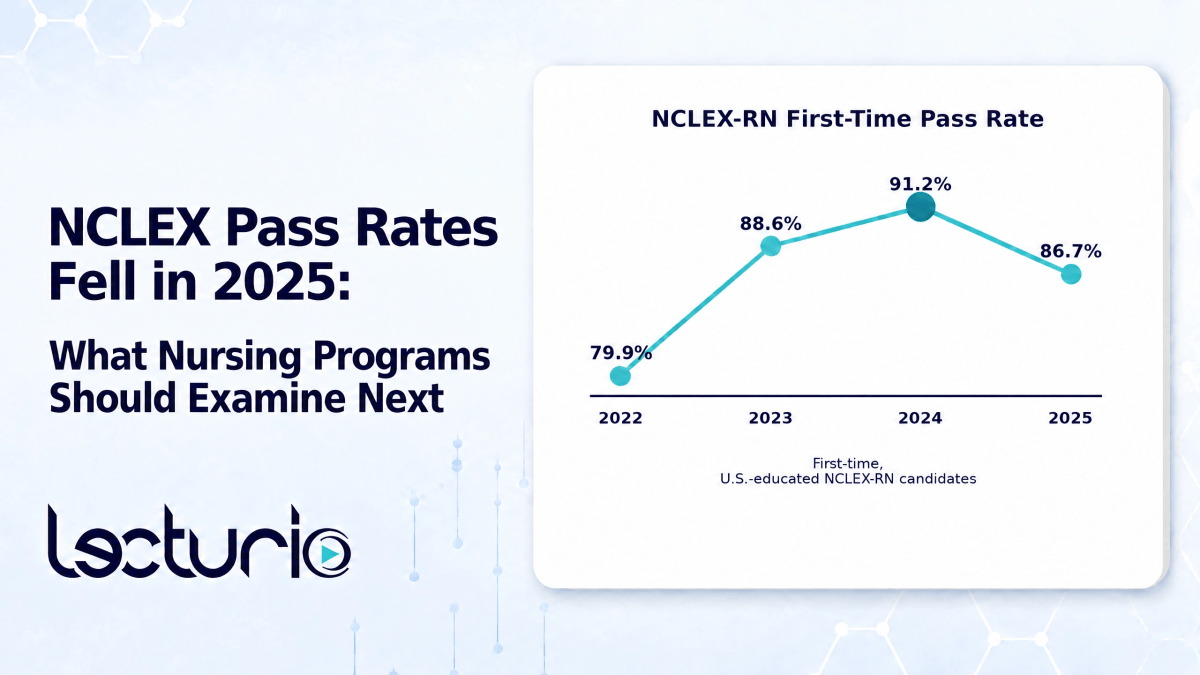
At a glance: First-time NCLEX-RN pass rates for U.S.-educated candidates rose after the 2023 NGN transition, peaked in 2024, and declined in 2025. National statistics show the trend, but not its cause. For nursing programs, the more useful question is whether clinical judgment has been embedded as a sustained curricular priority across teaching, assessment, faculty development, and continuous quality improvement rather than addressed mainly through short-term exam preparation.
The pattern in the data is worth sitting with before drawing any conclusions from it. First-time, U.S.-educated NCLEX-RN pass rates climbed from 79.9% in 2022 to 88.6% in 2023 to 91.2% in 2024, a decade high, then fell to 86.7% in 2025, 167,272 passing out of 192,916 candidates. The all-candidate pass rate followed a similar arc, dropping from 73.3% in 2024 to 69.1% in 2025, 226,946 passing out of 328,443 total (National Council of State Boards of Nursing, 2026).
The passing standard did not change between 2024 and 2025, which makes the decline worth examining. However, national pass-rate statistics alone cannot tell us whether the change reflects curriculum design, cohort characteristics, program variation, candidate preparation, educational disruption, or other factors. The data therefore raise questions rather than answer them.
It helps to be precise about what’s being measured here, because three related concepts often get conflated, and that’s where a lot of implementation confusion starts. NGN refers to the current NCLEX examination design: its item formats, delivery, and scoring. The CJMM, the Clinical Judgment Measurement Model, is the measurement model NCSBN uses to represent aspects of clinical judgment within that examination. Clinical judgment itself is the broader professional capability nurses use in practice. It exists independently of any single exam, and a nurse exercises it at the bedside whether or not anyone is testing for it that day. NGN therefore makes clinical judgment more visible within licensure assessment, but an institution’s NCLEX pass rate should not be treated as a direct or complete measure of how well its curriculum teaches clinical judgment. Pass-rate trends are a reason to look more closely at curriculum, not a verdict on it.
This piece looks at what the 2024 peak and 2025 decline can and cannot tell us, and offers a practical, sequenced approach to building clinical judgment instruction as an ongoing system, not something scoped narrowly around passing one exam.
What the 2024–2025 Trend Can—and Cannot—Tell Us
The rise in pass rates following the NGN transition and the subsequent decline in 2025 invite several possible explanations, but the national statistics do not identify which are responsible. Programs should therefore resist reading one causal story into the trend. What the pattern does reinforce is the importance of monitoring whether changes introduced during a major assessment transition become embedded in routine curriculum and assessment practice over time.
Earlier national survey data also showed considerable variation in how explicitly programs approached clinical judgment, with only 27% of responding prelicensure programs reporting use of a named clinical judgment model at the time and another 51% intending to adopt one (Jessee et al., 2023). Because that survey predates full NGN implementation, it should not be used to explain the 2025 pass-rate decline. It does, however, illustrate why programs benefit from making their clinical judgment approach explicit and coherent across courses. Without a shared, consistently applied approach, programs may find it harder to keep instruction aligned once the initial transition energy fades.
Whatever explains the national trend, the implementation question for individual programs is the same. The goal isn’t simply to get through the NGN transition. It’s to embed clinical judgment longitudinally across curriculum, assessment, faculty development, and quality-improvement processes, so that instruction doesn’t depend on one high-effort semester and stays consistent from one cohort to the next.
From Short-Term Adaptation to Sustainable Curriculum Design
Major assessment or accreditation changes often generate a burst of implementation activity: faculty development, new cases, revised assessments, and curriculum mapping. The educational challenge is ensuring that useful changes become part of routine program design rather than remaining dependent on individual champions or transition-period urgency.
A short-term implementation response may include workshops, new simulation cases, revised item banks, or local faculty initiatives without yet creating consistent alignment across objectives, teaching, assessment, and faculty development. Nothing about how the curriculum is actually built or assessed changes underneath it, the structure stays the same, only the content on top gets a light refresh.
A more sustainable approach makes clinical judgment visible across program outcomes, course objectives, learning activities, assessment, faculty development, and curriculum review, so that it is not dependent on a small number of faculty or a one-time initiative.
The broader literature on competency-based education points in the same direction. A 2025 scoping review of 37 peer-reviewed studies on how nursing programs revise curricula for competency-based education grouped the strategies it identified into three aligned domains: curriculum design, teaching methods, and assessment. It concluded that this kind of reform is a system-wide transformation rather than a teaching change alone, and that faculty development and continuous evaluation and feedback are essential for sustaining it (Mani, 2025).
On the instructional side, a companion to the Jessee et al. survey found that case studies and simulation are the most common strategies programs use to teach clinical judgment (Nielsen et al., 2023), a useful starting point for programs deciding where to invest first.
A Practical, Phased Roadmap for Sustaining Clinical Judgment Instruction
The following phases offer one realistic sequence. They’re deliberately not tied to fixed deadlines, so they stay usable regardless of where a program is starting from.
Phase 1: Assess where you actually are
Begin by mapping where clinical judgment is already represented across learning outcomes, learning activities, assessment, and clinical experiences. Case discussions, simulation debriefs, clinical post-conferences, and workplace feedback may already require learners to interpret cues, prioritize problems, make decisions, and reflect. The task is to determine whether those experiences are explicit, developmentally sequenced, aligned with assessment, and visible across the curriculum, not simply whether a named framework appears in the syllabus. It’s the same mapping-before-assuming-a-gap approach that supports curriculum updates more broadly, applied here to clinical judgment specifically.
Phase 2: Build faculty capacity alongside curriculum redesign
Sustainable implementation depends on faculty being able to recognize, teach, observe, and give feedback on clinical judgment. Faculty development should therefore accompany curriculum and assessment redesign rather than being added after new materials have already been created. Shared language, exemplars, debriefing practice, and opportunities to calibrate assessment judgments can help create consistency across courses.
Phase 3: Align outcomes, learning activities, and assessment
Learners take cues from what programs assess, so clinical judgment cannot remain prominent in teaching but peripheral in assessment. Programs should review whether learning outcomes, instructional activities, simulation, and assessment all require the kinds of reasoning they expect learners to develop. Assessment redesign is therefore important, but it should occur as part of constructive alignment rather than as a separate step that automatically precedes teaching redesign.
Phase 4: Build in a review cycle, not a one-time launch
Treat implementation data as input for continuous improvement rather than proof that the work is complete. Programs can review cohort-level assessment patterns, faculty experience, learner feedback, simulation performance, and NCLEX outcomes alongside other indicators. No single metric should determine whether the curriculum is working; the purpose of the review cycle is to identify patterns, investigate them, and refine the program accordingly.
This roadmap focuses on the implementation sequence rather than the underlying frameworks, which earlier pieces in this series cover in depth: the CJMM’s six cognitive functions and how clinical judgment goes beyond task-level competency, and when to use Tanner’s model for day-to-day teaching versus CJMM vocabulary for exam alignment.
NCLEX performance is an important program outcome, but it should sit within a broader evaluation strategy. A curriculum designed to develop clinical judgment should also examine evidence from course assessments, simulation, clinical performance, workplace feedback, progression, and graduate readiness. Optimizing only for the licensing examination risks narrowing both the construct and the curriculum.
From Scramble to System
| Dimension | Short-term implementation | Sustainable implementation |
| Curriculum alignment | Changes concentrated in selected courses or activities | Clinical judgment aligned across outcomes, teaching, assessment, and clinical learning |
| Faculty development | One-time or optional training | Ongoing development, calibration, and onboarding |
| Assessment | New item formats added without broader assessment review | Assessments deliberately sample reasoning and clinical judgment across the curriculum |
| Framework use | Terminology varies considerably across faculty and courses | Shared language with explicit links between teaching and assessment frameworks |
| Evaluation | Success judged mainly through a single outcome such as NCLEX pass rate | Multiple sources of evidence reviewed through a continuous quality-improvement cycle |
| Sustainability | Dependent on transition-period effort or individual champions | Embedded in routine curriculum governance and review |
The 2025 NCLEX decline should prompt inquiry, not a single national diagnosis. Programs cannot infer from pass rates alone why performance changed, but they can ask a more useful local question: is clinical judgment embedded coherently across the curriculum, or does it depend on isolated courses, individual faculty, or exam-preparation periods?
Sustainable clinical judgment education requires alignment across outcomes, learning activities, assessment, faculty development, and continuous program evaluation. NCLEX performance can inform that work, but the goal is broader: graduates who can reason effectively and safely in practice. Ready to see what a sustained, phased approach to clinical judgment instruction looks like for your own nursing program? Schedule a Demo with the Lecturio team today.
Frequently Asked Questions
Why did NCLEX pass rates decline in 2025 after rising in 2024?
National statistics show that first-time NCLEX-RN pass rates increased after the NGN transition, peaked in 2024, and declined in 2025, but they do not establish why. Programs should therefore examine their own cohort, curriculum, assessment, and implementation data before attributing changes to any single cause.
Is the 2025 NCLEX pass rate decline related to a harder exam?
The passing standard did not change between 2024 and 2025, so a change in that standard does not explain the decline. However, national pass-rate data alone cannot determine what caused the year-to-year difference. Curriculum design and clinical judgment instruction are important factors for programs to examine alongside other local evidence.
How long does it take to build a sustainable clinical judgment curriculum?
There is no single timeline. The work may include curriculum mapping, faculty development, assessment redesign, implementation, and at least one meaningful review cycle. The appropriate pace depends on the program’s starting point, faculty capacity, governance processes, and existing alignment.
Should curriculum redesign or assessment redesign come first?
Neither should be redesigned in isolation. Clinical judgment outcomes, learning activities, and assessment should be reviewed together through constructive alignment. If the program says clinical judgment matters but assesses primarily recall, learners receive conflicting signals about what counts.
Do we need to fully commit to one clinical judgment framework before starting?
Programs do not need to adopt the same named framework, but they do need a coherent approach that faculty and learners can understand across courses. Consistency should support rather than oversimplify clinical judgment, and programs should make explicit how their teaching framework relates to assessment approaches such as the CJMM.