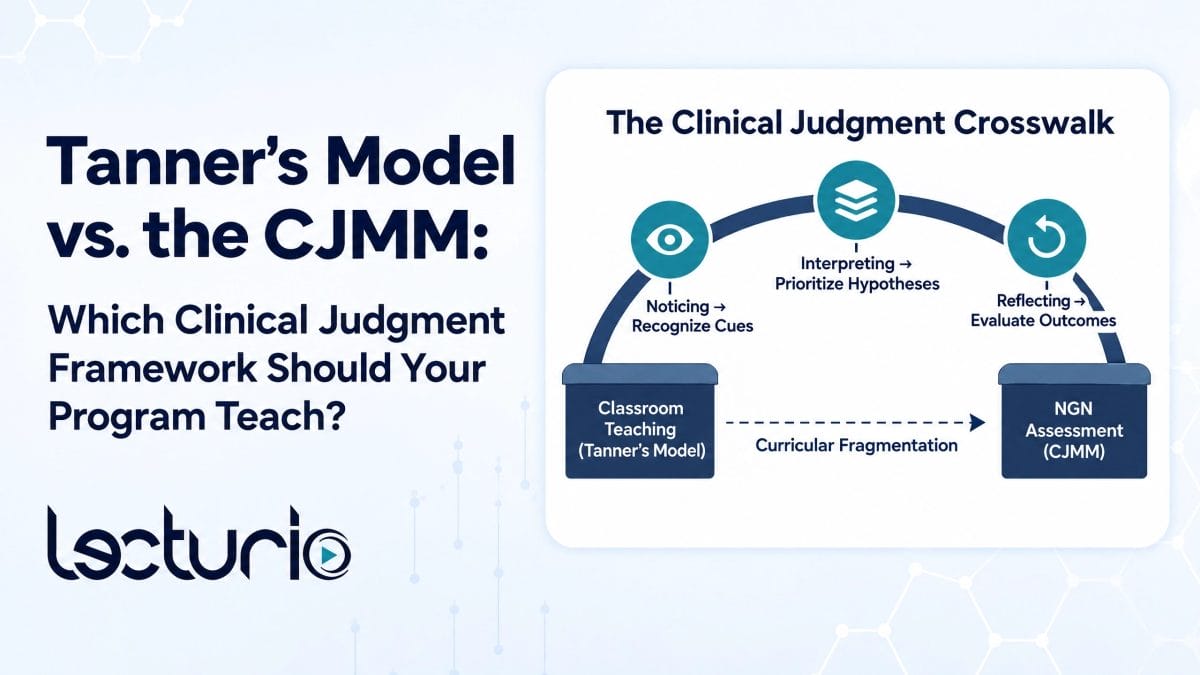
At a glance: Tanner’s Clinical Judgment Model and the NCSBN Clinical Judgment Measurement Model (CJMM) serve different but overlapping purposes. Tanner offers a practice-grounded framework that is widely used for teaching, reflection, and simulation debriefing, while the CJMM was developed to support measurement of clinical judgment within the Next Generation NCLEX. Programs do not necessarily need to choose between them; the priority is creating coherent language across teaching, assessment, and licensure preparation
Nursing faculty are navigating a real tension right now. The Next Generation NCLEX transition pushed the CJMM into every curriculum conversation, but Tanner’s Model didn’t disappear when it did. In a national survey cited here, Tanner’s model was the most commonly reported framework among programs that were already using a named clinical judgement model.The question faculty are actually asking isn’t “which model is correct.” It’s “which one do I teach with day to day, and which one do I need for exam alignment.” Those turn out to be different questions with different answers, and conflating them is where most of the curriculum confusion actually comes from.
This matters for reasons beyond tidiness. A program that quietly drops its established teaching language in favor of unfamiliar assessment vocabulary risks disorienting both faculty and students mid-curriculum, while a program that never introduces CJMM structure risks leaving graduates unprepared for the format of the exam they’ll actually sit. Getting the sequencing right, teaching model first, assessment vocabulary layered in deliberately, is a curriculum design decision with real consequences for NGN readiness.
This piece walks through what each model actually measures, the one distinction that resolves most of the confusion between them, what programs are actually doing according to the national data, and a practical crosswalk for using both without duplicating your curriculum.
Two Models, Built for Two Different Jobs
Tanner’s Model dates to 2006, four phases, Noticing, Interpreting, Responding, Reflecting, synthesized from nearly 200 studies on how nurses actually think in practice (Tanner, 2006). Noticing is about perceiving the situation, picking up on a patient’s changed breathing pattern or a subtle shift in affect before it becomes an obvious problem. Interpreting is where a nurse makes sense of what was noticed, drawing on prior experience and clinical knowledge to form a working understanding. Responding is the decision about what to do, and reflecting is what happens afterward, in the moment and later, when a nurse reconsiders whether the response actually worked. Tanner’s model emerged from research examining how nurses make clinical judgments in practice and has subsequently become widely used in nursing education for teaching, reflection, simulation, and debriefing. The Lasater Clinical Judgment Rubric, developed from Tanner’s framework, further supported its use for formative assessment and clinical judgment development
The CJMM works differently. Its six cognitive functions, Recognize Cues, Analyze Cues, Prioritize Hypotheses, Generate Solutions, Take Actions, Evaluate Outcomes, sit within a larger layered model that also accounts for contextual factors like the clinical environment and the individual nurse’s background. NCSBN will use the CJMM to measure clinical judgment and score candidate responses on the Next Generation NCLEX (Jessee et al., 2023). The model itself is grounded in established decision-making theory, a multidisciplinary comparative analysis found the CJMM aligns with both the Information-Processing Model and the Intuitive-Humanistic Model of clinical decision-making (Dickison, Haerling, & Lasater, 2019). If you want the full breakdown of the six cognitive functions of the CJMM, Lecturio has already covered that ground in depth, so we won’t re-derive it here.
Here’s the one sentence that resolves most of the “which one” confusion: the CJMM was developed primarily as a measurement model for clinical judgment within the NGN. Its six cognitive functions can provide useful language for teaching and feedback, but the model does not by itself prescribe how clinical judgment should be taught, scaffolded, or debriefed.
What Programs Are Actually Doing
The national data here is worth sitting with, because it cuts against a common assumption. A cross-sectional survey of prelicensure programs found only 27% were using a named clinical judgment model at all at the time, with another 51% intending to adopt one. Among the programs already using a model, Tanner’s Model was the most common, ahead of the clinical reasoning cycle (Jessee et al., 2023).
The survey predates full implementation of the NGN, so current patterns may have evolved. What the findings do show is that many programs had already invested in established clinical judgment frameworks, particularly Tanner’s Model. NGN alignment therefore does not automatically require abandoning familiar pedagogical language; programs can instead examine how existing frameworks align with the reasoning processes represented in the CJMM
The low overall adoption rate, just over a quarter of programs using any named model, is itself worth noting. It suggests a fair amount of clinical judgment instruction is still happening informally, without a shared framework connecting classroom teaching, simulation debriefs, and clinical evaluation. That’s the gap a deliberate choice of framework, whichever one a program lands on, is meant to close.
A companion national survey gives a fuller picture of how programs are operationalizing clinical judgment instruction day to day: programs report using multiple strategies to teach clinical judgment, with case studies and simulation the most common, and participants believed these strategies positively affect student thinking and practice readiness (Nielsen, Gonzalez, Jessee, Monagle, Dickison, & Lasater, 2023).
A Practical Crosswalk
For faculty trying to reconcile a classroom-taught model with an exam-scored one, a crosswalk helps:
| Tanner’s Model | Related CJMM function(s) |
| Noticing | Recognize Cues |
| Interpreting | Analyze Cues, Prioritize Hypotheses |
| Responding | Generate Solutions, Take Actions |
| Reflecting | Evaluate Outcomes |
Worth being honest about what this table is and isn’t. It’s a reasonable teaching bridge, not an official NCSBN equivalence chart. The two models weren’t designed as parallel constructs, and forcing a strict one-to-one mapping in either direction will occasionally feel forced, Interpreting, for instance, covers real cognitive ground that the CJMM splits across two separate functions, and that split isn’t arbitrary, it reflects a deliberate choice to make hypothesis prioritization independently measurable. The real value of the crosswalk isn’t precision, it’s giving faculty and students shared vocabulary that spans a classroom-taught model and an exam-scored one, so a student walking into an NGN-style item doesn’t have to relearn from scratch a reasoning process they’ve already practiced under different names.
Why This Isn’t Actually an Either/Or Decision
The practical recommendation follows directly from what each model was built for. The practical implication is not that every program should teach Tanner first and introduce the CJMM only near graduation. Rather, programs should choose a coherent primary language for teaching clinical judgment and make the relationship with the CJMM explicit across the curriculum.
A program already using Tanner’s Model, for example, may continue using Noticing, Interpreting, Responding, and Reflecting to structure simulation and debriefing while periodically connecting those processes with CJMM functions such as Recognize Cues, Prioritize Hypotheses, and Evaluate Outcomes. This helps learners understand that the frameworks describe related aspects of clinical judgment without treating them as interchangeable.
In an early med-surg simulation, faculty might structure debriefing around what learners noticed, how they interpreted the situation, why they responded as they did, and what they would reconsider. As learners progress, faculty can explicitly connect those same reasoning processes with relevant CJMM functions. The goal is not to teach two separate reasoning systems, but to help learners move comfortably between pedagogical and assessment language.
A recent Lecturio educator session, Teaching Clinical Reasoning: Moving Beyond Textbook Competency, used Tanner’s four phases to structure discussion of clinical judgment and demonstrated how virtual patient encounters in Healer can provide learners with repeated opportunities to gather information, interpret findings, make decisions, and reflect on their reasoning in a low-stakes environment. For an institution already teaching with Tanner’s Model, that’s a concrete signal that clinical judgment tooling doesn’t assume CJMM vocabulary as a starting point.
The curricular risk is inconsistency rather than choosing the “wrong” model. Programs that introduce CJMM terminology without connecting it to existing teaching approaches may create unnecessary cognitive and curricular fragmentation. Programs that never familiarize learners with CJMM processes and NGN item structures may leave them less prepared to recognize how clinical judgment is represented on licensure assessment. Clear alignment between teaching, practice, and assessment language can avoid both problems.
One honest caveat worth naming: current evidence on model use doesn’t yet tell us whether using one model, both, or neither produces measurably better clinical judgment outcomes. That’s flagged as an open research question in the underlying survey literature itself, not something this piece can resolve. Treat the recommendation above as informed pragmatism grounded in what programs are actually doing, not as a settled research finding.
Tanner’s Model vs. the CJMM at a Glance
| Dimension | Tanner’s Clinical Judgment Model | NCSBN CJMM |
| Origin | Research-based model of clinical judgment in nursing practice | NCSBN model developed to support measurement of clinical judgment |
| Primary educational contribution | Supports teaching, reflection, debriefing, and discussion of clinical judgment | Provides structured language for observable clinical judgment functions and NGN assessment |
| Structure | Noticing, Interpreting, Responding, Reflecting | Recognize Cues, Analyze Cues, Prioritize Hypotheses, Generate Solutions, Take Actions, Evaluate Outcomes |
| Related assessment approach | Lasater Clinical Judgment Rubric developed from Tanner’s framework | Integrated into NGN item development and measurement |
| Curriculum use | Can provide a coherent pedagogical framework across classroom, simulation, and clinical learning | Can be integrated into teaching and assessment to support alignment with NGN clinical judgment processes |
| Key caution | Should not be assumed to map perfectly onto NGN measurement language | Should not be treated as a complete pedagogy for teaching clinical judgment |
Programs do not need to choose a winner between Tanner’s Model and the CJMM. They need a coherent approach to clinical judgment that connects how learners are taught, coached, assessed, and prepared for licensure. Tanner’s framework and the CJMM can contribute differently to that goal, provided faculty make the relationship between them explicit rather than treating them as competing or interchangeable models. Ready to see what a clinical judgment curriculum grounded in both frameworks looks like for your program? Schedule a Demo with the Lecturio team today.
Frequently Asked Questions
Do nursing programs have to switch from Tanner’s Model to the CJMM for NGN?
No. NGN alignment does not require programs to abandon Tanner’s Model. Tanner can remain a useful framework for teaching, reflection, and simulation, while faculty also make the CJMM’s clinical judgment functions explicit so learners understand how related reasoning processes are represented in NGN assessment.
What’s the actual difference between Tanner’s Model and the CJMM?
Tanner’s Model describes clinical judgment through four practice-grounded phases—Noticing, Interpreting, Responding, and Reflecting—and is widely used for teaching and debriefing. The CJMM organizes clinical judgment into six cognitive functions developed for measurement within the NGN. They overlap conceptually, but they were developed for different primary purposes and should not be treated as interchangeable.
Which clinical judgment model do most nursing programs currently use?
Among programs using a named model, Tanner’s Model is the most common, according to the most recent national survey, ahead of the clinical reasoning cycle. Adoption of a model at all remains limited, with a majority of programs surveyed still not using one.
Can Tanner’s Model and the CJMM be taught together in the same curriculum?
Yes. Programs can use Tanner’s Model as an educational framework while making explicit connections to the CJMM functions used in NGN assessment. The important principle is coherence: learners should understand how the language used in teaching relates to the reasoning processes they encounter in assessment.
Is the CJMM meant to replace the nursing process?
No. The CJMM was developed as a measurement model for NGN scoring, not a replacement for existing teaching frameworks like the nursing process or Tanner’s Model. Programs are not required to discard prior frameworks to align with it.