

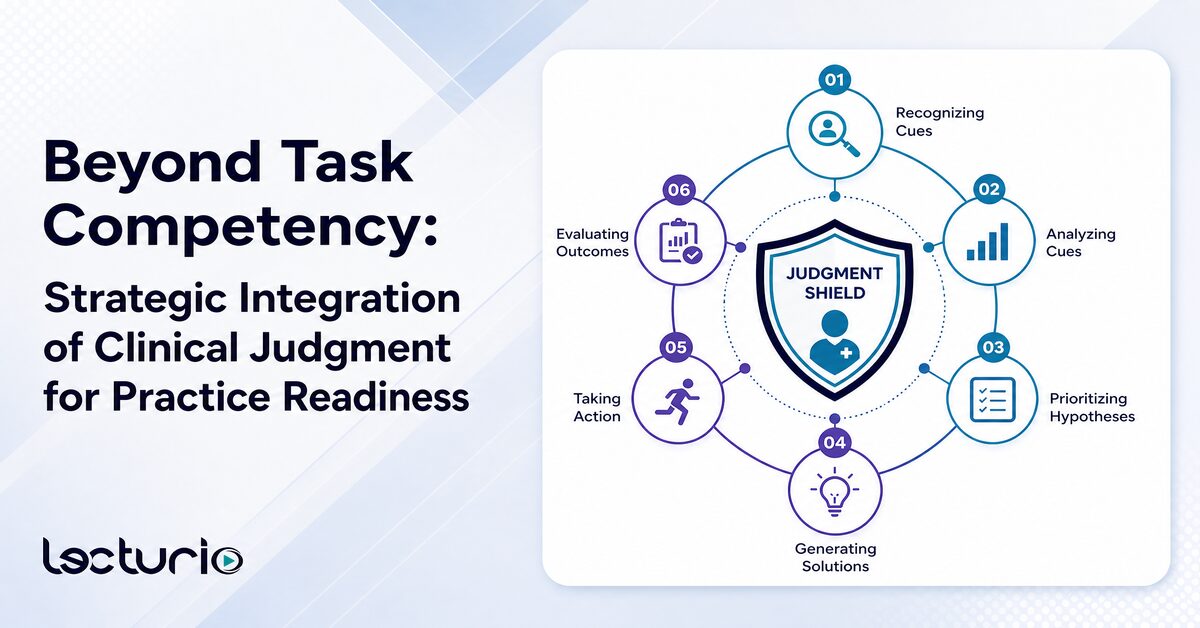
At a glance: Nursing clinical judgment is a reflective and reasoning process that draws upon comprehensive data and an extensive knowledge base to form clinical conclusions. It is the fundamental competency by which nurses recognize patient cues, weigh hypotheses, and evaluate outcomes to ensure safe, person-centered care.
The Crisis in Practice Readiness
Faculty must address the alarming reality that less than 10% of newly graduated nurses demonstrate the baseline clinical judgment required for independent, safe professional practice. The scale of this challenge is significant. Research by Kavanagh and Sharpnack (2021) found that 65% of new graduate nurses fail to recognize and respond to patient clinical deterioration, and that poor clinical judgment underlies approximately 50% of medication errors. These findings point to clinical judgment deficits as a primary driver of preventable adverse outcomes. Establishing a standardized judgment framework is now the benchmark for accurate and timely nursing decisions. Addressing this gap early is central to broader nursing student retention and remediation strategy.
While many graduates can perform isolated psychomotor tasks, they often struggle to apply the “why” behind abnormal assessment findings. Developing this deeper clinical judgment ultimately requires repeated application in authentic practice settings, relying heavily on immersive clinical placements, consistent supervision, and structured reflective feedback. Without this experiential support to bridge the gap, students quickly become task-oriented rather than critically identifying patient deterioration. To improve safety and meet institutional standards, curriculum shifts must focus on bridging the divide between theory and clinical application.
Decoding the 6 Cognitive Functions
The Clinical Judgment Measurement Model (CJMM) serves as the primary framework for isolating measurable decision-making traits across nursing education. By utilizing Layer 3 of the model, programs can assess six specific cognitive aspects that lead to sound clinical decisions: recognizing cues, analyzing cues, prioritizing hypotheses, generating solutions, taking actions, and evaluating outcomes.
To ease faculty implementation, Sessions (2026) describes a simulation-based teaching approach that connects CJMM cognitive functions to familiar nursing process stages, providing a practical entry point for faculty implementation:
- Assessment becomes Recognizing Cues.
- Analysis evolves into Analyzing Cues and Prioritizing Hypotheses.
- Planning becomes Generating Solutions.
- Implementation is redefined as Taking Action.
- Evaluation remains Evaluating Outcomes.
Overcoming “Curriculum Debt” and Faculty Training Gaps
Nursing institutions can recover significant faculty time by shifting from information delivery to questioning understanding, a key transition for clinical experts moving toward educational mastery. While faculty are experts in practice, many identify as “novices” when teaching the specific cognitive processes of judgment. This challenge typically arises because expert clinicians have limited formal preparation in making their own implicit reasoning processes explicit for learners. To ease this transition, institutions must prioritize targeted faculty development strategies, such as training in cognitive apprenticeship modeling, structured socratic questioning, and active-learning facilitation. Without these instructional tools, this gap often leads to a heavy reliance on traditional lecture methods that do not support active student reasoning.
Lecturio provides the infrastructure to bridge this instructional gap through pre-made, evidence-based repositories and unfolding case studies. By providing these resources, institutions can facilitate high-quality simulation and active learning without overwhelming faculty workload. This ensures the standardized model is taught consistently across every campus and semester.
Practice Readiness Comparison
| Metric | Current Nursing State | Optimized Judgment State |
| Instructional Priority | Task-oriented performance and psychomotor imitation. | Cognitive process and evidence-based reasoning mastery. |
| Faculty Workload | High remediation burdens for students struggling with clinical cues. | Enhanced self-efficacy via digital clinical judgment guides. |
| Institutional Impact | Associated with elevated error risks and prolonged practice-readiness gaps. | Framework designed to mitigate error risks while supporting retention and professional identity. |
Alignment with 2026 AACN Essentials
Integrating clinical judgment is foundational, as it is a Featured Concept in the 2026 AACN Essentials that must be interwoven across all ten domains of competence. This standard specifically mandates that programs demonstrate clinical judgment founded on a broad knowledge base under Domain 1.3.
The 2026 Essentials’ emphasis on ‘Connection’—linking theoretical knowledge to real-world clinical practice—reinforces the need for resources that bridge didactic learning and clinical application. This creates vital links between theoretical knowledge and real-world care, ensuring that graduates do not just “know” the science of nursing, but can “do” the work of a professional nurse with precision.
Don’t map your curriculum in a silo. Our team provides a personalized Implementation Plan to map your program to the standardized clinical judgment model. Schedule a Demo with the Lecturio team today.
Frequently Asked Questions
How does the CJMM improve student practice readiness?
The CJMM moves students beyond rote memorization by requiring the active analysis of patient cues and prioritization of actions. This cognitive practice mirrors real-world clinical demands, ensuring students can perform safely in complex healthcare settings.
Why is clinical judgment a “Featured Concept” in the 2026 Essentials?
The AACN identifies clinical judgment as a key attribute of professional nursing that directly impacts care outcomes. Because it is required in every practice situation, it must be integrated throughout the entire educational trajectory.
How can faculty overcome the challenges of teaching clinical judgment?
Faculty can improve self-efficacy by utilizing standardized clinical judgment guides and digital repositories that automate case study creation. Transitioning to a facilitator role focuses on questioning student logic rather than simple content delivery.