

At a glance: Deskilling describes the erosion of previously developed knowledge or skills when tasks are repeatedly delegated to technology. In nursing, concerns include over-reliance on AI for assessment, documentation, interpretation, or clinical reasoning. The emerging evidence warrants attention, although nursing-specific research remains limited. Education, deliberate skill maintenance, appropriate human oversight, and organizational governance can help reduce this risk while allowing nurses to benefit from useful AI-supported workflows.
“Will AI replace nurses?” is an understandable question, but it may not be the most useful one. A more immediate concern is how AI will reshape nursing work, and whether clinicians and organizations can adopt useful technologies without weakening the knowledge, relationships, and professional judgment on which safe nursing practice depends.
Dr. Clipper is well positioned to make that case. A nurse futurist with more than 20 years of experience as a chief nurse executive, founder of Innovation Advantage, and a former Vice President of Innovation at the American Nurses Association, she joined a recent Lecturio global webinar for a session titled “The Deskilling Debate.”
This piece walks through her framework: what AI is genuinely doing well in nursing practice today, what deskilling actually looks like and why it’s a measurable risk rather than a hypothetical one, and the workforce-preparation and governance structures that let organizations adopt AI without losing the skill underneath it.
What AI Actually Does (and Doesn’t Do) in Nursing Practice
Dr. Clipper’s own definition is a useful level-set: AI simulates aspects of human intelligence through pattern recognition and prediction. AI systems identify patterns, generate predictions, classify information, or produce recommendations based on data and the way the system has been designed. These outputs may inform clinical decisions, but they do not possess professional judgment, contextual understanding, or accountability in the way a licensed clinician does. Right now, it’s a supplement to nursing and medical decisions, not a replacement for them.
That distinction matters beyond semantics. It’s also the basis for the accountability discussion later in this piece: a tool that supports a decision and a tool that makes one carry very different implications for who’s responsible when something goes wrong. AI has already been part of daily life for over a decade. What changes in healthcare is not simply the presence of AI, but the consequence of error. When algorithmic outputs influence assessment, escalation, medication decisions, or prioritization of care, validation, oversight, transparency, and accountability become patient-safety issues.
Where AI Is Genuinely Helping, With Evidence
Several of the benefits Dr. Clipper names have real evidence behind them, not just plausible-sounding claims.
The evidence is promising across several applications, but “AI” is not a single intervention. Effects depend on the specific tool, clinical setting, implementation, underlying data, workflow integration, and actions clinicians take in response to an output.
Reducing cognitive overload and alarm burden. Filtering and prioritizing the volume of alarms, notifications, and calls nurses face daily is a genuine, named benefit of AI in clinical settings, freeing attention for the alerts that actually require action.
Reducing errors through faster, deeper record review. Supporting record review and medication safety. AI-enabled clinical decision-support tools can help clinicians synthesize large volumes of information and identify potential contraindications, interactions, or other findings requiring review. These tools can reduce information-search burden, but clinically significant alerts still require professional interpretation
Deterioration prediction and risk mitigation. AI-supported early-warning systems have shown promising effects in some clinical settings. A 2025 meta-analysis reported improved patient outcomes, including reductions in in-hospital and 30-day mortality, across the studies evaluated (Yuan et al., 2025). Importantly, predictive models do not improve outcomes by prediction alone; benefit depends on how reliably alerts lead to appropriate clinical assessment and action
Sepsis detection. AI-based predictive models drawing on vitals, labs, and unstructured clinical notes, which Dr. Clipper notes increasingly includes nurses’ own documentation, have shown meaningful value for early sepsis detection across a systematic review of the evidence (Abbas, Sen, Giri, & Khan, 2025).
Imaging and pathology. AI-supported mammography screening is a concrete, well-studied example: a large randomized trial found significantly higher cancer detection rates with AI support, without any increase in false positives (Hernström, Josefsson, Sartor, et al., 2025).
Ambient documentation. Reducing time spent writing notes has been linked to measurably lower burnout in a large multicenter study (Olson, Meeker, Troup, et al., 2025). Worth noting directly: that study’s population was physicians and advanced practice providers, not RNs specifically. Nursing-specific ambient documentation adoption is newer and less studied, so treat this as a directionally relevant signal rather than nursing-specific proof.
None of this requires believing AI will replace nursing judgment. It requires recognizing exactly where AI’s speed and pattern recognition genuinely reduce burden, which is also exactly where the deskilling risk enters if it’s adopted without guardrails.
What Deskilling Actually Looks Like, and Why It’s Measurable
Deskilling describes deterioration in a capability that was previously developed, potentially because repeated reliance on automation reduces opportunities to practise that capability independently. The concern is particularly relevant to clinical skills that must remain available when technology fails, produces an uncertain result, or does not fit the clinical context.
Dr. Clipper defines deskilling plainly: becoming so dependent on something that the underlying skill is lost. Her analogy is longhand math. Generations of students learned addition, multiplication, and geometry by hand first, not because calculators didn’t exist, but so that later, using a calculator, they’d still understand where the answer came from. Applied to nursing, the same logic holds for assessment, documentation, and care coordination: nurses need to know how to do these things “long-handed” even as AI tools increasingly do them faster.
Dr. Clipper described seeing this during EHR downtime, when clinicians accustomed to electronic workflows found it harder to reconstruct and document a coherent patient picture using paper processes. Her example illustrates the practical question behind deskilling: what capabilities must remain available when the supporting technology is removed?
Direct nursing evidence remains limited, but evidence from other clinical disciplines gives the concern plausibility. Budzyń et al. (2025) found that endoscopists regularly exposed to AI-assisted colonoscopy experienced a decline in adenoma detection when AI support was removed. The finding should not be generalized directly to nursing skills, but it provides an important cross-disciplinary signal that sustained automation can alter independent human performance
It’s worth distinguishing this from a related but different concept Lecturio has covered elsewhere: never-skilling, the risk that trainees who use AI before building foundational reasoning skills may fail to develop them at all. Deskilling concerns loss of an established capability; never-skilling concerns failure to develop that capability independently in the first place. For health professions education, the distinction matters because learners may require protected opportunities to build and demonstrate foundational competence before AI assistance is introduced.
Accountability, License, and the Human in the Loop
A direct question from the webinar audience gets at the heart of this: should nurses be concerned about AI involvement, especially around human-in-the-loop versus human-out-of-the-loop design? Dr. Clipper’s answer was unambiguous: humans absolutely have to remain in the loop. Nurses and physicians are not absolved of responsibility because an AI made a recommendation. Clinicians remain professionally responsible for the decisions and actions within their scope of practice, including how they interpret and respond to AI-supported recommendations. At the same time, responsibility for AI-related harm may also involve organizations, technology developers, implementation policies, and regulatory frameworks. This makes clear governance and escalation pathways essential rather than placing the entire burden on an individual nurse
That accountability needs a practical mechanism, and Dr. Clipper points out that every credible AI product she’s evaluated includes one: the ability to say the tool’s answer is wrong and do something different instead, paired with documentation that justifies the decision. Clinicians should be able to question or override algorithmic recommendations when professional judgment indicates that another action is appropriate. Organizations should also make escalation pathways clear and ensure that clinicians can document the reasoning behind consequential decisions without creating excessive administrative burden. Override capability alone, however, does not make a system safe; organizations still need validation, monitoring, incident review, and clear responsibility for responding when the technology performs poorly.
Her broader philosophy for getting there: “go slow now to go faster later.” Vet tools deliberately. Test them against a real problem they’re meant to solve, rather than adopting because of an expo demo. Bring frontline nurses into the evaluation process, have them attend demos, ask questions, do reference checks with organizations already using the product, before any wider rollout. Pilot evaluation should include patient-safety outcomes, workflow effects, usability, equity, unintended consequences, and impact on professional practice, and not simply whether users like the technology.
This lines up closely with the emerging nursing-specific literature on the same tension. A 2025 integrative review of automation in nursing practice found real benefits (reduced physical and cognitive workload) alongside real risks, deskilling, dehumanization of care, and unclear legal accountability, and recommended human-in-the-loop design and ongoing outcome monitoring as the safeguards that make automation trustworthy rather than merely convenient (Pepito, Acaso, Merioles, & Ismael, 2025).
Organizational Governance, From the CNO Seat to the Frontline
Dr. Clipper describes a governance structure that’s increasingly common among organizations she considers successful: an AI governance committee at the top organizational level, with the Chief Nursing Officer holding a seat at that table, alongside shared-governance AI councils where frontline staff have a real voice in what gets adopted and how. This is a different governance layer than a faculty-in-the-loop governance model built for curriculum and assessment, but the underlying principle, deliberate oversight paired with genuine practitioner input, is the same one applied to a clinical rather than academic context.
Professional nursing organizations are increasingly engaging with AI literacy, informatics, governance, and workforce preparation, reflecting the growing importance of these issues across nursing practice and education.
Preparing the Workforce, Both Ends of the Pipeline
Workforce preparation needs to begin in pre-licensure education and continue throughout professional practice. Nursing students need opportunities to develop foundational assessment, communication, clinical reasoning, and documentation skills while also learning how AI may influence those tasks. Practising nurses need continuing professional development that allows them to evaluate new tools, understand their limitations, recognize inappropriate outputs, and maintain competence when technology is unavailable
Rather than building competencies around individual platforms that may quickly become obsolete, nursing programs can embed durable AI capabilities within existing professional competencies. Learners still need to understand when AI is appropriate, how to interrogate an output, recognize uncertainty or bias, verify important information, protect patient data, and know when professional judgment should override or escalate beyond the tool.
Faculty do not need to become AI engineers, but they need sufficient AI literacy to explain what a tool is designed to do, what kinds of information it uses, where it can fail, how its outputs should be interpreted, and when learners should question or verify a recommendation. That’s a meaningful standard for AI literacy in nursing education, and it connects to the broader project of building foundational clinical reasoning before AI reliance on the pre-licensure side, preparation that has to happen before a nurse ever reaches a unit where AI is already part of the workflow.
Designing Education That Protects Independent Clinical Capability
Preventing deskilling is not simply a matter of telling learners to “think for themselves.” Educational programs need to create deliberate opportunities for nurses to develop and periodically demonstrate important capabilities without AI assistance.
Depending on the competency, this may include unaided assessment exercises, clinical reasoning before algorithmic recommendations are revealed, downtime simulations, independent documentation practice, structured comparison of human and AI recommendations, and debriefing cases in which the algorithm is incomplete or wrong.
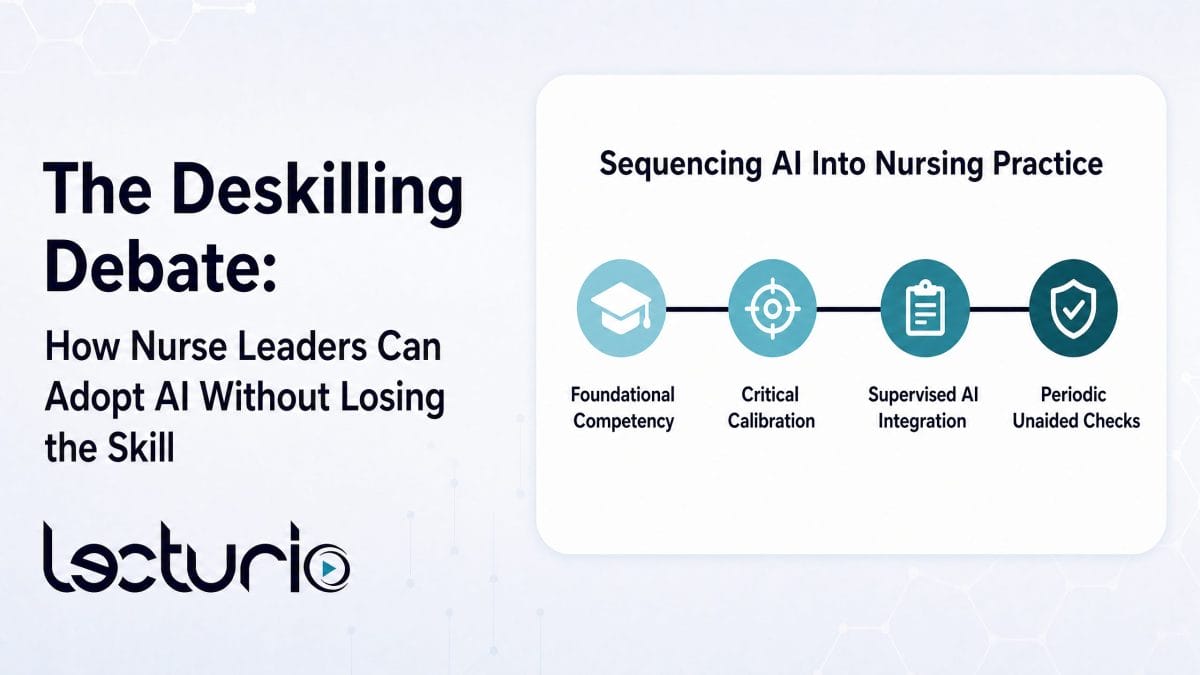
The educational principle is not to keep AI out of training. It is to sequence its introduction deliberately: build foundational capability, practise critical comparison and calibration, and then integrate AI into authentic clinical workflows while maintaining opportunities to demonstrate independent competence.
From Ungoverned Adoption to Deskilling-Aware Governance
| Dimension | Higher-risk implementation | Deskilling-aware approach |
| Competency development | Training focused mainly on how to operate a specific tool | Durable AI literacy integrated with assessment, communication, reasoning, documentation, ethics, and patient safety |
| Tool evaluation | Adoption driven primarily by demonstrations or vendor claims | Evaluation against a defined clinical need with frontline user involvement and local testing |
| Independent capability | AI available before foundational skills are established or routinely demonstrated | Foundational competence developed first, with periodic opportunities for unaided performance |
| Override and escalation | Clinicians are expected to follow outputs or improvise when they disagree | Clear processes for questioning, overriding, escalating, and documenting consequential recommendations |
| Accountability | Responsibility for errors or decisions is unclear | Professional, organizational, vendor, and regulatory responsibilities are explicitly defined |
| Governance | Adoption led by a single department or professional group | Multidisciplinary governance with nursing leadership and meaningful frontline representation |
| Workforce preparation | One-time training at implementation | Longitudinal preparation across pre-licensure education, transition to practice, and continuing professional development |
| Monitoring | Success measured primarily through adoption or efficiency | Ongoing evaluation of safety, workload, equity, skill maintenance, and unintended consequences |
Nursing does not need to choose between technological innovation and professional expertise. The challenge is to adopt AI in ways that reduce unnecessary burden and extend clinical capability without weakening the foundational skills, judgment, relationships, and accountability that define nursing practice.
For educators, that means preparing learners to work both with AI and without it: developing competence first, learning to evaluate and calibrate algorithmic support, and retaining the ability to recognize when technology is wrong, unavailable, or inappropriate.
Ready to see what deskilling-aware AI adoption looks like for your own nursing or medical program? Schedule a Demo with the Lecturio team today.
Frequently Asked Questions
Is AI going to replace nurses?
AI is already changing individual nursing tasks, but nursing practice involves clinical judgment, coordination, communication, advocacy, relational care, and accountability that cannot be reduced to a single automated function. The more useful question for nursing leaders is therefore how roles and workflows will change, and how education and governance should prepare nurses for that change.
What does deskilling actually look like in a clinical setting?
Deskilling may become visible when clinicians have difficulty performing a previously established task without technological support—for example, synthesizing information, documenting, or making an assessment when an automated system is unavailable. The concern is gradual loss of independent capability through repeated reliance rather than failure caused by a single use of AI.
Who is accountable when an AI recommendation leads to patient harm?
Licensed clinicians retain professional responsibility for decisions and actions within their scope of practice, including how they respond to AI-supported recommendations. However, legal and organizational accountability for AI-related harm may also involve employers, vendors, manufacturers, governance processes, and applicable regulation. Institutions therefore need explicit policies defining responsibility, escalation, documentation, and incident review.
What AI capabilities should nursing schools teach?
Nursing programs should avoid curricula built around a single platform that may quickly become outdated. Instead, AI literacy can be integrated into existing professional competencies: understanding appropriate use, recognizing limitations and uncertainty, evaluating outputs critically, identifying potential bias, protecting privacy, and knowing when clinical judgment or escalation should take precedence.
What should an organization’s AI governance structure include?
AI governance should include nursing leadership and meaningful frontline nursing participation alongside expertise in clinical practice, informatics, education, patient safety, data governance, ethics, legal issues, and technology. Governance should cover tool selection, validation, privacy, workflow integration, training, monitoring, incident reporting, equity, and ongoing review after implementation.