
At a glance: Case-based learning (CBL) uses clinical cases to engage learners in applying knowledge, reasoning through problems, and discussing decisions, usually with facilitator guidance. Recent meta-analyses report favorable outcomes compared with lectures, but certainty is very low and findings vary substantially across studies. The strongest case for CBL therefore rests not on the label itself, but on thoughtful case design, meaningful learner participation, skilled facilitation, and alignment with the intended learning outcomes.
Does Case-Based Learning Deserve Its Own Evidence Case?
Curriculum committees that have already piloted one alternative to lecture, such as simulation, tend to ask a fair question when a second is proposed: what does this one add? For case-based learning (CBL), the honest answer is that it has an evidence base of its own, mostly favorable, and considerably weaker than the headlines suggest.
The foundational review set the tone. A systematic review in the Best Evidence Medical Education (BEME) series coded 104 papers and rated only 23 of them (22%) as higher quality (Thistlethwaite et al., 2012). It concluded that students overwhelmingly enjoy CBL and think it helps their learning, while the data as a whole were inconclusive about its effect on learning compared with other activities.
More recent meta-analyses report much larger gains over lecture, but they carry their own warnings, including ratings of very low certainty. This post covers what CBL is, what the research shows, why the certainty is low, what makes CBL work, and how to pilot it without adding a second round of unmeasured change.
What Case-Based Learning Is, and How It Differs from Problem-Based Learning
CBL and PBL both use clinical problems to stimulate inquiry, but they differ in the degree and timing of structure. CBL typically works toward predefined learning objectives with greater facilitator guidance and information supplied as the case unfolds. In PBL, learners generally take greater responsibility for identifying learning needs and directing subsequent inquiry. In practice, both approaches vary considerably in how much scaffolding and facilitation they provide.
Before we outline the differences of CBL and PBL, let’s define them first. A review of 70 articles defines case-based learning by five ingredients: a clinical case, a question that makes students think, stated learning objectives, information supplied before and during the session, and a measured outcome (McLean, 2016). The BEME review treats it as inquiry-based learning on a continuum from structured to guided approaches and found no international consensus on a single definition (Thistlethwaite et al., 2012).
The closest relative is problem-based learning (PBL), and the difference is structure. CBL gives small groups a guided path with more scaffolding, while PBL leaves inquiry open (Srinivasan et al., 2007). In PBL, learners largely generate their own objectives, which makes it harder for faculty to steer what is learned (McLean, 2016). After a curricular shift at two medical centers, 286 students and 31 faculty overwhelmingly preferred CBL, and only 11% of students preferred PBL (Srinivasan et al., 2007), though that study measured preferences, not learning.
Harvard Medical School’s case-based collaborative learning, which draws on team-based learning principles, is a concrete example. Students complete a pre-class readiness process, commit to individual answers to focused, open-ended questions about a case, compare them in groups of 4 before building consensus in groups of 16 (Krupat et al., 2016).
CBL is delivered in several formats: 49% of studies used live presentation, 20% computer or web delivery, and 19% mixed modalities (McLean, 2016). It is distinct from simulation, with a separate evidence base and few direct comparisons. A 2025 systematic review found only two studies comparing CBL with simulation-based learning, one in pharmacy and one in nursing, with a small, imprecise pooled difference in knowledge (SMD 0.19, 95% CI -0.08 to 0.46), and the one study that reported satisfaction found it higher with simulation (Varma et al., 2025). Read plainly, that is no clear difference, and it says little about medical students. Our simulation article covers that evidence.
What the Research Shows
The syntheses run from cautious to enthusiastic, with a recurring pattern: some studies report sizable gains compared with lecture, while direct comparisons with other active approaches are fewer and generally provide less evidence of a clear advantage. Confidence in the overall literature remains low.. Several include other professions: only 12 of the 22 studies in the 2025 review were in medicine, with the rest in dentistry, nursing, and pharmacy (Varma et al., 2025).
The largest medical-student synthesis found CBL outperformed other methods on exam scores (SMD 2.37, 95% CI 1.25 to 3.49) and on interest and motivation (SMD 0.79, 95% CI 0.13 to 1.44), while four other outcomes did not differ significantly (Maia et al., 2023), but rated the certainty of every outcome very low. An effect of 2.37 standard deviations is far larger than most educational interventions produce, which in our reading, not the authors’, points to heterogeneity, small studies, and bias more than a true effect of that size.
A 2025 review of 22 studies, nine of them randomized, found critical thinking scores were higher with CBL (SMD 0.75, 95% CI 0.21 to 1.29, from four pooled studies), as was satisfaction (SMD 0.50, 95% CI 0.11 to 0.88, from three) (Varma et al., 2025). On knowledge, its text and numbers disagree: it calls the result “no significant difference,” yet the pooled estimate from eight studies (SMD 0.41, 95% CI 0.20 to 0.62, I-squared 65%) excludes zero. It also calls a teamwork estimate whose interval crosses zero (-0.19 to 0.66) a significant gain, so its labels err both ways. The narrative labels in the review do not always match the reported confidence intervals, so interpretation should rely on the numerical estimates and their uncertainty rather than the authors’ significance labels alone.
A 2024 network meta-analysis of 80 randomized trials (6,180 students) ranked six newer strategies against lecture: CBL had an SMD of 1.19 (95% CI 0.49 to 1.90) for theoretical test scores, problem-based learning 3.37 for practical scores, and simulation 2.64 for satisfaction (Zhang et al., 2024). The authors rated all 21 network comparisons very low certainty, reported heterogeneity of 87% to 98% across the three outcomes, and found only minor differences among the newer strategies. Only 13 of the trials measured satisfaction. For a committee already running simulation, that suggests effect size alone does not clearly favor a second method, so fit and capacity are the real questions.
Compared directly with another active format, the picture is less dramatic. In Harvard’s 2013 randomized trial, 64 student volunteers were assigned to problem-based learning or case-based collaborative learning in a first-year physiology course, and overall exam scores did not differ (Krupat et al., 2016). Students below the median on prior exams did better with the case-based format, and engagement was higher.
At whole-curriculum scale, Harvard’s Pathways curriculum bundled case-based pedagogy with early clinical exposure and changes to teaching and assessing clinical skills. In a prospective comparison of two cohorts of 135 students, the new cohort scored 62.4 versus 51.9 on the Educational Climate Inventory and was more satisfied with its preclerkship education (88% versus 73%), and mean scores on USMLE Step 1 and Step 2 were no different between the cohorts (Sullivan et al., 2022). Because the reforms were bundled, the cohorts were adjacent at one school, and the knowledge evidence reported in the abstract rests on USMLE scores, this cannot isolate the effect of cases.
Digital cases follow the same pattern. Virtual patients showed large effects against no intervention (knowledge 0.94, clinical reasoning 0.80) but essentially none against noncomputer instruction (knowledge 0.06, reasoning about zero) (Cook et al., 2010), and a later review of 51 trials found virtual patients matched traditional education on knowledge (SMD 0.11) and favored them on skills (SMD 0.90), with high heterogeneity (Kononowicz et al., 2019). Theory also provides a plausible mechanism for case-based learning: as expertise develops, biomedical and clinical knowledge become increasingly organized around meaningful clinical patterns and illness scripts (Schmidt & Rikers, 2007). Cases may therefore help learners connect foundational knowledge with patient problems and contextualize its application. This provides a theoretical rationale for CBL, not evidence that CBL is inherently superior to other approaches—a rationale, not proof.
Why the Certainty Is Low
Here is how to read any CBL claim a committee encounters.
- Methods. Of the 104 studies in the BEME review, 81 were of poor methodological quality and 86 focused on student reaction, as later summarized (Varma et al., 2025). The 2025 review itself found only nine randomized trials among its 22 studies.
- Ratings of the evidence. Two large reviews grade their own certainty. Maia et al. (2023) rated every outcome very low, and Zhang et al. (2024) rated all 21 network comparisons very low and noted possible publication bias.
- How CBL is evaluated. Surveys were the most common evaluation (36%), followed by tests (17%) and test plus survey (16%) (McLean, 2016).
- What is missing. Because most studies in the foundational review measured student reaction, evidence on long-term retention, performance in practice, and patient outcomes is thin (Varma et al., 2025), although McLean (2016) describes a few studies with patient-level results. It is also unclear whether benefits come from the cases or from small-group learning (Thistlethwaite et al., 2012).
- Selection and bundling. The Harvard trial used volunteers (Krupat et al., 2016), one BEME comparison had mandatory attendance at case sessions (Thistlethwaite et al., 2012), and program evaluations bundle several reforms (Sullivan et al., 2022).
What Makes Case-Based Learning Work in Practice
The best implementation evidence shifts the question from whether CBL works to under what conditions. A 2026 realist review of 25 studies of required case-based courses in undergraduate health professions programs, mostly in medicine (19 of 25) with the rest in nursing, dentistry, and interprofessional programs, found factors at the institutional, implementation, and student levels all shaped results, from exam performance to clinical reasoning, and when schools did not support faculty time or recognize faculty effort, outcomes were poorer and the learning environment sometimes turned hostile (Daly et al., 2026). Clinical facilitators and authentic multimodal cases promoted engagement. The authors caution that positive findings predominated in published studies, which may have hidden what goes wrong. Importantly, small-group participation is not automatically productive simply because it is active: learners also need a psychologically safe environment in which they can expose uncertainty, test reasoning, disagree, and make mistakes without humiliation.
Case quality is important as well. A review of 100 studies of case-based teaching synthesized 17 strategies around five attributes of a good case, which it called “relevant, realistic, engaging, challenging, and instructional” (Kim et al., 2006), offered as a framework to test, not proven causal evidence. One reviewed example shows how inadequate preparation hurt both faculty and students (McLean, 2016), and Harvard’s model builds a readiness process into its sessions (Krupat et al., 2016). Pre-class preparation is also where CBL meets the flipped classroom.
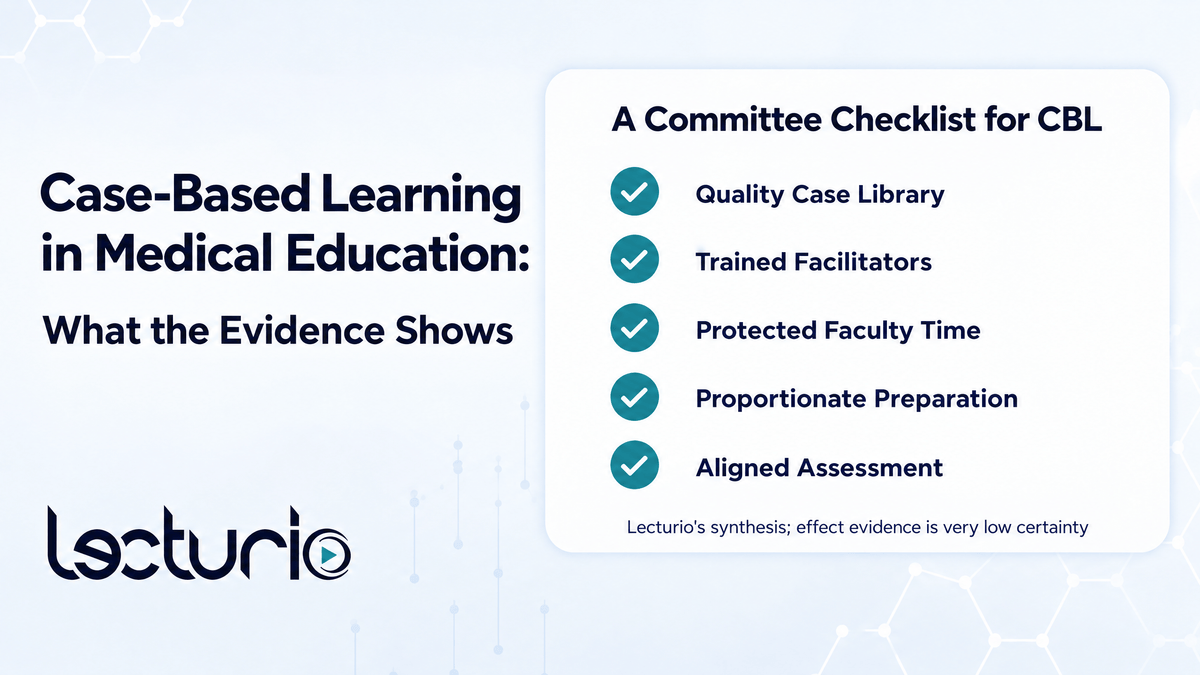
From this evidence we draw a checklist for committees. It is our synthesis, not a finding from the studies:
- A case library with quality criteria, such as the five attributes above
- Facilitators trained in small-group learning, with relevant clinical expertise where the case requires it
- Protected and recognized faculty time
- Purposeful, proportionate preparation that enables learners to engage with the case without unnecessarily increasing workload
- Assessment aligned to what the cases are meant to teach
Piloting Case-Based Learning Without Pilot Fatigue
This section is our advice, derived from the limits above, not a finding from the studies. It also fits accreditation. LCME Element 8.3 makes the faculty committee responsible for instructional and assessment methods suited to the program’s learning objectives, plus continuing review and revision of content (Liaison Committee on Medical Education [LCME], 2025), and Element 8.4 expects a school to collect and use a variety of outcome data to show that students are achieving program objectives and to improve the program (LCME, 2025). A well-designed pilot produces exactly that evidence.
- Measure beyond satisfaction, since most existing studies measure reaction.
- Pick a comparator that matches the real decision: lecture, PBL, or no change. Effects against no intervention are routinely large and against alternatives small, as the virtual patient reviews show.
- Use a meaningful comparison where feasible, such as baseline performance, a previous cohort, or a parallel teaching approach, and document important implementation factors such as facilitator numbers, training, learner participation, and case exposure.
- Align assessment with the intended learning outcomes. If cases are designed to develop clinical reasoning, application, communication, teamwork, or decision-making, assessment should capture those capabilities rather than relying predominantly on factual recall. Quantifying clinical reasoning shows one way to make it measurable.
- Decide in advance what result would lead you to scale, adjust, or stop, and sequence pilots so each can be judged on its own.
The Verdict
CBL is widely used and a well-liked method with favorable but low-certainty evidence. The case for it is not that it beats lecture by a large margin. The stronger argument is educational: well-designed cases can give learners structured opportunities to retrieve and apply knowledge, articulate reasoning, encounter different perspectives, and connect foundational concepts with clinical problems. Those benefits are not produced by the case alone. They depend on what learners are asked to do with it, how appropriately they are challenged and supported, how discussion is facilitated, and whether assessment reinforces the intended learning. For curriculum committees, the question is therefore not simply “Does CBL work?” but “What learning problem are we trying to solve, and is CBL a good design for solving it here?”
| Institutional question | Lecture-based course | Case-based course: what the evidence supports | Strength of evidence |
| Engagement and satisfaction | Baseline | Higher satisfaction (SMD 0.50, three studies), interest and motivation (SMD 0.79) | Mixed to very low |
| Exam performance | Baseline | Large gains reported; knowledge evidence inconsistent | Very low |
| Licensing exam scores | Baseline | No USMLE difference after a bundled Harvard reform | One school, two cohorts |
| Faculty workload | Lecture preparation | Requires faculty time and recognition (Daly et al., 2026), plus case development and facilitation; not quantified in any source we reviewed | Unmeasured |
| Long-term and patient outcomes | Not measured | Thin; a few studies report patient-level results | Largely unknown |
If you want to see how a digital case works, you can try a virtual patient case in Healer by Lecturio, which provides virtual patient encounters designed to support practice and assessment of clinical reasoning. The evidence in this piece covers case-based learning broadly, not any single product, so a hands-on case is a way to judge the format for yourself. Would you prefer a walkthrough? Schedule a Demo with the Lecturio team today.
Frequently Asked Questions
What is case-based learning in medical education?
A teaching method built around a clinical case, a question that makes students think, stated learning objectives, and a measured outcome (McLean, 2016), usually delivered in small groups with a facilitator (Daly et al., 2026).
How is case-based learning different from problem-based learning?
CBL gives small groups a guided path with more scaffolding, while PBL leaves inquiry open (Srinivasan et al., 2007). Most learners and faculty in a two-school comparison preferred the guided format, though it measured preferences, not learning.
Does case-based learning improve exam scores?
Some meta-analyses report large gains over lecture, but the certainty is very low in the two largest reviews (Maia et al., 2023; Zhang et al., 2024), and another review called its knowledge evidence inconclusive while reporting an estimate that favors CBL (Varma et al., 2025).
What does a case-based learning session look like for medical students?
At Harvard, students prepare in advance, answer a focused question on a case individually, discuss their answers in small groups of four, and then reach consensus in groups of 16 (Krupat et al., 2016).
What does it take to implement case-based learning well?
Authentic cases, credible facilitators, student trust, and institutional support for faculty time and recognition (Daly et al., 2026).
Is there evidence that case-based learning improves patient care?
Little is known. Most studies in the foundational review measured student reactions (Varma et al., 2025), the two largest recent meta-analyses rate their certainty very low (Maia et al., 2023; Zhang et al., 2024), and only a few studies report patient-level results (McLean, 2016).