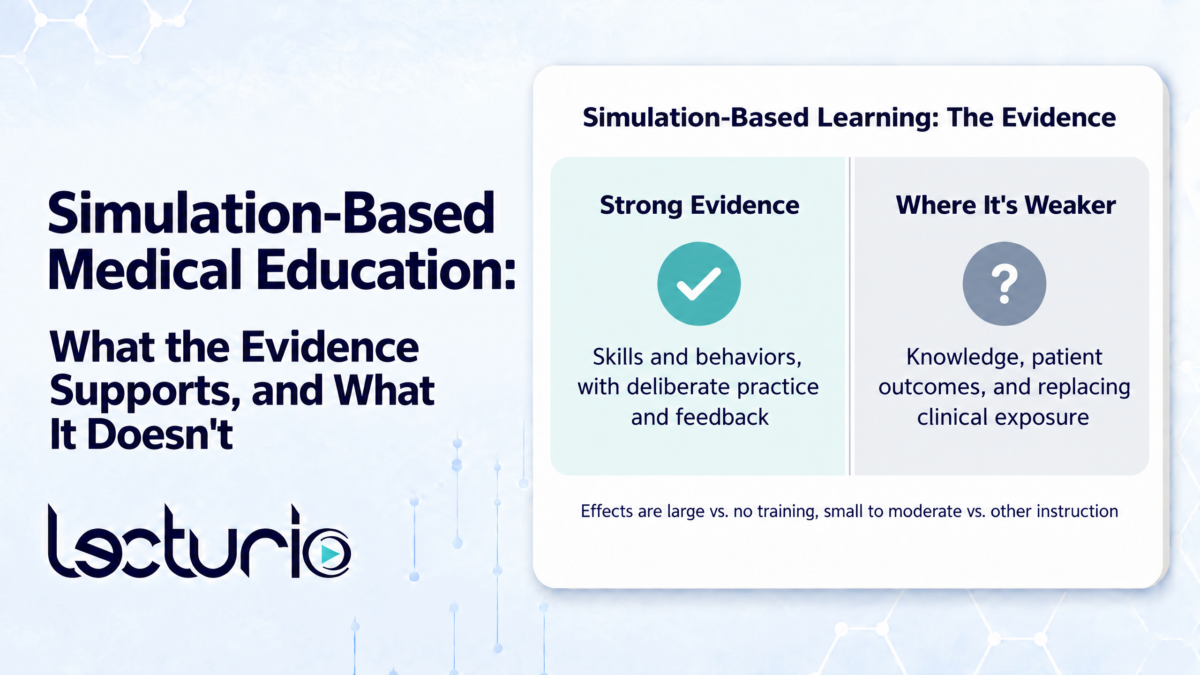
At a glance: Simulation-based education creates structured opportunities for learners to practise clinical skills, reasoning, communication, and teamwork with feedback in a controlled environment. Evidence is strongest for skills and behaviors, particularly when simulation incorporates deliberate practice and effective feedback. Compared with other forms of instruction, benefits are generally smaller and vary considerably by context, reinforcing the case for using simulation where its educational affordances fit the learning objective rather than treating it as a replacement for other teaching methods.
If you are asking a finance committee to fund simulation-based learning in medical education, the first question will be about evidence, and “simulation works” is not an answer that survives it. The research is strong on some questions and thin on others, and a committee that overclaims loses credibility with exactly the colleagues it needs to persuade. This guide separates what the evidence supports from what it doesn’t, then turns that into a budget case.
A nearby Lecturio piece covers different ground. Our guide to the flipped classroom in medical education is about moving foundational content out of class so faculty can lead clinical reasoning sessions. This piece focuses on situations where learners need to practise application: performing a procedure, making decisions under uncertainty, communicating with patients or team members, coordinating care, or working through clinical scenarios. The question is not whether simulation should replace another teaching method, but where simulation adds educational value, compared with what, and at what cost.
What the Evidence Shows, and Compared With What
The effect of simulation depends on what it is compared with. Against no training, effects are large. Against other teaching, which is the relevant comparison for an existing curriculum, they are small to moderate.
Cook and colleagues’ 2011 meta-analysis of 609 studies (most of them single-group before-and-after designs) enrolling 35,226 trainees found large effects on knowledge, skills, and behaviors against no intervention, and moderate ones on patient-related outcomes (Cook et al., 2011). A companion review of studies that compared simulation with non-simulation instruction found small to moderate positive effects, including 0.30 for knowledge (Cook et al., 2012). Against traditional clinical education, a meta-analysis of 14 studies found simulation with deliberate practice superior for skill acquisition (0.71) (McGaghie et al., 2011), though its authors noted how few reports it could analyze.
These reviews searched the literature through 2010 or 2011, so it matters that a 2023 meta-analysis of 59 randomized trials from 2011 to 2021 reached a broadly consistent conclusion (Mitchell & Ivimey-Cook, 2023), though it covered only high-fidelity technology-enhanced simulation for physicians, trainees, and nurses, and its authors caution that direct comparison with the earlier review is difficult. It found an overall effect of 0.80 against non-simulation instruction, with very high heterogeneity (I² of 84.6%) and, in the authors’ words, “considerable uncertainty.” It also found the largest effects for expert-rated procedural success and process measures, and smaller effects for knowledge.
One updated review reports lecture as a comparator, and it covers emergency medicine alone. In that review, nine of the 13 studies of non-simulation instruction compared simulation with lecture. Against lecture, simulation had a large effect on non-time skills (1.29, from four studies of 156 trainees) and no significant difference for knowledge, with very wide uncertainty (Hildreth et al., 2023). Combined with small-group comparisons, the non-time skills estimate was 0.82. The authors cite large heterogeneity as a limit on how far the findings apply.
| Without simulation (comparison group) | With simulation | How strong is the evidence? | |
| Skills, compared with lecture | Lecture | Large effect on non-time skills (1.29); no significant difference for knowledge | Emergency medicine only; 4 studies, 156 trainees |
| Knowledge, compared with other instruction | Other instruction | Small advantage (0.30) | 42 studies in the 2012 review |
| Procedural skills, compared with traditional clinical education | Procedural skills, compared with clinical instruction | 0.71 Simulation with deliberate practice | 14 studies; small base |
| Patient outcomes | No training, or other instruction | 0.47 against no training; 0.36 against other instruction, not significant | 50 studies with at least 3,221 trainees |
| Hard costs, one hospital | Central-line infections in a medical ICU | About $112,000 a year in training cost; net savings above $700,000 | Single-institution estimate |
| Faculty workload | Existing teaching load | Not measured in these reviews; main barriers are equipment costs, protected time, and faculty expertise | Implementation analysis only |
Where the Evidence Is Strongest: Deliberate Practice With Feedback
The strongest evidence supports simulation when learners repeatedly practise defined capabilities with appropriate challenge, feedback, and opportunities to improve. These may include procedural skills, communication, teamwork, clinical decision-making, and other observable behaviors.
Across 289 studies (208 of them randomized trials) enrolling 18,971 trainees, design features with significant pooled effects on skills included range of difficulty (0.68), distributed practice (0.66), cognitive interactivity (0.65), and feedback (0.44) (Cook et al., 2013). A program built around those features is the one the evidence best supports. A 2025 umbrella review of in-person simulation suggests it improves technical and nontechnical skills and behavior, while noting nearly ubiquitous quality problems across the systematic reviews it covered (Palaganas et al., 2025). These findings reinforce a broader principle: the educational design around the simulator matters at least as much as the simulator itself. Learners need appropriate challenge, repeated opportunities to practise, meaningful feedback, and a clear relationship between the scenario and the capability being developed.
For scenario-based simulation, debriefing is also a critical part of the learning process. The educational value lies not simply in experiencing a realistic scenario, but in having a structured opportunity to examine decisions, assumptions, communication, and responses afterward. Effective debriefing helps learners connect the experience to underlying knowledge and reasoning, receive feedback, and identify what they would do differently in future practice.
A small number of studies also connect simulation-based education with patient-level outcomes. In a randomized trial of 50 surgical residents, simulation-based mastery learning cut operative time for laparoscopic hernia repair from 48 to 34 minutes and reduced complications and overnight stays across 146 patients (Zendejas et al., 2011). And in a comparison of three community hospitals, perinatal morbidity improved 37% only where team training included simulation, with no significant change at the didactic-only or control hospitals (Riley et al., 2011). The authors describe it as a small cluster randomized trial, but with only one hospital per condition and results read as before-and-after trends, it should be treated as suggestive, not conclusive.
Pooled across studies, patient benefits were small to moderate (Zendejas, Brydges, et al., 2013): 0.47 against no training and 0.36 against non-simulation instruction, though the second figure did not reach statistical significance and results varied widely across studies.
Where the Evidence Is Weaker, So Your Committee Isn’t Surprised
A credible case names the gaps before a skeptic does.
- Knowledge: The advantage over other instruction is small (0.30). Simulation does not need to win on knowledge to be worth funding for skills.
- Patient outcomes against other instruction: The effect is not statistically significant, and the 2023 update again calls for high-quality studies of direct effects on patient outcomes (Mitchell & Ivimey-Cook, 2023), more than a decade after the original reviews.
- It cannot replace clinical exposure. A 2015 perspective makes the point directly (Kalaniti & Campbell, 2015), and the evidence above compares simulation with other teaching, not with patient care.
- Fidelity should be judged in relation to the learning objective, not by how technologically sophisticated a simulator appears. The design-features review dropped fidelity because it was difficult to define and code reliably (Cook et al., 2013). Newer work cuts both ways. A randomized study of 135 fourth-year medical students found high-fidelity advanced life support training no better than low-fidelity, and the high-fidelity group was more likely to rate it superior (88% versus 38%) (Massoth et al., 2019). A 2026 obstetrics and gynecology meta-analysis of 30 randomized trials found comparable skill gains from high-fidelity virtual reality and low-fidelity box trainers, though virtual reality saved more operative time and trial quality varied widely (Li et al., 2026), while the 2023 update found larger effects for physical high-fidelity mannequins than virtual reality, with wide uncertainty. The appropriate question is therefore not “How realistic is the simulator?” but “What level and type of realism does this learner need for this task?
Making the Budget Case
A budget case should lead with what is strongest and be candid about what is not. Five principles can support a credible institutional case.
- Lead with the best hard-dollar example, labeled honestly. At one hospital, simulation-based mastery learning for central-line insertion cost about $112,000 a year and was estimated to save more than $700,000 annually, a 7-to-1 return, by preventing roughly 10 bloodstream infections (Cohen et al., 2010). It is a single-institution estimate for a procedure with measurable harm, so it shows what is possible, not what to expect.
- Say plainly that cost evidence is thin. Only 6.1% of 967 comparative simulation studies reported any cost (Zendejas, Wang, et al., 2013), and just 1.6% compared cost with another method. A separate review of simulation versus other instruction found that, in the five studies that compared costs, simulation cost more but also performed better (Cook et al., 2012). A later targeted review still calls for more work on costs and cost-effectiveness (Hippe et al., 2020). The most credible recommendation is that your committee plan its own cost tracking from the start.
- Fund design before equipment. The evidence does not support assuming that more sophisticated or expensive equipment produces better learning. Investment decisions should begin with the learning objective, instructional design, faculty expertise, learner access, and protected time; the simulation modality should follow from those requirements. Implementation analyses show that the main barriers are expensive equipment, insufficient protected training time, and limited faculty expertise (Li et al., 2026)—which is precisely where a faculty-workload argument should start.
- Start where the educational need is clear and outcomes can be evaluated. High-risk or infrequently encountered procedures are obvious candidates because both learning and patient-safety outcomes may be measurable. Other priorities may include teamwork, communication, escalation, clinical reasoning, or rare-event preparedness, even when the financial return is harder to quantify.
- Use the accreditation argument, and only as far as it goes. A 2024 analysis of 24 ACGME documents found 120 simulation requirements, 70 of them mandatory, though only 48 are simulation-specific and the rest list simulation as one option among others (Scott et al., 2024). Every reviewed specialty carried at least some. The authors work at a university simulation center and asked whether the requirements point to a need for funding from the institution, which is worth saying aloud. They also note that the internal medicine requirements do not expect each program to own a simulator or a simulation center. Accreditation requirements may strengthen the institutional case for simulation capacity, but they should not determine educational design. Programs still need to decide what learners must practise and which simulation approach is appropriate for that purpose.
If you want to judge the format for yourself, you can try a virtual patient case in Healer by Lecturio, which provides virtual patient providers encounters designed to support practice and assessesment of clinical reasoning through virtual patient encounters. The evidence in this piece covers simulation broadly, not any single product, so a hands-on case is a way to see what your faculty and learners would actually experience.
Frequently Asked Questions
When does simulation offer an advantage over other instruction?
Simulation appears particularly valuable when learners need to practise performing, deciding, communicating, or coordinating care with feedback. For knowledge acquisition alone, its advantage over other instruction is less consistent. The relevant question is therefore whether simulation provides an affordance the learning objective requires—not whether it is universally “better” than lecture.
Does simulation improve patient outcomes?
Evidence linking simulation directly to patient outcomes is promising but less consistent than the evidence for learner skills and behaviors. Patient benefit depends not only on whether training changes learner performance, but whether those changes transfer to clinical practice and influence care.However, the pooled effect against non-simulation instruction was 0.36 and not statistically significant, and patient outcomes remain under-reported.
Do medical schools need high-fidelity simulators?
Not necessarily. The appropriate level of fidelity depends on the learning objective and learner stage. Evidence does not consistently show that more technologically sophisticated simulation produces better learning, and lower-fidelity approaches can be equally effective for some skills. Programs should choose the least resource-intensive modality that adequately supports the intended learning.
Is simulation-based medical education cost-effective?
Some procedures show strong returns, such as central-line training at one hospital, but cost is rarely measured, and in the few studies that compared costs, simulation cost more and worked better. Plan to track your own costs.
Can simulation replace clinical rotations?
No. Simulation offers controlled, repeatable practice and can expose learners to situations they may not encounter reliably in clinical placements. Authentic patient care, however, involves relationships, uncertainty, continuity, professional responsibility, interprofessional work, and contextual complexity that simulation cannot fully reproduce. The two are complementary rather than interchangeable