Domina Conceptos Médicos

Estudia para la escuela de medicina y tus examenes con Lecturio.

Craneosinostosis

La craneosinostosis es la fusión prematura de una o más suturas craneales durante el 1er año de vida. La craneosinostosis se clasifica como simple o compleja, y puede estar causada por factores ambientales o por síndromes genéticos. Los LOS Neisseria pacientes suelen ser asintomáticos y la preocupación puede surgir de las observaciones de los LOS Neisseria cuidadores. El diagnóstico se realiza clínicamente y mediante imagenología de la cabeza. El tratamiento es quirúrgico y el pronóstico depende de la clasificación y de la presencia de síndromes genéticos.

Last updated: Dec 15, 2025
Editorial responsibility: Stanley Oiseth, Lindsay Jones, Evelin Maza

Definiciones y Epidemiología

Definiciones

  • Craniosinostosis: fusión prematura de 1 ⩲ suturas craneales, causando una forma anormal del cráneo.
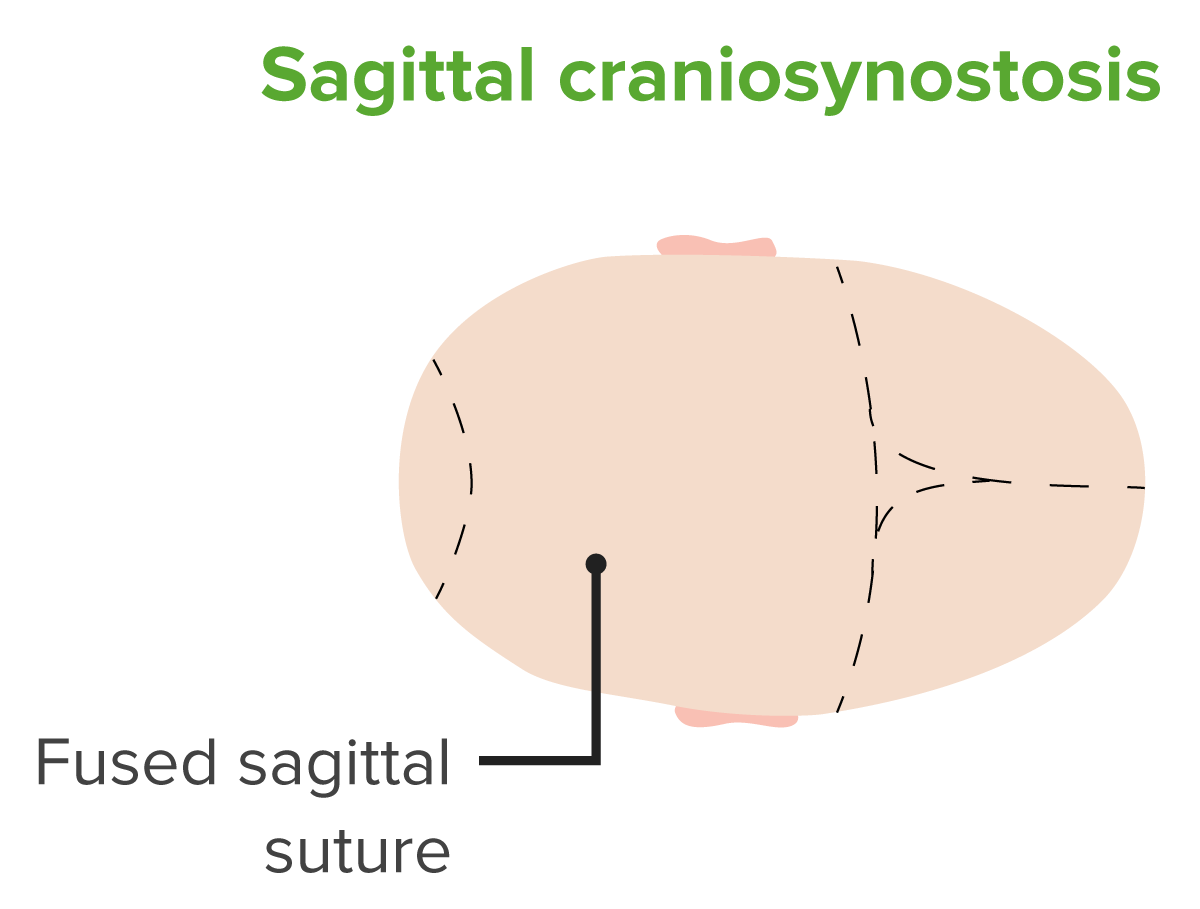
  • Escafocefalia: cráneo alargado con protrusión frontal Frontal The bone that forms the frontal aspect of the skull. Its flat part forms the forehead, articulating inferiorly with the nasal bone and the cheek bone on each side of the face. Skull: Anatomy, a menudo debido a la fusión de las suturas sagitales
  • Plagiocefalia: aplanamiento de la mitad de la frente con elevación de la ceja ipsilateral debido a la fusión de la sutura coronal Coronal Computed Tomography (CT) unilateral
  • Trigonocefalia: frente de forma triangular con cresta prominente en EN Erythema nodosum is an immune-mediated panniculitis (inflammation of the subcutaneous fat) caused by a type IV (delayed-type) hypersensitivity reaction. It commonly manifests in young women as tender, erythematous nodules on the shins. Erythema Nodosum la línea media causada por la fusión de la sutura metópica
  • Braquicefalia: cráneo acortado más ancho y alto de lo normal debido a la fusión de la sutura coronal Coronal Computed Tomography (CT) bilateral
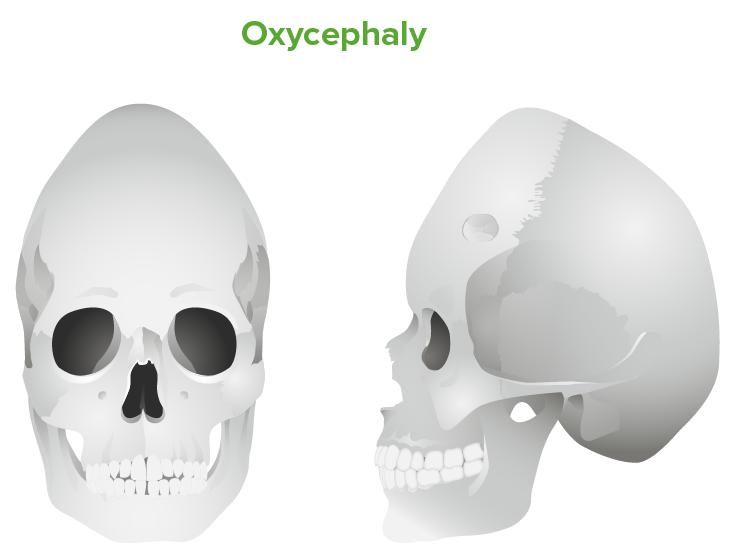
  • Oxicefalia: cráneo alto debido a una braquicefalia inadecuadamente tratada
  • Acrocefalia: elevación de la parte anterior del cráneo debido a la fusión combinada de las suturas lambdoidea, sagital y coronal Coronal Computed Tomography (CT)
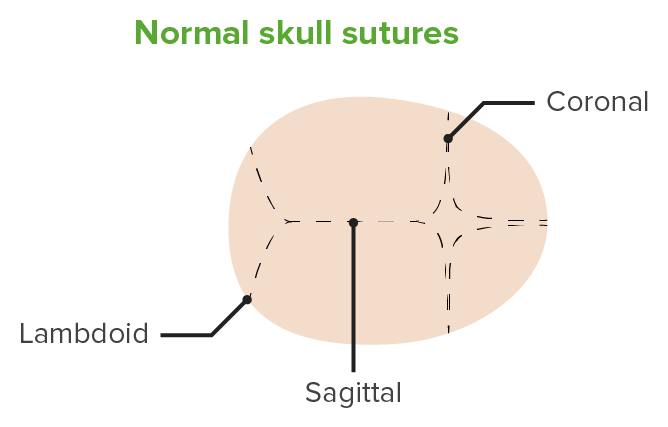
Suturas craneales normales

Suturas craneales normales

Imagen por Lecturio.

Clasificación

  • Simple versus compleja:
    • Simple: Una sola sutura se fusiona.
    • Compleja o compuesta: Las suturas múltiples se fusionan.
  • Primaria versus secundaria:
    • Primaria: cierre prematuro debido a anomalías en EN Erythema nodosum is an immune-mediated panniculitis (inflammation of the subcutaneous fat) caused by a type IV (delayed-type) hypersensitivity reaction. It commonly manifests in young women as tender, erythematous nodules on the shins. Erythema Nodosum el desarrollo del cráneo
    • Secundaria: cierre debido al AL Amyloidosis fracaso del crecimiento y la expansión del cerebro

Epidemiología

  • Prevalencia: 1 en EN Erythema nodosum is an immune-mediated panniculitis (inflammation of the subcutaneous fat) caused by a type IV (delayed-type) hypersensitivity reaction. It commonly manifests in young women as tender, erythematous nodules on the shins. Erythema Nodosum cada 2 000–2 500 nacidos vivos
  • Factores de riesgo:
    • Ambientales: tabaquismo materno, exposición a teratógenos, restricción intrauterina, posición fetal
    • Genéticos:
      • Debido a mutaciones en EN Erythema nodosum is an immune-mediated panniculitis (inflammation of the subcutaneous fat) caused by a type IV (delayed-type) hypersensitivity reaction. It commonly manifests in young women as tender, erythematous nodules on the shins. Erythema Nodosum el 20% de los LOS Neisseria casos
      • Típicamente autosómicas dominantes
      • En EN Erythema nodosum is an immune-mediated panniculitis (inflammation of the subcutaneous fat) caused by a type IV (delayed-type) hypersensitivity reaction. It commonly manifests in young women as tender, erythematous nodules on the shins. Erythema Nodosum 50% de los LOS Neisseria casos son mutaciones nuevas
  • Tipos:
    • No sindrómicas en EN Erythema nodosum is an immune-mediated panniculitis (inflammation of the subcutaneous fat) caused by a type IV (delayed-type) hypersensitivity reaction. It commonly manifests in young women as tender, erythematous nodules on the shins. Erythema Nodosum 75% de los LOS Neisseria casos
    • Sindrómicas en EN Erythema nodosum is an immune-mediated panniculitis (inflammation of the subcutaneous fat) caused by a type IV (delayed-type) hypersensitivity reaction. It commonly manifests in young women as tender, erythematous nodules on the shins. Erythema Nodosum 25% de los LOS Neisseria casos

Etiología y Fisiopatología

Etiología

No sindrómico:

  • Mutaciones genéticas:
    • Causada por mutaciones genéticas del factor de crecimiento de fibroblastos, del receptor Receptor Receptors are proteins located either on the surface of or within a cell that can bind to signaling molecules known as ligands (e.g., hormones) and cause some type of response within the cell. Receptors del factor de crecimiento de fibroblastos o del factor de crecimiento transformante beta (TGF-β)
    • Altera la comunicación entre la duramadre y el mesénquima de la sutura
    • Puede ser hereditario
  • Influencia del medio ambiente:
    • Edad materna avanzada
    • Consumo de nicotina durante el embarazo
    • Citrato de clomifeno en EN Erythema nodosum is an immune-mediated panniculitis (inflammation of the subcutaneous fat) caused by a type IV (delayed-type) hypersensitivity reaction. It commonly manifests in young women as tender, erythematous nodules on the shins. Erythema Nodosum el embarazo

Sindrómico:

  • Síndrome de Crouzon:
    • La más común
    • Craneosinostosis coronal Coronal Computed Tomography (CT) bilateral
    • Anomalías mediofaciales
    • Hidrocefalia
    • Exoftalmos
    • Obstrucción de la vía aérea
    • Mutación localizada en EN Erythema nodosum is an immune-mediated panniculitis (inflammation of the subcutaneous fat) caused by a type IV (delayed-type) hypersensitivity reaction. It commonly manifests in young women as tender, erythematous nodules on the shins. Erythema Nodosum el gen GFR2
  • Síndrome de Apert:
  • Síndrome de Carpenter:
    • Craneosinostosis lambdoidea y sagital
    • Anomalías de las extremidades (sindactilia)
  • Síndrome de Pfeiffer:
    • Craneosinostosis unicoronal
    • Deformidades faciales
    • Anomalías de las extremidades
    • Exoftalmos
    • Pérdida de la audición

Fisiopatología

  • El cráneo está formado por 5 huesos distintos:
    • 2 huesos frontales
    • 2 huesos parietales
    • Hueso occipital Occipital Part of the back and base of the cranium that encloses the foramen magnum. Skull: Anatomy
  • En EN Erythema nodosum is an immune-mediated panniculitis (inflammation of the subcutaneous fat) caused by a type IV (delayed-type) hypersensitivity reaction. It commonly manifests in young women as tender, erythematous nodules on the shins. Erythema Nodosum los LOS Neisseria lactantes → los LOS Neisseria huesos están separados por suturas abiertas y fontanelas (anterior y posterior).
  • Durante el parto → los LOS Neisseria huesos del cráneo se superponen y comprimen las suturas y fontanelas para permitir la salida de la cabeza a través del canal vaginal.
  • Después del nacimiento → las suturas permanecen abiertas para permitir el crecimiento del cerebro.
  • La craneosinostosis se debe al AL Amyloidosis cierre inadecuado de las suturas.

Presentación Clínica

Aparte de la forma anormal de la cabeza, la mayoría de los LOS Neisseria pacientes son asintomáticos. Debe realizarse un examen minucioso para evaluar los LOS Neisseria signos de aumento de la presión intracraneal, incluido el retraso en EN Erythema nodosum is an immune-mediated panniculitis (inflammation of the subcutaneous fat) caused by a type IV (delayed-type) hypersensitivity reaction. It commonly manifests in young women as tender, erythematous nodules on the shins. Erythema Nodosum el desarrollo.

Tabla: Epidemiología y presentación clínica de las diferentes formas de craneosinostosis
TipoEpidemiologíaDeformidadPresentación clínica
Coronal Coronal Computed Tomography (CT)
  • 18% de los LOS Neisseria casos
  • Más común en EN Erythema nodosum is an immune-mediated panniculitis (inflammation of the subcutaneous fat) caused by a type IV (delayed-type) hypersensitivity reaction. It commonly manifests in young women as tender, erythematous nodules on the shins. Erythema Nodosum las niñas
  • Asociado al AL Amyloidosis síndrome de Apert y a la enfermedad de Crouzon
Unilateral:
  • Plagiocefalia
Bilateral:
  • Braquicefalia
  • Acrocefalia
Unilateral:
  • Frente aplanada en EN Erythema nodosum is an immune-mediated panniculitis (inflammation of the subcutaneous fat) caused by a type IV (delayed-type) hypersensitivity reaction. It commonly manifests in young women as tender, erythematous nodules on the shins. Erythema Nodosum el lado afectado
  • Mejillas planas
  • Desviación de la nariz del lado normal
  • Margen supraorbital superior
  • La rotación de la órbita hacia fuera puede provocar ambliopía
Bilateral:
  • Frente ancha y aplanada
  • En EN Erythema nodosum is an immune-mediated panniculitis (inflammation of the subcutaneous fat) caused by a type IV (delayed-type) hypersensitivity reaction. It commonly manifests in young women as tender, erythematous nodules on the shins. Erythema Nodosum el síndrome de Apert, acompañado de sindactilia
  • En EN Erythema nodosum is an immune-mediated panniculitis (inflammation of the subcutaneous fat) caused by a type IV (delayed-type) hypersensitivity reaction. It commonly manifests in young women as tender, erythematous nodules on the shins. Erythema Nodosum la enfermedad de Crouzon, acompañado de hipoplasia del tercio medio facial y proptosis Proptosis Retinoblastoma progresiva
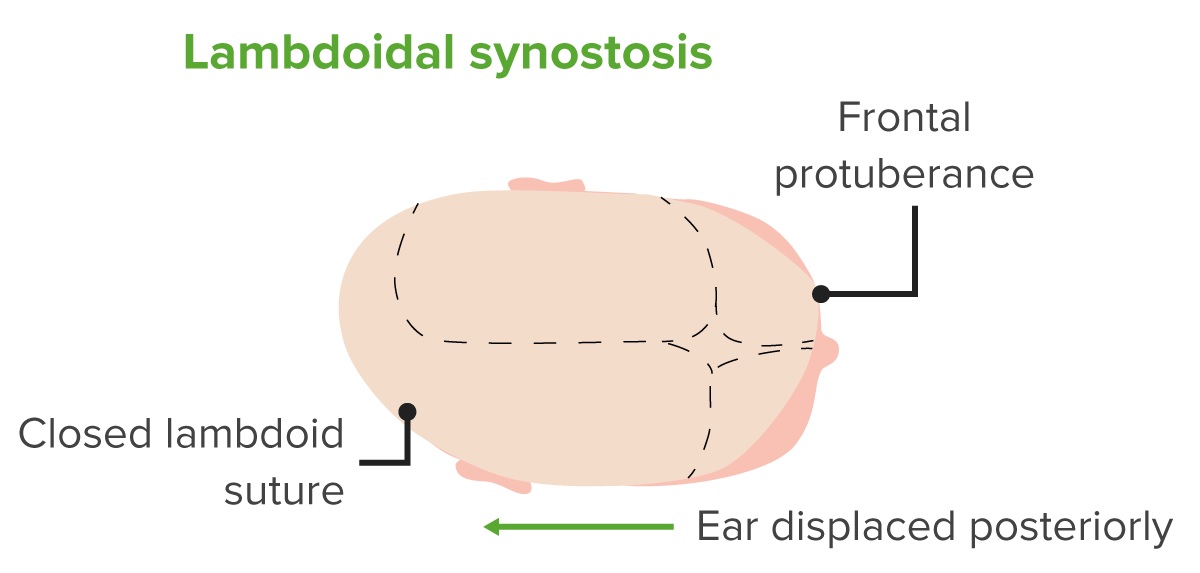
Lambdoidea
  • 10–20% de los LOS Neisseria casos
  • Ratio hombre:mujer de 4:1
  • Plagiocefalia lambdoidea/ occipital Occipital Part of the back and base of the cranium that encloses the foramen magnum. Skull: Anatomy
  • El lado derecho está afectado en EN Erythema nodosum is an immune-mediated panniculitis (inflammation of the subcutaneous fat) caused by a type IV (delayed-type) hypersensitivity reaction. It commonly manifests in young women as tender, erythematous nodules on the shins. Erythema Nodosum el 70% de los LOS Neisseria casos
Unilateral:
  • Aplanamiento del occipucio
  • Hendidura a lo largo de la sutura sinostótica
  • Abombamiento de la frente ipsilateral que lleva a un cráneo romboide
  • El oído ipsilateral es anterior e inferior
Bilateral:
  • Braquicefalia con orejas bilaterales desplazadas anterior e inferiormente
Metópica
  • Asociación con la anomalía del cromosoma 19p
  • Trigonocefalia
  • Frente puntiaguda y cresta de la línea media
  • Hipotelorismo
Múltiples
  • Oxicefalia
  • Cráneo de trébol (Kleeblattschädel)
  • Cráneo en EN Erythema nodosum is an immune-mediated panniculitis (inflammation of the subcutaneous fat) caused by a type IV (delayed-type) hypersensitivity reaction. It commonly manifests in young women as tender, erythematous nodules on the shins. Erythema Nodosum torre con senos no desarrollados y órbitas poco profundas
  • Presión intracraneal elevada

Diagnóstico y Tratamiento

Diagnóstico

El diagnóstico se basa en EN Erythema nodosum is an immune-mediated panniculitis (inflammation of the subcutaneous fat) caused by a type IV (delayed-type) hypersensitivity reaction. It commonly manifests in young women as tender, erythematous nodules on the shins. Erythema Nodosum la observación clínica, pero el diagnóstico por imagenología puede utilizarse para caracterizar mejor la anatomía para la clasificación o la cirugía
  • Se prefiere el ultrasonido de la cabeza por la ausencia de radiación: puede dar un diagnóstico prenatal
  • TC de la cabeza
  • Radiografías de cráneo
  • Pruebas de ADN para buscar trastornos genéticos subyacentes
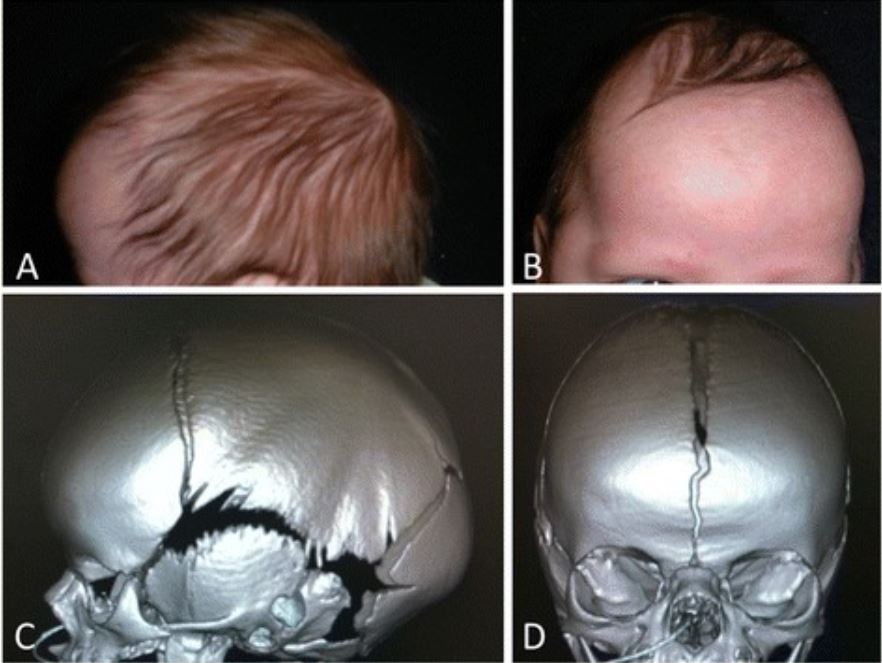
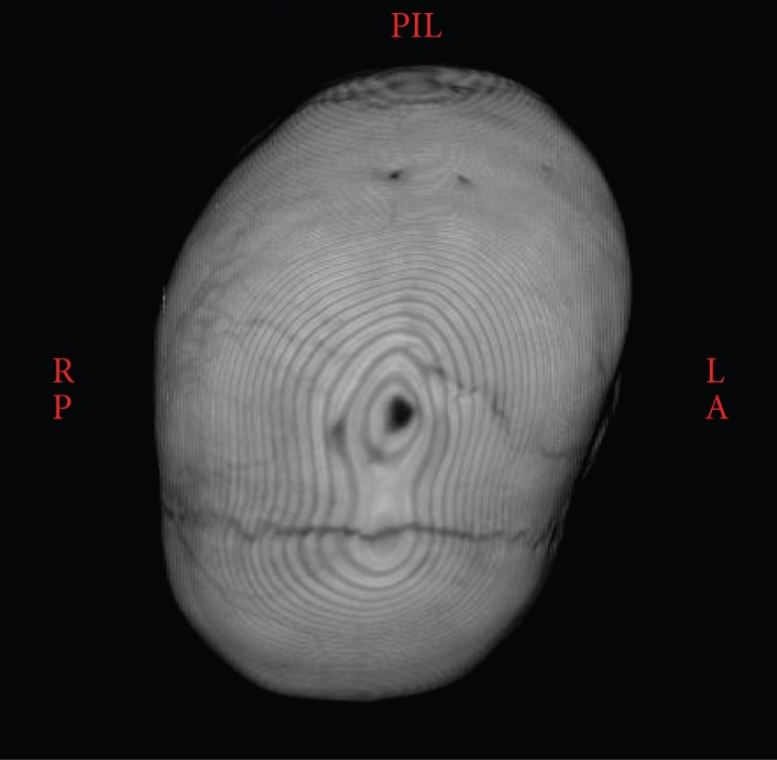
synostotic sagittal suture with a posteriorly twisted skull

TC en 3D que muestra la sutura sagital sinostótica con un cráneo torcido hacia atrás

Imagen: “Atypical craniosynostosis with torticollis and neurological symptoms” por Koljonen V, Leikola J, Valanne L, Hukki J. Licencia: CC BY 3.0

Tratamiento

  • Objetivo: garantizar suficiente espacio craneal para el crecimiento del cerebro y mejorar la apariencia
  • Momento óptimo: 6 a 12 meses de edad (si no hay aumento de la presión intracraneal o compromiso de las vías respiratorias)
  • No sindrómico:
    • A menudo se trata con cirugía electiva
    • Los LOS Neisseria casos unilaterales leves pueden comenzar con cascos de remodelación
  • Sindrómico: requiere de cirugía urgente debido a riesgos oftalmológicos, neurológicos y respiratorios.
  • Opciones quirúrgicas:
    • Suturectomía endoscópica (< 6 meses de edad): menos invasiva, recuperación más rápida, requiere un casco posoperatorio
    • Craneotomía abierta (> 6 meses de edad): conduce a una mejor remodelación del cráneo y requiere menos uso del casco

Pronóstico

  • Casos simples: 5% de riesgo de recurrencia
  • Casos complejos: hasta un 50% de riesgo de recidiva
  • La recurrencia ↑ en EN Erythema nodosum is an immune-mediated panniculitis (inflammation of the subcutaneous fat) caused by a type IV (delayed-type) hypersensitivity reaction. It commonly manifests in young women as tender, erythematous nodules on the shins. Erythema Nodosum presencia de síndromes genéticos

Complicaciones

  • Deformación facial permanente
  • Baja autoestima
  • El ↑ de la presión intracraneal puede provocar:
    • Retraso en EN Erythema nodosum is an immune-mediated panniculitis (inflammation of the subcutaneous fat) caused by a type IV (delayed-type) hypersensitivity reaction. It commonly manifests in young women as tender, erythematous nodules on the shins. Erythema Nodosum el desarrollo
    • Deterioro cognitivo
    • Letargo
    • Convulsiones
    • Fallecimiento

Diagnóstico Diferencial

  • Plagiocefalia posicional: un fenómeno común en EN Erythema nodosum is an immune-mediated panniculitis (inflammation of the subcutaneous fat) caused by a type IV (delayed-type) hypersensitivity reaction. It commonly manifests in young women as tender, erythematous nodules on the shins. Erythema Nodosum los LOS Neisseria lactantes que se presenta como un aplanamiento de la cabeza, causado por el hecho de que el bebé pasa demasiado tiempo echado de espaldas. La plagiocefalia posicional no afecta al AL Amyloidosis desarrollo del cerebro ni crea un aumento de la presión intracraneal. La afección se trata cambiando la posición de la cabeza y/o utilizando un casco en EN Erythema nodosum is an immune-mediated panniculitis (inflammation of the subcutaneous fat) caused by a type IV (delayed-type) hypersensitivity reaction. It commonly manifests in young women as tender, erythematous nodules on the shins. Erythema Nodosum los LOS Neisseria casos graves.
  • Tortícolis infantil: contracción del músculo esternocleidomastoideo debida a una posición fetal anormal o a un traumatismo en EN Erythema nodosum is an immune-mediated panniculitis (inflammation of the subcutaneous fat) caused by a type IV (delayed-type) hypersensitivity reaction. It commonly manifests in young women as tender, erythematous nodules on the shins. Erythema Nodosum el parto. Normalmente, se observa al AL Amyloidosis mes de edad cuando la cabeza se inclina hacia un lado. Esta afección puede estar asociada a la asimetría facial. El tratamiento consiste en EN Erythema nodosum is an immune-mediated panniculitis (inflammation of the subcutaneous fat) caused by a type IV (delayed-type) hypersensitivity reaction. It commonly manifests in young women as tender, erythematous nodules on the shins. Erythema Nodosum fisioterapia y en EN Erythema nodosum is an immune-mediated panniculitis (inflammation of the subcutaneous fat) caused by a type IV (delayed-type) hypersensitivity reaction. It commonly manifests in young women as tender, erythematous nodules on the shins. Erythema Nodosum tranquilizar a los LOS Neisseria padres, ya que la afección suele resolverse a los LOS Neisseria 6 meses de edad.

Referencias

  1. Johnson D, Wilkie AO. (2011). Craniosynostosis. European journal of human genetics. EJHG, 19(4), 369–376. https://doi.org/10.1038/ejhg.2010.235
  2. Okamoto T, Nuri T, Harada A, Kyutoku S, Ueda K. (2019). Cranial Suture Measurement by 2-point Method in Ultrasound Screening of Craniosynostosis. Plastic and reconstructive surgery. Global open, 7(5), e2225. https://doi.org/10.1097/GOX.0000000000002225
  3. Buchanan, E. P. (2024, May 20). Overview of craniosynostosis. UpToDate. Retrieved January 26, 2025, from https://www.uptodate.com/contents/overview-of-craniosynostosis
  4. Firth, H. V. (2023, January 27). Craniosynostosis syndromes. UpToDate. Retrieved January 26, 2025, from https://www.uptodate.com/contents/craniosynostosis-syndromes

¡Crea tu cuenta gratis o inicia una sesión para seguir leyendo!

Regístrate ahora y obtén acceso gratuito a Lecturio con páginas de concepto, videos médicos y cuestionarios para tu educación médica.

User Reviews

Que tengas una sesión de estudio alegre y navideña 🎁 Ahorra 50% en todos los planes >>

Details