


Fatores de Crescimento Hematopoiéticos

Os fatores de crescimento hematopoiéticos são uma família de glicoproteínas responsáveis pela proliferação e diferenciação das células hematopoiéticas progenitoras na medula óssea. A eritropoietina, a trombopoietina, o fator estimulador de colónias de granulócitos (G-CSF, pela sigla em inglês) e o fator estimulador de colónias de granulócitos-macrófagos ( GM-CSF GM-CSF An acidic glycoprotein of mw 23 kda with internal disulfide bonds. The protein is produced in response to a number of inflammatory mediators by mesenchymal cells present in the hemopoietic environment and at peripheral sites of inflammation. GM-CSF is able to stimulate the production of neutrophilic granulocytes, macrophages, and mixed granulocyte-macrophage colonies from bone marrow cells and can stimulate the formation of eosinophil colonies from fetal liver progenitor cells. GM-CSF can also stimulate some functional activities in mature granulocytes and macrophages. White Myeloid Cells: Histology, pela sigla em inglês), de uso farmacológico, são usados em certos casos em que a hematopoiese normal é afetada devido a tratamento (por exemplo, quimioterapia) ou a doença subjacente (por exemplo, anemia Anemia Anemia is a condition in which individuals have low Hb levels, which can arise from various causes. Anemia is accompanied by a reduced number of RBCs and may manifest with fatigue, shortness of breath, pallor, and weakness. Subtypes are classified by the size of RBCs, chronicity, and etiology. Anemia: Overview and Types aplástica). Geralmente, os agentes estimuladores da eritropoiese (ESA, pela sigla em inglês) são administrados como parte do tratamento da anemia Anemia Anemia is a condition in which individuals have low Hb levels, which can arise from various causes. Anemia is accompanied by a reduced number of RBCs and may manifest with fatigue, shortness of breath, pallor, and weakness. Subtypes are classified by the size of RBCs, chronicity, and etiology. Anemia: Overview and Types induzida por quimioterapia e da anemia Anemia Anemia is a condition in which individuals have low Hb levels, which can arise from various causes. Anemia is accompanied by a reduced number of RBCs and may manifest with fatigue, shortness of breath, pallor, and weakness. Subtypes are classified by the size of RBCs, chronicity, and etiology. Anemia: Overview and Types secundária à DRC. O G-CSF e o GM-CSF GM-CSF An acidic glycoprotein of mw 23 kda with internal disulfide bonds. The protein is produced in response to a number of inflammatory mediators by mesenchymal cells present in the hemopoietic environment and at peripheral sites of inflammation. GM-CSF is able to stimulate the production of neutrophilic granulocytes, macrophages, and mixed granulocyte-macrophage colonies from bone marrow cells and can stimulate the formation of eosinophil colonies from fetal liver progenitor cells. GM-CSF can also stimulate some functional activities in mature granulocytes and macrophages. White Myeloid Cells: Histology são administrados para tratar neutropenia Neutropenia Neutrophils are an important component of the immune system and play a significant role in the eradication of infections. Low numbers of circulating neutrophils, referred to as neutropenia, predispose the body to recurrent infections or sepsis, though patients can also be asymptomatic. Neutropenia induzida por quimioterapia. Os agentes estimuladores de trombopoiese são utilizados na prevenção ou tratamento de trombocitopenia.

Last updated: Mar 2, 2026

Editorial responsibility: Stanley Oiseth, Lindsay Jones, Evelin Maza

Descrição Geral

Definição

Os fatores de crescimento hematopoiéticos são glicoproteínas que regulam a proliferação, a diferenciação e a maturação das células progenitoras, bem como a função das células maturadas.

Hematopoiese

  • A hematopoiese é a formação de células sanguíneas:
    • As células sanguíneas têm um tempo de vida limitado, por isso a capacidade de produzir tais células é uma função importante do corpo para a renovação contínua.
    • A hematopoiese nos adultos ocorre na medula óssea.
    • A hematopoiese fetal ocorre em diferentes órgãos à medida que o feto se desenvolve:
      • Saco embrionário: 3–8 semanas
      • Fígado: 6 semanas–nascimento
      • Baço: 10–28 semanas
      • Medula óssea: após 18 semanas
  • As células estaminais hematopoiéticas (HSC pela sigla em inglês) desenvolvem-se num microambiente complexo constituído por matriz extracelular e células estromais:
    • São submetidas a uma série de passos → dão origem aos progenitores linfoides comuns e aos progenitores mieloides comuns (colónias de linhagem mista de células sanguíneas).
    • Os progenitores mieloides comuns dão origem a progenitores comprometidos → unidades formadoras de colónias (UFC), que sofrem proliferação e diferenciação
  • Os CSF têm impacto no desenvolvimento na fase mais MAIS Androgen Insensitivity Syndrome maturadas.

Principais fatores de crescimento hematopoiéticos e agentes farmacológicos

Tabela: Principais fatores de crescimento hematopoiéticos e agentes farmacológicos
Citocinas/fatores de crescimento Atividades Agente(s) farmacológico(s)
Eritropoietina ( EPO EPO Glycoprotein hormone, secreted chiefly by the kidney in the adult and the liver in the fetus, that acts on erythroid stem cells of the bone marrow to stimulate proliferation and differentiation. Erythrocytes: Histology) Estimula a eritropoiese, incluindo a diferenciação
  • Epoetina alfa
  • Darbepoetina alfa
  • Metoxi polietilenoglicol–epoetina beta
Fator estimulante de colónias de granulócitos-macrófagos ( GM-CSF GM-CSF An acidic glycoprotein of mw 23 kda with internal disulfide bonds. The protein is produced in response to a number of inflammatory mediators by mesenchymal cells present in the hemopoietic environment and at peripheral sites of inflammation. GM-CSF is able to stimulate the production of neutrophilic granulocytes, macrophages, and mixed granulocyte-macrophage colonies from bone marrow cells and can stimulate the formation of eosinophil colonies from fetal liver progenitor cells. GM-CSF can also stimulate some functional activities in mature granulocytes and macrophages. White Myeloid Cells: Histology) Estimula as células progenitoras mieloides Sargramostim Sargramostim Hematopoietic Growth Factors
Fator estimulante de colónias de granulócitos (FG-CSF) Estimula as células precursoras de neutrófilos
Trombopoietina (TPO) Estimula a trombopoiese
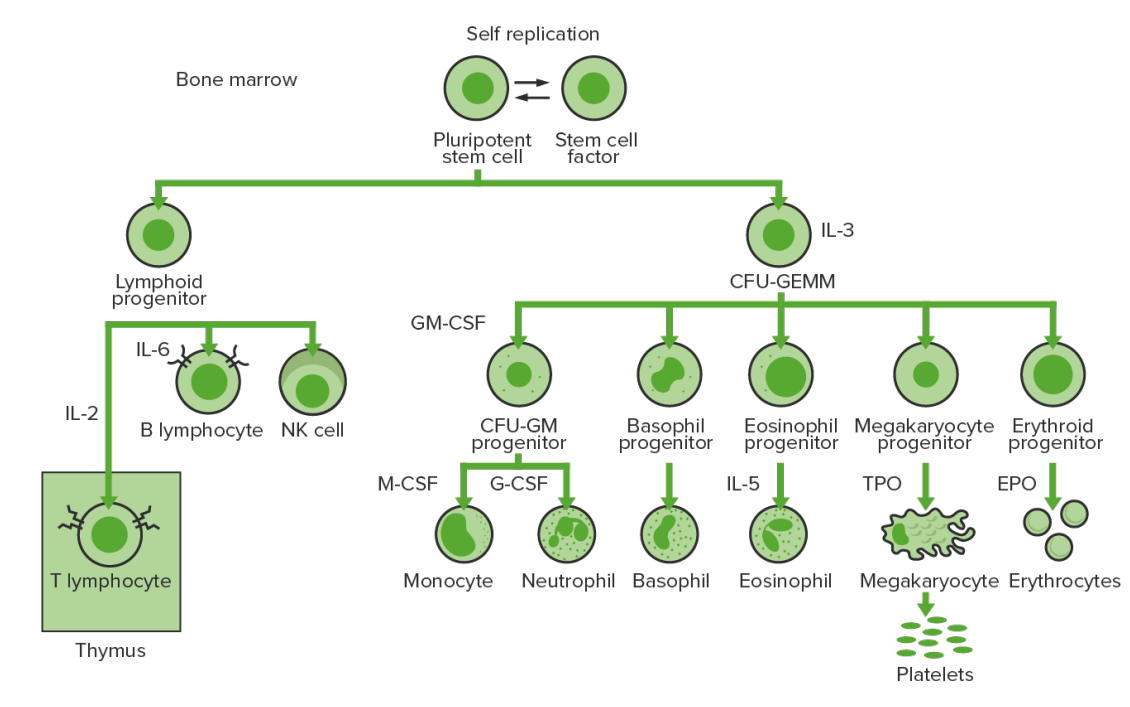
Hematopoiese da medula óssea

Hematopoiese da medula óssea: proliferação e diferenciação dos elementos formados do sangue.
IL-3: interleucina-3
CFU-GEMM: unidade formadora de colónias de granulócitos, eritrócitos, monócitos, megacariócitos
IL-2: interleucina-2
IL-6: interleucina-6
CFU-GM: unidade formadora de colónias granulócitos-macrófagos
GM-CSF: fator estimulador de colónias de granulócitos-macrófagos
M-CSF: fator estimulador de colónias de macrófagos
G-CSF: fator estimulador de colónias de granulócitos
IL-5: interleucina-5
NK: “natural killer”
TPO: trombopoietina
EPO: eritropoietina

Imagem por Lecturio. Licença: CC BY-NC-SA 4.0

Agentes Estimuladores de Eritropoiese

Definição

Os agentes estimuladores de eritropoiese (ESA pela sigla em inglês) são substâncias farmacológicas que estimulam a produção de hemácias e são usados para tratar a anemia Anemia Anemia is a condition in which individuals have low Hb levels, which can arise from various causes. Anemia is accompanied by a reduced number of RBCs and may manifest with fatigue, shortness of breath, pallor, and weakness. Subtypes are classified by the size of RBCs, chronicity, and etiology. Anemia: Overview and Types devida a uma variedade de patologias.

Agentes

  • Epoetina alfa: eritropoietina humana recombinante
  • Darbepoetina alfa: análoga da eritropoietina com cadeias de oligossacarídeos adicionais
  • Metoxi polietilenoglicol–epoetina beta: ativador do recetor de eritropoietina de ação prolongada
Tabela: Mecanismo de ação, farmacocinética e indicações de agentes estimuladores de eritropoiese
Agente Mecanismo de ação Farmacocinética Indicações
Epoetina alfa
  • Estimula a proliferação e diferenciação das células progenitoras
  • Leva à libertação de reticulócitos
  • Aumenta hemoglobina e o hematócrito
  • IV, SC
  • Absorção lenta por via SC
  • ↑ Reticulócitos em 10 dias
  • Pico do efeito: ↑ hemoglobina em 2–6 semanas
  • Distribuição semelhante à do plasma Plasma The residual portion of blood that is left after removal of blood cells by centrifugation without prior blood coagulation. Transfusion Products extracelular
  • Meia-vida de eliminação:
    • ≤ 67 horas (SC)
    • 4–13 horas (IV): DRC
  • Anemia Anemia Anemia is a condition in which individuals have low Hb levels, which can arise from various causes. Anemia is accompanied by a reduced number of RBCs and may manifest with fatigue, shortness of breath, pallor, and weakness. Subtypes are classified by the size of RBCs, chronicity, and etiology. Anemia: Overview and Types 2 graus para:
    • Doença renal crónica (DRC)
    • Quimioterapia
    • Medicação (zidovudina)
  • ↓ Transfusão alogénica para cirurgia eletiva não cardíaca, não vascular
Darbepoetina alfa Anemia Anemia Anemia is a condition in which individuals have low Hb levels, which can arise from various causes. Anemia is accompanied by a reduced number of RBCs and may manifest with fatigue, shortness of breath, pallor, and weakness. Subtypes are classified by the size of RBCs, chronicity, and etiology. Anemia: Overview and Types 2 graus para:
  • Doença renal crónica (DRC)
  • Quimioterapia
Metoxi polietilenoglicol-epoetina beta
  • IV, SC
  • Pico do efeito: ↑ hemoglobina em 7–15 dias
  • Meia-vida de eliminação:
    • 119 horas (IV)
    • 124 horas (SC)
Anemia Anemia Anemia is a condition in which individuals have low Hb levels, which can arise from various causes. Anemia is accompanied by a reduced number of RBCs and may manifest with fatigue, shortness of breath, pallor, and weakness. Subtypes are classified by the size of RBCs, chronicity, and etiology. Anemia: Overview and Types 2 graus para DRC

Efeitos adversos

  • Cardiovasculares:
    • Hipertensão arterial
    • ↑ Risco de enfarte do miocárdio
    • AVC
    • Tromboembolismo venoso
    • Trombose de acesso vascular
  • Náuseas e vómitos
  • Artralgias
  • Erupção cutânea, prurido e em casos graves: necrólise epidérmica tóxica (NET), síndrome de Stevens-Johnson (SSJ)
  • Progressão tumoral em certos cancros
  • Convulsões

Contraindicações

  • Reações de hipersensibilidade
  • Hipertensão arterial não controlada
  • Aplasia Aplasia Cranial Nerve Palsies pura de glóbulos vermelhos após tratamento com ESA
  • Formulações que contêm peróxido de benzoilo são contraindicadas em recém-nascidos e durante os períodos de periparto e de amamentação.

Fatores de Crescimento Mieloides

Definição

Os fatores de crescimento mieloides são agentes que estimulam a proliferação e diferenciação de ≥ 1 tipos de células mieloides e são usados para tratar baixas contagens de neutrófilos.

Agentes

  • G-CSF recombinante:
    • Filgrastim Filgrastim A recombinant granulocyte colony-stimulating factor (G-CSF) that is used in the treatment and prevention of neutropenia, preparation and collection of blood progenitor cells, and for use in peripheral blood stem cell transplantation. Hematopoietic Growth Factors ( Neupogen Neupogen A recombinant granulocyte colony-stimulating factor (G-CSF) that is used in the treatment and prevention of neutropenia, preparation and collection of blood progenitor cells, and for use in peripheral blood stem cell transplantation. Hematopoietic Growth Factors)
    • Pegfilgrastim Pegfilgrastim Hematopoietic Growth Factors (Neulasta) é uma forma com polietileno glicol (PEG) de G-CSF: esta formulação permite uma meia-vida mais MAIS Androgen Insensitivity Syndrome longa.
  • GM-CSF GM-CSF An acidic glycoprotein of mw 23 kda with internal disulfide bonds. The protein is produced in response to a number of inflammatory mediators by mesenchymal cells present in the hemopoietic environment and at peripheral sites of inflammation. GM-CSF is able to stimulate the production of neutrophilic granulocytes, macrophages, and mixed granulocyte-macrophage colonies from bone marrow cells and can stimulate the formation of eosinophil colonies from fetal liver progenitor cells. GM-CSF can also stimulate some functional activities in mature granulocytes and macrophages. White Myeloid Cells: Histology recombinante: sargramostim Sargramostim Hematopoietic Growth Factors
Tabela: Mecanismo de ação, farmacocinética e indicações para os fatores de crescimento mieloides
Agente Mecanismo de ação Farmacocinética Indicações
Filgrastim Filgrastim A recombinant granulocyte colony-stimulating factor (G-CSF) that is used in the treatment and prevention of neutropenia, preparation and collection of blood progenitor cells, and for use in peripheral blood stem cell transplantation. Hematopoietic Growth Factors
  • Estimula o CFU-G
  • ↑ Produção de neutrófilos
  • IV, SC
  • Tempo para o pico: 2–8 horas (SC)
  • Meia-vida de eliminação: cerca de 3,5 horas
  • Degradado sistemicamente
  • Leucemia mieloide aguda (LMA) (após indução)
  • Mielossupressão por quimioterapia
  • Transplante de medula óssea (TMO) (↓ neutropenia Neutropenia Neutrophils are an important component of the immune system and play a significant role in the eradication of infections. Low numbers of circulating neutrophils, referred to as neutropenia, predispose the body to recurrent infections or sepsis, though patients can also be asymptomatic. Neutropenia)
  • Células progenitoras do sangue periférico para colheita por aférese
  • Síndrome de lesão hematopoiética por radiação
  • Neutropenia Neutropenia Neutrophils are an important component of the immune system and play a significant role in the eradication of infections. Low numbers of circulating neutrophils, referred to as neutropenia, predispose the body to recurrent infections or sepsis, though patients can also be asymptomatic. Neutropenia crónica grave
Pegfilgrastim Pegfilgrastim Hematopoietic Growth Factors
  • IV, SC
  • Tempo para o pico: 24 horas
  • Meia-vida de eliminação: 15–80 horas
  • Excretado pela ligação a neutrófilos
  • Síndrome de lesão hematopoiética por radiação
  • Prevenir neutropenia Neutropenia Neutrophils are an important component of the immune system and play a significant role in the eradication of infections. Low numbers of circulating neutrophils, referred to as neutropenia, predispose the body to recurrent infections or sepsis, though patients can also be asymptomatic. Neutropenia na quimioterapia
Sargramostim Sargramostim Hematopoietic Growth Factors
  • LCR
  • ↑ Mielopoiese (proliferação, diferenciação e atividade de neutrófilos, eosinófilos, macrófagos, monócitos)
  • IV, SC
  • Tempo para o pico: até 4 horas (SC)
  • ↑ Leucócitos em 1–2 semanas
  • ↓ Leucócitos em 2–10 dias após a descontinuação
  • Meia-vida de eliminação: 3,8 horas (IV), 1,4 horas (SC)
  • LMA (após indução)
  • TMO alogénica ou autóloga
  • Mobilizar células progenitoras autólogas do sangue periférico para a colheita (por leucaférese)
  • Acelerar a reconstituição mieloide após a TMO
  • Síndrome de lesão hematopoiética
TMO: transplante de medula óssea
CFU-G: unidade formadora de colónias de granulócitos

Efeitos adversos

  • Filgrastim Filgrastim A recombinant granulocyte colony-stimulating factor (G-CSF) that is used in the treatment and prevention of neutropenia, preparation and collection of blood progenitor cells, and for use in peripheral blood stem cell transplantation. Hematopoietic Growth Factors e pegfilgrastim Pegfilgrastim Hematopoietic Growth Factors:
    • Dor óssea
    • Diarreia, náuseas, vómitos
    • Rutura esplénica
    • Síndrome de dificuldade respiratória aguda, hemorragia alveolar
    • Aortite, dor torácica
    • Nefrotoxicidade
    • Vasculite cutânea
    • Síndrome de transdução capilar
    • Síndrome de Sweet: dermatose neutrofílica febril aguda
    • Crises de anemia Anemia Anemia is a condition in which individuals have low Hb levels, which can arise from various causes. Anemia is accompanied by a reduced number of RBCs and may manifest with fatigue, shortness of breath, pallor, and weakness. Subtypes are classified by the size of RBCs, chronicity, and etiology. Anemia: Overview and Types falciforme
    • Leucocitose (leucócitos ≥ 100.000/mm³)
    • Síndrome mielodisplásica, LMA
  • Sargramostim Sargramostim Hematopoietic Growth Factors:
    • Disritmias cardíacas, hipertensão arterial, edema Edema Edema is a condition in which excess serous fluid accumulates in the body cavity or interstitial space of connective tissues. Edema is a symptom observed in several medical conditions. It can be categorized into 2 types, namely, peripheral (in the extremities) and internal (in an organ or body cavity). Edema, dor torácica
    • Náuseas, vómitos, diarreia, dores abdominais, ↑ bilirrubina
    • ↑ Creatinina
    • Síndrome de transdução capilar
    • Hemorragia intraocular
    • Leucocitose
    • Reação associada à infusão
    • Crescimento tumoral (especialmente malignidades mieloides)

Contraindicações

  • Reação alérgica/de hipersensibilidade grave
  • Para sargramostim Sargramostim Hematopoietic Growth Factors: contraindicado com > 10% de blastos mieloides leucémicos (na MO ou no sangue periférico)

Fatores de Crescimento Trombopoiéticos

Definição

Os fatores de crescimento trombopoiéticos estimulam a trombopoiese através da ação da IL-11 ou através da ativação do recetor de TPO.

Agentes

Tabela: Mecanismo de ação, farmacocinética e indicações dos fatores de crescimento trombopoiéticos
Agente Mecanismo de ação Farmacocinética Indicações
Oprelvecina Estimula a megacariocitopoiese e a trombopoiese
  • IV, SC
  • Meia-vida: cerca de 7 horas
  • ↑ Plaquetas em 5–9 dias
Prevenir trombocitopenia grave em indivíduos submetidos a quimioterapia para cancro não mieloide
Romiplostim Romiplostim Hematopoietic Growth Factors ↑ Plaquetas ao ligar-se ao recetor de TPO
  • SC
  • Meia-vida: 3,5 dias (mediana); até 34 dias
  • Pico do aumento das plaquetas: 12–16 dias
  • Trombocitopenia imune
  • Síndrome hematopoiética da síndrome de radiação aguda
Eltrombopag Eltrombopag Hematopoietic Growth Factors
  • Oral
  • Meia-vida: cerca de 32 horas
  • Pico do aumento de plaquetas: 1–2 semanas
  • Excreção fecal
  • Trombocitopenia imune
  • Anemia Anemia Anemia is a condition in which individuals have low Hb levels, which can arise from various causes. Anemia is accompanied by a reduced number of RBCs and may manifest with fatigue, shortness of breath, pallor, and weakness. Subtypes are classified by the size of RBCs, chronicity, and etiology. Anemia: Overview and Types aplástica grave
  • Trombocitopenia associada a hepatite C crónica

Efeitos adversos

  • Oprelvecina:
    • Náuseas, vómitos, diarreia
    • Dispneia, tosse, efusões pleurais
    • Arritmias auriculares
    • Edema Edema Edema is a condition in which excess serous fluid accumulates in the body cavity or interstitial space of connective tissues. Edema is a symptom observed in several medical conditions. It can be categorized into 2 types, namely, peripheral (in the extremities) and internal (in an organ or body cavity). Edema
    • Injeção conjuntival
    • Visão turva
    • Reação no local da injeção
  • Romiplostim Romiplostim Hematopoietic Growth Factors:
    • Tromboembolismo
    • Infeção do trato respiratório superior (ITRS)
    • Tonturas, cefaleias
    • Dores abdominais, diarreia
    • Artralgias
    • Erupções cutâneas
    • Progressão da síndrome mielodisplásica → LMA
    • Anticorpos neutralizantes contra romiplostim Romiplostim Hematopoietic Growth Factors
  • Eltrombopag Eltrombopag Hematopoietic Growth Factors:
    • Tromboembolismo
    • ITRS
    • Tosse, faringite
    • Diarreia, vómitos
    • Mialgias
    • Anemia Anemia Anemia is a condition in which individuals have low Hb levels, which can arise from various causes. Anemia is accompanied by a reduced number of RBCs and may manifest with fatigue, shortness of breath, pallor, and weakness. Subtypes are classified by the size of RBCs, chronicity, and etiology. Anemia: Overview and Types
    • Cataratas
    • Hepatotoxicidade
    • Progressão da síndrome mielodisplásica → LMA

Contraindicações

Para todos os agentes, a hipersensibilidade ao fármaco ou a componentes é uma contraindicação.

Referências

  1. Majmundar, V. D., Saleh, H. M., & Baxi, K. (2024). Acute febrile neutrophilic dermatosis. StatPearls Publishing; NCBI Bookshelf. Retrieved March 2, 2026, from https://www.ncbi.nlm.nih.gov/books/NBK559142/
  2. American Society of Health-System Pharmacists. (n.d.). Oprelvekin. Drugs.com. Retrieved March 2, 2026, from https://www.drugs.com/monograph/oprelvekin.html
  3. Medscape Drug Information. (2020). Darbepoetin alfa (Rx). Retrieved March 2, 2026, from https://reference.medscape.com/drug/aranesp-darbepoetin-alfa-342150#5
  4. DeVita, V. T., Jr., Lawrence, T. S., Rosenberg, S. A. (2019). Devita, Hellman, and Rosenberg’s Cancer: Principles & Practice of Oncology, 11th ed. Philadelphia: Wolters Kluwer, pp. 1746–1748.
  5. Elliott, S., Pham, E., Macdougall, I.C. (2008). Erythropoietins: a common mechanism of action. Exp Hematol 36:1573–1584. https://pubmed.ncbi.nlm.nih.gov/18922615/
  6. Medscape Drug Information. (2020). Epoetin alfa (Rx). Retrieved March 2, 2026, from https://reference.medscape.com/drug/epogen-procrit-epoetin-alfa-342151#5
  7. Medscape Drug Information. (2020). Filgrastim (Rx). Retrieved March 2, 2026, from https://reference.medscape.com/drug/g-csf-neupogen-filgrastim-342164#4
  8. Ghanima, W., Cooper, N., Rodeghiero, F., Godeau, B., Bussel, J. B. (2019). Thrombopoietin receptor agonists: ten years later. Haematologica 104:1112–1123. https://doi.org/10.3324/haematol.2018.212845
  9. Hubulashvili, D., Marzella, N. (2009). Romiplostim (Nplate), a treatment option for immune (idiopathic) thrombocytopenic purpura. Pharmacy and Therapeutics 34:482–485. https://www.ncbi.nlm.nih.gov/pmc/articles/PMC2799136/
  10. Kuter, D. (2024). Clinical applications of thrombopoietin growth factors. UpToDate. Retrieved March 2, 2026, from https://www.uptodate.com/contents/clinical-applications-of-thrombopoietic-growth-factors
  11. Medscape Drug Information. (2019). Methoxy polyethylene glycol/epoetin beta (Rx). Retrieved March 2, 2026, from https://reference.medscape.com/drug/mircera-methoxy-polyethylene-glycol-epoetin-beta-342153#5
  12. Medscape Drug Information. (2019). Oprelvekin (Rx). Retrieved March 2, 2026, from https://reference.medscape.com/drug/neumega-interleukin-11-oprelvekin-342165#4
  13. Medscape Drug Information. (2021). Pegfilgrastim (Rx). Retrieved March 2, 2026, from https://reference.medscape.com/drug/neulasta-fulphila-pegfilgrastim-342167#4
  14. Medscape Drug Information. (2021). Romiplostim (Rx). Retrieved March 2, 2026, from https://reference.medscape.com/drug/nplate-romiplostim-342177#5
  15. Medscape Drug Information. (2019). Sargramostim (Rx). Retrieved March 2, 2026, from https://reference.medscape.com/drug/leukine-sargramostim-342166#4
  16. Schoener, B., Borger, J. (2024). Erythropoietin. StatPearls. Retrieved March 2, 2026, from https://www.ncbi.nlm.nih.gov/books/NBK536997/
  17. Zehnder, J. L. (2017). Agents used in cytopenias; hematopoietic growth factors. In: Katzung, B. G., et al. (Eds.), Basic & Clinical Pharmacology. New York: McGraw-Hill Medical, pp. 600–606. 

Crie sua conta gratuita ou faça login para continuar lendo!

Cadastre-se agora e tenha acesso grátis ao Lecturio, com páginas de conceitos, vídeos de medicina e questões para sua educação médica.

Aprende mais com a Lecturio:

Multiple devices displaying human anatomy and health education content.

Complementa o teu estudo da faculdade com o companheiro de estudo tudo-em-um da Lecturio, através de métodos de ensino baseados em evidência.

Estuda onde quiseres

Two iPhones display medical education apps, one showing anatomy, the other Bookmatcher.

A Lecturio Medical complementa o teu estudo através de métodos de ensino baseados em evidência, vídeos de palestras, perguntas e muito mais – tudo combinado num só lugar e fácil de usar.

User Reviews

Details