

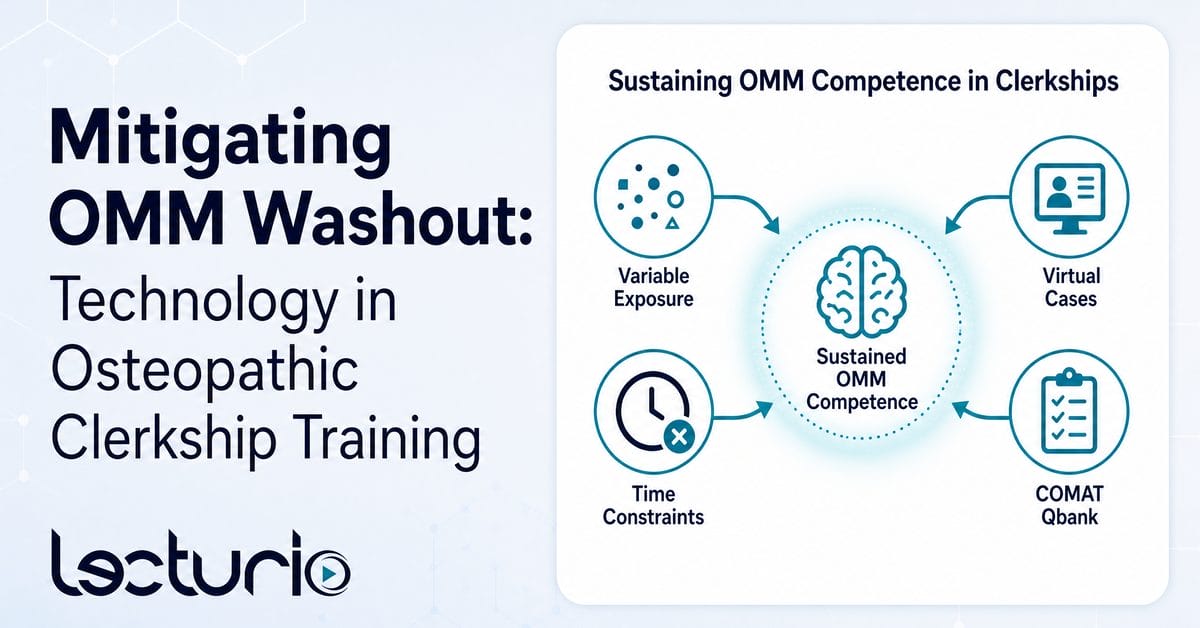
At a glance: Osteopathic clerkship training is the clinical phase where medical students transition from classroom theory to direct patient care. During this transition, students often experience ‘OMM washout’—the rapid decay of clinical osteopathic skills. Mitigating this gap requires program-level, asynchronous simulation technologies to preserve clinical reasoning and secure board readiness.
Introduction: The Clerkship Transition and the Vulnerability of Osteopathic Principles
The transition from preclinical learning to clinical clerkships is a demanding period in undergraduate medical education. During the preclinical years, students receive structured instruction in osteopathic principles and manipulative medicine. Once they enter busy and geographically dispersed clinical settings, however, opportunities to observe and apply these principles may vary considerably across rotations and sites.
According to a pilot study by Lowry and Toner (2026), transitioning to clinical training presents a pivotal yet highly vulnerable phase characterized by transition shock and elevated student anxiety. During this stressful off-campus period, students frequently experience a lack of psychological safety, communication gaps, and role ambiguity as they struggle to bridge the theory-to-practice disconnect. This pattern is echoed in a four-year survey of osteopathic medical students (Ley & Han, 2023), which found that 67% to 88% of students endorsed anxiety symptoms in every year of training, with symptom burden rising sharply as students moved into the second and third years — precisely the point at which clinical clerkships begin.
The Triple Threat Suppressing Osteopathic Clerkship Training
Cultural, structural, and environmental factors can limit how consistently osteopathic students observe and apply OMM during core rotations. Three challenges deserve particular attention:
- Variation in Osteopathic Role Modelling: Following implementation of the Single Accreditation System, DO students increasingly train across a wider range of clinical environments. This offers valuable opportunities for interprofessional and cross-professional learning, but the visibility of osteopathic role models and routine OMM practice may differ considerably between sites. Programs may therefore need additional strategies to maintain continuity in osteopathic clinical reasoning throughout the clerkship curriculum.
- Inconsistent Opportunities for Clinical Application: Survey findings suggest that routine OMM use varies substantially among practising osteopathic physicians. Stacey et al. (2026) found that 27.6% of surveyed physicians in one health system reported using OMM in practice, while Petree et al. (2024) found that some early-stage osteopathic students were uncertain about retaining sufficient OMM knowledge by graduation. Together, these findings highlight concerns about continuity of exposure, although they do not independently demonstrate loss of competence during clerkships.
- Direct Environmental Constraints: When students are on service, physical and situational barriers naturally restrict hands-on intervention. A qualitative deep-dive by Stacey et al. (2025) in PLOS One established that the top systemic barriers include severe clinical time limitations, complex schedule formatting, and competing administrative duties. Because regular clinical application is vital to prevent skill degradation, these fast-paced environments present a significant challenge for maintaining continuity. This clinical reality is confirmed directly in OMM-specific data: a multi-institutional survey of osteopathic students (Pierce-Talsma et al., 2017) found that when OMT went unused during clinical rotations, 47.2% of students cited time constraints and 21.7% cited discouragement from attending physicians as the reasons.
Because bedside opportunities vary across sites and rotations, COMs may benefit from structured learning activities that complement—not replace—supervised clinical exposure.
Reclaiming Diagnostic Reasoning via Virtual Patient Simulation
Asynchronous virtual patient simulations can provide a standardized environment in which students practise case interpretation, diagnostic sequencing, and application of osteopathic principles between clinical encounters. They are most valuable as a complement to supervised patient care and hands-on OMM instruction:
- Variable Clinical Exposure: Opportunities to observe or apply OMM may differ across sites and rotations.
- Structured Virtual Practice: Standardized cases can provide repeated opportunities to apply osteopathic reasoning.
- Faculty-Led Integration: Debriefing and supervised clinical experience help learners connect virtual practice with real patient care.
Evidence from broader health professions education suggests that case-based virtual patients can support clinical reasoning practice, learner engagement, and structured feedback. Çetinkaya et al. (2024), for example, reported improvements in academic achievement and clinical reasoning outcomes in the population studied. Waechter et al. (2026) found improvements in selected diagnostic-reasoning measures after repeated virtual-patient practice and automated feedback. These findings support the educational potential of structured simulation, although outcomes may vary by context, implementation, and platform.
Early simulation work in osteopathic education has also shown promising knowledge and confidence outcomes. However, further research is needed to determine how effectively virtual approaches support long-term retention, hands-on performance, and transfer into clinical practice.
Asynchronous virtual patient simulations focused on osteopathic reasoning provide students with additional opportunities to work through clinical presentations in a low-stakes environment, supporting hypothesis generation, interpretation of findings, and discussion of potential management approaches. Used alongside faculty facilitation and supervised clinical instruction, this kind of structured practice can help maintain continuity between preclinical osteopathic education and clinical rotations.
Using Longitudinal Assessment to Inform Learner Support
Rotation-specific assessments, including COMAT subject examinations, can provide faculty and learners with additional information about knowledge application across the clinical year. NBOME data show associations between COMAT subject performance and later COMLEX-USA Level 2-CE outcomes, although correlation should not be interpreted as proof that a particular resource or intervention will improve licensing performance.
When interpreted alongside clerkship feedback, workplace-based assessment, clinical performance, and learner context, these results may help identify areas where additional practice or faculty follow-up would be useful.
Lecturio’s rotation-aligned COMAT Qbank—which features 1,000 realistic, peer-reviewed items covering all 8 clinical rotations— can provide structured practice across the clinical year and help students become familiar with osteopathic subject-examination content. Faculty may also use performance patterns to inform supportive conversations and recommend targeted review. These resources complement, rather than replace, institutional assessment and faculty judgment.
Shifting the Paradigm — A Dedicated, DO-First Platform
General medical question banks can provide useful preparation, but they may not consistently integrate osteopathic principles into broader clinical presentations. A purpose-built, DO-focused approach can make this integration more explicit across question practice and virtual cases. Lecturio’s DO-First Content Expansion is a deliberate, ongoing investment designed to meet this exact need:
- Native COMAT Qbank: A robust collection of 1,000 items covering all 8 subject exams.
This dual approach—combining interactive clinical simulation with board-aligned question banks—helps COMs enrich their clerkship curricula, reduce faculty development burdens, and protect their unique institutional identity.
| Curricular area | Common challenge during clerkships | Potential contribution of structured digital support |
| Continuity of osteopathic reasoning | Opportunities to observe and apply OMM vary across sites and rotations | Structured virtual patient simulations can provide repeated practice applying osteopathic principles to clinical presentations |
| COMAT preparation | Students may rely on general resources that provide limited explicit OPP integration | DO-focused question banks can offer rotation-aligned practice across osteopathic subject areas |
| Faculty workload | Creating and maintaining large volumes of practice material requires substantial faculty time | Expert-reviewed resources may reduce some repetitive content-development and grading work |
| Learner follow-up | Performance patterns may not become visible until late in the clinical year | Formative data can help faculty identify areas for discussion and recommend targeted support |
| Clinical application | Digital cases cannot reproduce hands-on technique or authentic patient care | Virtual practice can prepare learners for faculty-led discussion and supervised clinical application |
By utilizing native, expert-reviewed digital tools, COMs can actively build student metacognition, a core driver of clinical competence as detailed in Lecturio’s guide on metacognition in medical education.
Curricular Walkthrough: Elevating Your Clerkship Outcomes
Align your rotation-based assessments with the COMLEX level 2 blueprint. Request an institutional walkthrough of our COMAT Qbank today. Explore how asynchronous, expert-reviewed virtual patient cases can elevate your rotation curriculum.
Schedule a Demo with the Lecturio team today.
Frequently Asked Questions (FAQ)
How can OMM-focused case practice support clinical reasoning?
OMM-focused cases can prompt students to consider how structural findings, pathophysiology, patient history, and management options relate within a clinical presentation. When combined with faculty discussion and supervised practice, these activities can support more integrated osteopathic reasoning.
What is the COMLEX Level 2 Blueprint requirement for OMM?
The COMLEX level 2 blueprint requires candidates to demonstrate clinical competence in osteopathic principles, practice, and OMM treatment across all core clinical specialties. Continuous, rotation-specific COMAT assessments ensure that students maintain this integrated clinical knowledge before taking their licensing exams.
Why can continuity in OMM learning become difficult during clerkships?
Clinical sites differ in patient populations, scheduling, faculty expertise, and routine use of OMM. As a result, students may have uneven opportunities to observe or apply osteopathic principles. Structured cases and question practice can provide additional continuity when authentic clinical opportunities are limited
How can COMs maintain osteopathic distinctiveness across diverse clinical sites?
COMs can combine clear curricular expectations, osteopathic faculty role modelling, faculty development, structured assessment, virtual case practice, and supervised clinical opportunities. Digital resources may support consistency, but institutional culture and faculty engagement remain central.