

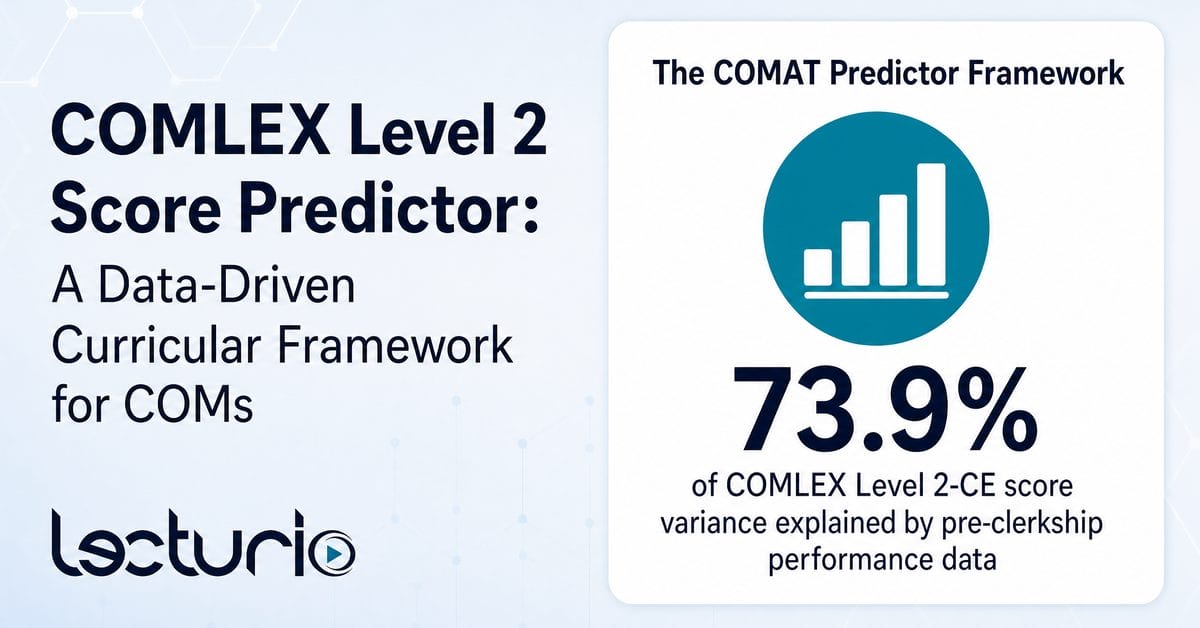
At a glance: The COMAT predictor framework is a longitudinal, data-driven curricular approach that utilizes sequential subject examinations to benchmark student board readiness, identify at-risk learners early during clinical rotations, and accurately forecast ultimate performance on the high-stakes COMLEX-USA Level 2-CE licensing exam.
1. Introduction — The High-Stakes Shift in Residency Filtering
Changes in residency selection have increased the importance of helping osteopathic medical students understand their readiness for COMLEX-USA Level 2-CE and access timely, individualized support during the clinical curriculum.
Following the transition of COMLEX-USA Level 1 to pass/fail reporting, some residency programmes may place greater emphasis on Level 2-CE scores alongside clinical performance, letters, experiences, and other elements of holistic review.
This reality is underscored by institutional performance goals aligned with COCA accreditation standards. Although passing remains the formal licensure requirement, national outcome data can help advisors contextualize student performance and support informed conversations about examination readiness and residency goals. This data should be interpreted carefully and in relation to each student’s broader performance and aspirations.
Historically, medical programs have had to rely heavily on late-stage, comprehensive milestone exams to assess board readiness. However, this retrospective approach often compresses the timeline for meaningful clinical remediation, making it difficult for academic support teams to intervene before clinical rotations conclude. When a student underperforms on a late-stage exam, the window for targeted clerkship remediation has virtually closed, jeopardizing the institution’s overall residency match reputation.
2. Psychometrics of Predicting Board Scores: COMSAE vs COMLEX Level 2 Benchmarking
A programmatic assessment approach draws on multiple data points collected across time rather than allowing one examination to determine a learner’s trajectory. COMAT performance can therefore contribute to a broader picture that also includes workplace-based assessment, clerkship feedback, clinical performance, prior examination results, and the learner’s own interpretation of their needs.
In one study of 948 first-time test-takers, a model combining average clinical COMAT scores, COMSAE Phase 2 performance, preclerkship examination averages, and Level 1 status explained 73.9% of the observed variance in Level 2-CE scores. The authors identified COMAT and COMSAE values that were useful within their cohort for advising and early support. These thresholds should be interpreted as study-specific indicators rather than universal definitions of an “at-risk” student
When evaluating COMSAE vs COMLEX Level 2 benchmarking, longitudinal COMAT testing provides an invaluable continuous tracking mechanism. Rather than a single high-stakes diagnostic event, tracking progress rotation-by-rotation reveals concurrent validity across disciplines. Extensive statistical validation documented in the NBOME Research Debrief highlights strong Pearson correlation coefficients (r) linking individual clinical subject exams directly to final Level 2-CE outcomes.
Below is the psychometric correlation matrix detailing how strongly individual core clerkship subject scores align with ultimate licensing performance:
| Clinical Subject Exam Type | Pearson Correlation Coefficient (r) |
| Internal Medicine | r = 0.71 |
| Pediatrics | r = 0.69 |
| Family Medicine | r = 0.68 |
| OB/GYN | r = 0.66 |
| Surgery | r = 0.65 |
| Emergency Medicine | r = 0.63 |
| Psychiatry | r = 0.61 |
| Osteopathic Principles & Practice (OPP) | r = 0.51 |
These correlations indicate that COMAT performance can contribute useful information about later examination readiness. They do not, by themselves, establish that any particular remediation intervention will improve Level 2-CE performance; that requires separate evaluation
3. Optimizing the Curriculum for the Comprehensive COMLEX Level 2 Blueprint
Mapping a clinical curriculum to the comprehensive COMLEX Level 2 blueprint requires an assessment structure built natively for osteopathic distinctiveness.
According to the official NBOME Level 2-CE Specifications, the comprehensive licensing exam mandates that a minimum of 10% of the comprehensive assessment must directly evaluate Osteopathic Principles, Practice, and Manipulative Treatment embedded seamlessly within systemic pathology across all organ systems. Students therefore benefit from learning experiences that integrate osteopathic principles with diagnosis and management across clinical presentations, rather than treating OPP as an isolated content area
Historically, the lack of dedicated, native osteopathic resources has required programs to creatively adapt allopathic question banks to bridge curricular gaps. While highly resource-efficient, manually integrating discrete osteopathic items into MD-first frameworks can inadvertently partition clinical reasoning into artificial silos. When students encounter highly integrated clinical vignettes on their actual exams or during their OMM COMAT assessment, they struggle to translate isolated diagnostic patterns into holistic clinical reasoning. To protect institutional metrics and student confidence, programs require native, DO-first educational resources that mimic the integrated logic of national boards.
4. Elevating Program Outcomes with Lecturio’s DO-First COMAT Qbank
Lecturio’s COMAT Qbank can support longitudinal preparation by giving students access to structured, rotation-specific practice and providing faculty with additional formative information. Its value lies in complementing the clinical curriculum and faculty-led support, and not in replacing institutional assessment or guaranteeing board outcomes
Key programmatic advantages include:
- Rotation-Specific Practice: Students engage with precision items tailored exactly to their current clerkship, reinforcing specialized clinical knowledge and instantly highlighting performance gaps.
- Native DO-First Integration: Questions are designed from the ground up to weave osteopathic structural assessments and clinical reasoning directly into general internal medicine, surgery, and pediatric scenarios.
- Scale and Support: Pre-built, blueprint-aligned question banks significantly reduce the burden on faculty tasked with writing assessments from scratch. This allows institutional educators to maintain proper oversight—retaining full authority over reviewing, contextualizing, setting standards, and integrating assessments into their local curriculum.
- Comprehensive Active Learning Ecosystem: Used alongside facilitated discussion, the Qbank can help students practice hypothesis generation, data interpretation, and application of osteopathic principles before applying these skills in supervised clinical settings, driving case-based clinical reasoning in small-group settings.
Demonstrating Lecturio’s deep, long-term investment in osteopathic academic excellence, our newly released COMAT Qbank is now live with 1,000 dedicated subject-specific items. Operating as a distinct offering alongside our broader COMLEX Level 2 Qbank, this standalone ecosystem ensures your program remains at the absolute cutting edge of digital medical education.
The Data-Driven Curricular Transformation
| Curricular domain | Common challenge | Potential contribution of an integrated DO-focused platform |
| Longitudinal visibility | Single late-stage assessments may leave limited time for support | Rotation-specific practice and formative data may help identify patterns warranting earlier faculty follow-up |
| Faculty workload | Developing and maintaining large banks of blueprint-aligned practice items requires substantial time | Expert-reviewed item repositories may reduce some repetitive development and mapping work |
| Integrated osteopathic preparation | General resources may not consistently integrate OPP with broader clinical reasoning | DO-focused questions can provide additional practice applying osteopathic principles within clinical presentations |
| Learner support | Assessment results may be reviewed too late or without sufficient context | Dashboards can help inform timely, faculty-led conversations and individualized learning plans |
| Clinical reasoning practice | Question banks alone provide limited opportunities to explore reasoning processes | Virtual cases and facilitated discussion can complement question practice and supervised clinical learning |
Elevating your program’s board readiness metrics and residency placement outcomes requires an assessment framework built for osteopathic medicine’s distinct future. Explore how Lecturio’s DO-focused question banks and virtual cases can complement your curriculum, provide structured practice, and reduce some of the workload associated with developing and maintaining educational resources.
Schedule an Institutional Demo with the Lecturio Team
Frequently Asked Questions
How can longitudinal COMAT data support COMLEX Level 2-CE preparation?
Reviewing performance across clinical rotations can help faculty identify patterns that may warrant additional exploration before a late-stage comprehensive examination. When interpreted alongside clinical performance, learner context, and other assessment data, COMAT results can inform earlier advising and individualized support. Whether this improves pass rates depends on the quality, timing, and appropriateness of the subsequent intervention.
Why might students benefit from resources designed specifically for the COMLEX Level 2-CE blueprint?
General medical resources can support broad clinical knowledge, but they may not consistently integrate osteopathic principles into clinical vignettes and management decisions. DO-focused resources can provide additional practice applying OPP and OMT concepts within the wider clinical reasoning expected on COMLEX-USA assessments.
What is the clinical benefit of the COMAT Qbank for board and clerkship preparation?
A rigorous, blueprint-aligned question bank helps students build both test-taking stamina and practical clinical reasoning. Faculty can use item review and performance data to facilitate active, case-based discussions in small groups or classrooms, preparing students for rotation-based clinical testing and real-world clinical clerkships.