

At a glance: Cognitive apprenticeship is a teaching framework, originally developed by Collins, Brown, and Newman, that makes expert thinking visible to learners through modeling, coaching, and scaffolded practice that gradually fades as competence grows, and it is increasingly used in health professions education to teach clinical reasoning as a coachable skill rather than an intuitive one.
A few years ago, a clinical reasoning club started at a medical school in Skopje, North Macedonia, now in its fifth year. The reason it started was a question that kept coming up from students: “could you please teach me how to think like you.” It was not simply a compliment. A genuine request for a skill they did not feel had been made explicit or deliberately taught.
That question exposes something worth sitting with. Teaching a physical skill like suturing is well understood, you demonstrate it, the learner observes, practices, gets feedback. Teaching reasoning is different, because the thinking itself isn’t visible the way a hand movement is. In many programs, a deliberate version of “what do you think is going on” doesn’t become an explicit part of teaching until clinical training begins, though this varies considerably depending on how a curriculum is structured. Waiting that long means missing an earlier chance to shape how learners approach reasoning from the start.
This piece walks through why clinical reasoning is genuinely hard to teach, the cognitive apprenticeship framework that addresses it directly, a practical five-part breakdown of how to apply it day to day, and where a structured tool like Healer fits into operationalizing it. Lecturio has already covered a broader survey of clinical reasoning teaching strategies, think-aloud modeling, illness scripts, simulation, and more, as a general overview. This piece goes deep on one framework specifically, the sequence behind it, and the recent evidence showing it measurably works.
Why Clinical Reasoning Is Genuinely Hard to Teach
A few specific reasons keep coming up, and they’re worth naming because a good framework has to solve for all of them, not just one. Expert cognition is compressed, experienced clinicians move quickly between noticing a finding, interpreting it, and deciding what to do, often almost simultaneously, in ways a novice can’t observe or reconstruct just by watching. Reasoning is also highly contextual, a case in emergency medicine and a case in endocrinology draw on different knowledge organization and different pacing, and reasoning trained in one context doesn’t automatically transfer to another (Penner, Schuwirth, & Durning, 2024).
Clinical exposure compounds the problem. Learners generally get whatever patient walks through the door on a given day, not a curated sequence building toward increasing complexity. And feedback, even well-intentioned feedback, typically evaluates whether the final answer was right rather than examining the process that produced it. A learner can reach the correct diagnosis through weak reasoning, or the wrong diagnosis through a mostly sound process that mis-weighed one finding, and a simple right-or-wrong assessment can’t tell those two situations apart.
None of this is a reason to give up on teaching reasoning deliberately. It’s the specific set of design problems a real framework needs to solve.
Cognitive Apprenticeship, From Theory to a Practical Teaching Lens
Cognitive apprenticeship was developed as a model of instruction that adapts traditional apprenticeship, learning a craft by watching a master, practicing under supervision, and receiving support that gradually fades, to teaching cognitive skills rather than physical ones. The original framework names six core teaching methods: modeling, coaching, scaffolding, articulation, reflection, and exploration (Collins, Brown, & Newman, 1989).
This isn’t a theoretical import with no track record in clinical settings. A qualitative review of cognitive apprenticeship’s use across health sciences education found it has been applied to instructional design and assessment across medicine, nursing, and other health professions, with a consistent focus on making expert thinking visible to learners (Lyons, McLaughlin, Khanova, & Roth, 2017). A separate scoping review focused specifically on clinical education found it consistently helps learners transform theoretical knowledge into the clinical reasoning and practical skills patient care actually requires (Salajegheh, 2023).
Recent studies have also reported measurable benefits in specific educational settings. A 2025 randomized clinical trial applying the cognitive apprenticeship teaching model in critical care medicine resident training found statistically significant improvements in clinical judgment, clinical reasoning, and decision-making skills compared to standard training, evaluated across six dimensions of the Mini-CEX assessment (Zhang, Xia, Zeng, Zhang, & Guo, 2025). In a separate setting, a cognitive apprenticeship-based teaching model improved clinical reasoning assessment scores and self-perceived readiness for advanced practice experiences among third-year student pharmacists (Robbins, Behal, Wiegand, D’Amico, Cain, Schadler, & Kolpek, 2024).
A Practical Way to Remember It: Five Educator Moves
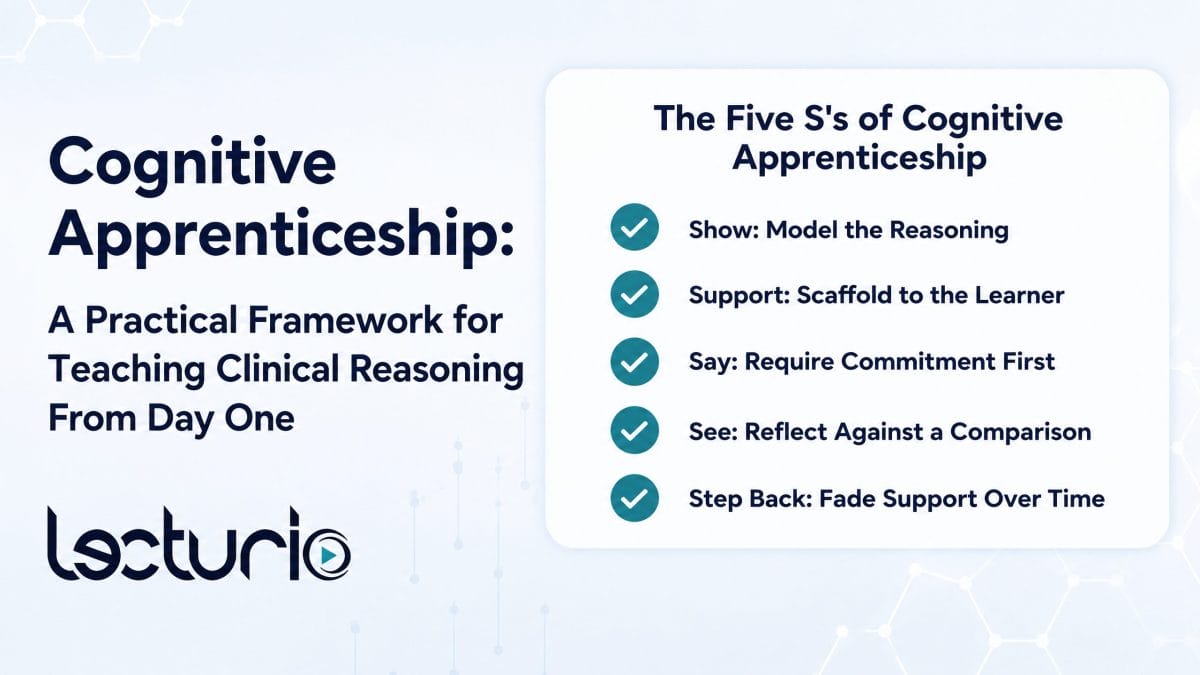
The original framework describes six core instructional methods and is well-researched. It also helps to have a practical way of holding onto it in the middle of a busy clinical teaching day: five educator moves, Show, Support, Say, See, Step back. This isn’t a separate published framework, it’s a practical reframing of the same established model, built to be easier to actually remember and use at the bedside.
Show is modelling the thinking, not just the conclusion. In clinical teaching, that means making selected parts of expert reasoning audible: what caught our attention, how we are weighing evidence, where uncertainty remains, and what might make us revise our working diagnosis. The aim is not to narrate every thought, but to make the moments that matter visible enough for learners to examine and eventually practise themselves. There’s a real difference between a clinician saying “this looks like a pulmonary embolism” and saying “the sudden dyspnea and pleuritic pain raise PE as an option for me, and the long flight changes the prior probability, but I still need to rule out the rest of the picture before I commit.” The first demonstrates an expert conclusion. The second lets the learner hear what’s actually being weighed, and hear that the working diagnosis is provisional rather than a flash of intuition (Jagannath, Dreicer, Penner, & Dhaliwal, 2022). Used selectively, on the moments that matter rather than as a running narration of every thought, this is the foundation the other four moves build on.
Support combines coaching and scaffolding, the core of clinical reasoning coaching in practice: providing structure appropriate to where a learner actually is, rather than a one-size-fits-all approach. In practice, that looks like asking “which finding matters most here?” instead of supplying the answer outright, a Socratic nudge rather than a rescue. Good scaffolding is contingent, different learners need different support, and the same learner needs different support at different points in their own development, not a fixed level applied forever (Masava, Nyoni, & Botma, 2023).
Say is articulation: requiring the learner to commit to something, a problem representation, a top-three differential, before any feedback arrives. This step matters more now than it used to. In an era where a learner could plausibly get an answer from an AI tool before ever committing to their own reasoning, protecting the moment of commitment is what keeps reasoning coachable at all. This is closely related to the never-skilling risk of AI tools that supply answers before a learner has reasoned through a problem, a risk worth understanding in more depth separately.
See is reflection, but reflection with something concrete to compare against, an expert’s approach, a peer’s reasoning, or the learner’s own earlier attempt, not a generic “how did that go?” Deliberate reflection structured this way is itself one of a small set of knowledge-oriented strategies with direct guidance for clinical reasoning teaching (Torre & Mamede, 2023). Reflection becomes genuinely useful once there’s something specific to inspect side by side, not as a closing formality. Lecturio has covered the metacognitive side of this in more depth, including how cognitive bias and the “illusion of knowing” undermine self-assessment, worth a closer look if reflection specifically is where your program needs the most work.
Step back combines two related moves: fading and exploration. Fading is the deliberate, gradual withdrawal of support as a learner’s competence grows. Worth being precise here, fading doesn’t mean the task gets easier. It means less structure is provided for a task whose actual complexity may well be increasing. A novice might be handed a diagnostic schema and asked which features matter most. A more advanced learner might simply be asked to talk through their reasoning, unprompted, on a case of equal or greater difficulty.
Exploration is the other half, and it shifts more than just the amount of support: it gives the learner room to pose their own questions and pursue reasoning on problems the educator hasn’t already framed for them. A learner ready for this might choose which aspect of a case to dig into further, or bring their own differential to a discussion rather than responding to one the educator set up. Fading and exploration describe the same underlying shift from two different angles, less structure provided, and more initiative taken, and together they’re what “stepping back” actually means.
A Coherent Teaching Approach, Not a Rigid Checklist
Worth stating plainly, since it’s easy to misread five neatly labeled steps as a sequence: this is a teaching scaffold, not a claim that expert reasoning happens in this order. In real practice, noticing, interpreting, and deciding often happen nearly simultaneously, especially for experienced clinicians working quickly. Treating the five moves as a rigid checklist, “first I’ll teach noticing, then interpreting,” misses the point entirely.
That doesn’t mean every encounter needs all five. Modeling on its own can sharpen how a learner listens for the next case. A single well-placed reflective question can be useful without the rest of the sequence around it. The value of the 5S lens is in giving educators a coherent way to think about teaching clinical reasoning over time, not a rule that each move must appear every time they teach.
The same five moves can provide a consistent organizing lens across learner levels, but how they are enacted changes with the learner. It is part of what makes the framework practical rather than a separate curriculum for every stage of training. What changes isn’t the moves themselves, it’s how much structure the educator provides within each one. An early learner needs more scaffolding inside “Support.” A resident nearing independence needs far less, sometimes none at all, on the exact same case.
Where a Tool Like Healer Fits
A structured clinical reasoning platform can create repeated opportunities to operationalize elements of this framework, particularly the “Say” step. A tool that requires a learner to commit to a differential, build a problem representation, and commit to a management plan before revealing any expert comparison creates exactly the externalized commitment cognitive apprenticeship calls for. The technology creates the practice space; the educator still defines the objective, calibrates the task to the learner, coaches the reasoning in the moment, and makes meaning of it through debrief.
The full picture of how Healer structures and makes elements of that reasoning process observable is its own subject, and it’s covered, alongside the broader strategies overview linked earlier, elsewhere on the site, so this piece stays focused on the teaching methodology itself rather than retracing that ground.
Making Clinical Reasoning More Explicit
| Dimension | When reasoning remains more implicit | With cognitive apprenticeship made explicit |
| Modelling | Learners may see the conclusion without seeing how it was reached | Educators deliberately make selected reasoning steps visible |
| Support | Guidance may depend largely on the moment or educator | Support is deliberately matched to the learner and task |
| Learner articulation | Learners may receive feedback before fully expressing their reasoning | Learners articulate key elements of their reasoning before feedback |
| Reflection | Discussion may focus mainly on whether the answer was correct | Learners compare how they reasoned with an expert, peer, prior attempt, or case outcome |
| Independence | Support may decrease informally as learners progress | Scaffolding is deliberately faded as learner capability and control increase |
| Curriculum timing | Reasoning may become most visible once learners enter clinical settings | Reasoning behaviours can be introduced earlier, with developmentally appropriate tasks and support |
None of this requires an elaborate curriculum overhaul to start. It requires being deliberate about five moves most clinical educators are already doing some of, showing thinking instead of conclusions, scaffolding instead of rescuing, requiring commitment before feedback, reflecting against something specific, and knowing when to step back. Ready to see what a structured approach to teaching clinical reasoning looks like for your own medical or nursing program? Try a Healer Case now or Schedule a Demo with the Lecturio team today.
Frequently Asked Questions
What is cognitive apprenticeship in medical education?
It’s a teaching framework that adapts traditional apprenticeship, learning by watching a master and practicing with fading support, to teaching cognitive skills like clinical reasoning rather than physical ones. It makes an expert’s thinking process visible through deliberate modeling, coaching, and reflection, rather than assuming reasoning will be picked up implicitly through exposure alone.
How is cognitive apprenticeship different from just asking students to explain their reasoning?
Asking a learner to explain their reasoning is only one part of the framework, the articulation step. On its own, without modeling how expert thinking actually sounds, appropriately scaffolded support, and structured reflection against something concrete, that single question doesn’t teach the underlying skill, it just tests whether the learner already has it.
Does cognitive apprenticeship actually improve clinical reasoning skills?
Yes, there is encouraging evidence that cognitive-apprenticeship approaches can improve aspects of clinical reasoning and related performance, although the evidence remains context-specific and includes different study designs. A 2025 randomized clinical trial in critical care resident training found statistically significant improvements in clinical judgment and reasoning, and a separate 2024 study found improved clinical reasoning assessment scores among student pharmacists using the same approach.
When should clinical reasoning teaching start in a training program?
Clinical reasoning can be introduced before formal clinical exposure begins, as long as the task and the scaffolding are matched to the learner’s level, it isn’t a question of earlier automatically being better. The distinction that matters is between early exposure and early independence: starting early doesn’t mean expecting first-year students to reason like residents, it means beginning to teach the underlying behaviors, noticing, representing, explaining, revising, with support that matches where the learner actually is.
How does cognitive apprenticeship apply to AI-assisted learning tools?
The framework’s articulation step, requiring a learner to commit to their own reasoning before receiving feedback, is one important safeguard against a real risk with AI tools: a learner getting an answer before ever reasoning through the problem themselves. But that commitment isn’t the end of the interaction. AI-generated feedback works best as something for the learner and educator to explain, compare, and reflect on together, more specific material for the debrief, not a verdict that closes the loop on its own.