

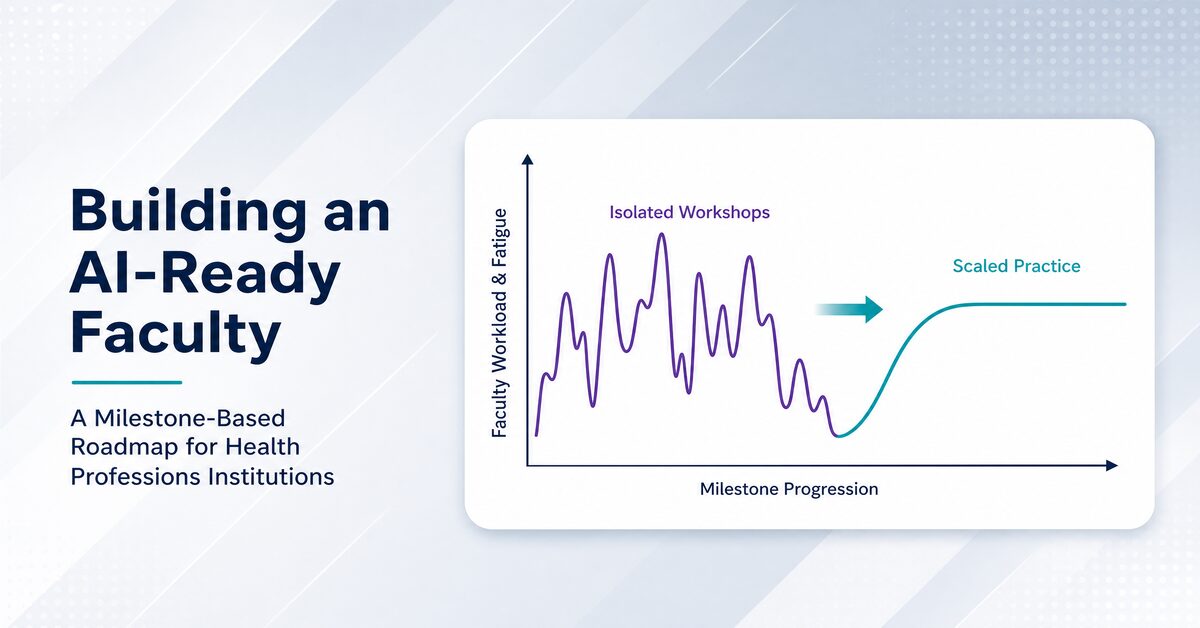
At a glance: Building an AI-ready faculty is the systematic process of equipping medical and health professions educators with longitudinal, milestone-based competencies to integrate algorithmic tools effectively into curriculum design, clinical instruction, and administrative workflows, bypassing isolated workshops to achieve sustainable institutional readiness.
Introduction: The Faculty Development Trap in Academic Medicine
Managing the rapid integration of artificial intelligence into medical curricula frequently creates a systemic bottleneck where grassroots experimentation outpaces centralized administrative coordination. As detailed in our core institutional framework, The 4 Dimensions of an AI-Ready Health Professions Institution, trapping a medical school in a cycle of isolated, single-event informational workshops is a restrictive “Pilot Stage” warning sign. It leaves educators isolated and resource-constrained when updating everyday workflows.
Whether an institution is in the initial exploratory phases or preparing to transition to a scaled ‘Practice Stage,’ leadership teams mapping out institutional retreats benefit from an AI adoption roadmap tailored to their current baseline. This cooperative framework horizontally aligns technology, data legal teams, and educational departments to build a sustainable path forward. This strategic coordination ensures that any curricular evolution maintains absolute compliance with institutional mandates. Specifically, it satisfies LCME Standard 6 requirements by using automated tracking protocols for curriculum mapping and program evaluation, while safely leveraging ACGME innovative approach allowances through structured algorithmic entrustment frameworks that balance machine outputs against clinical intuition.
Survey data from a large urban medical school (Blanco et al., 2025) reveal that faculty and students face significant initial barriers to AI integration, specifically pointing to a lack of technical knowledge, severe time constraints, and unclear programmatic benefits as the primary hurdles.
Faculty Development Progression: From Disconnected Pilots to Scaled Competence
| Operational Upskilling Dimension | Legacy Institutional State (The Restricted Pilot Phase) | Transformed Institutional State (The Scaled Practice Phase) |
| Faculty Time & Cognitive Workload | Overstretched educators manually parse unvetted software and parse inconsistent department policies, spending dozens of hours building custom evaluation templates, which increases instructional fatigue. | Milestone-based continuous upskilling with centralized guidelines, stabilizing faculty workloads and supporting sustainable, programmatic alignment. |
| Instructional Risk & Deskilling Management | Passive, uncritical software utilization lacking real-world clinical context, accelerating the risk of professional deskilling. | Faculty apply structured algorithmic entrustment frameworks, explicitly balancing machine outputs against clinical intuition. |
| Accreditation and Alignment Validation | Isolated training interventions fail to generate long-term pedagogical adjustments, leaving educators resource-constrained under LCME Standard 6 rules. | Clear, milestone-driven tracking protocols automate the documentation of data lifecycles, curriculum mapping, and program evaluation. |
The Core Pedagogical Framework: From Literacy to Entrustment
Developing a scalable approach to medical faculty training requires moving beyond baseline technical literacy to a comprehensive model of algorithmic entrustment. By embedding computational evaluation directly into established clinical supervision and adult learning theories, health professions institutions ensure that educators can systematically assess and deploy advanced technologies, driving faculty confidence and intentional assessment redesign without compromising teaching quality.
To achieve sustainable faculty readiness, upskilling initiatives must look past superficial software tutorials and anchor to multi-dimensional frameworks. Applying the longitudinal AI-PACE Framework (McGrath et al., 2026) illustrates how comprehensive educational planning can ground competencies across the traditional Psychomotor, Affective, and Cognitive domains, while deploying an ‘Embedded’ structural pillar to sustain learning throughout training. This multi-dimensional approach is further supported by recent mixed-methods pilot data evaluating synchronous, theory-grounded generative AI workshops for experienced medical faculty (Anand et al., 2026). This research notes an evolving shift from initial exploration toward intentional pedagogical application, with participating faculty reporting increased confidence and explicit intent to utilize generative AI frameworks for backward lesson planning and case scenario creation.
This paradigm shifts educator preparation toward the trust-based model detailed by Gin et al. (2025) in Academic Medicine, which applies clinical entrustment principles directly to machine learning systems. Under this framework, faculty are trained to evaluate algorithmic platforms across three core characteristics:
- Ability: Assessing domain competence and clinical accuracy.
- Integrity: Demanding transparency, source verification, and explicit bias disclosure.
- Benevolence: Ensuring alignment with ethical standards, data privacy, and society’s best interests.
This structured oversight serves as a vital safeguard against “professional deskilling”—the systematic reduction in baseline clinical or instructional competence that occurs when educators exhibit an uncritical, passive overreliance on automated architectures.
The Faculty Development Menu: Strategic Table Matrix
Establishing a clear, milestone-driven curriculum for continuous professional development ensures that faculty progress from initial awareness to advanced pedagogical expertise. Providing deans and clerkship directors with a structured competency matrix enables medical schools to map clear educational interventions to specific operational goals, directly optimizing instructional analytics and lowering administrative fatigue.
The following matrix is adapted from the milestone principles established in the Khamis et al. (2025) AI Competency Framework, mapping localized institutional session highlights to progressive mastery levels:
| Competency Domain | Target Milestone Level | Recommended Session Focus | Operational Rationale & Institutional Progression |
| I. AI Fundamentals & Data Literacy | Level 1 to 3 (Novice to Competent) | Demystifying the Black Box: Generative Mechanics in HPE | Explains foundational terminology such as prompts, tokens, and context windows , while differentiating machine learning from retrieval-augmented generation (RAG) to eliminate manual confusion. |
| II. Ethical Algorithm Governance | Level 3 to 4 (Competent to Proficient) | Mitigating Algorithmic Bias and Securing Student Privacy | Equips educators to apply institutional policies that safeguard sensitive student records and implement formal bias audits to prevent demographic profiling. |
| III. AI-Assisted Educational Activities | Level 3 to 5 (Competent to Expert) | Rethinking Examination Integrity & Automated Feedback Loops | Focuses on designing advanced assessment formats—such as quantifying script concordance testing metrics—backed by validated backend pipelines to scale student feedback without accelerating faculty burnout. |
| IV. Workflow Efficiency & Well-being | Level 2 to 4 (Advanced Beginner to Proficient) | Combating Academic Burnout Through Instructional Analytics | Utilizes administrative dashboards to streamline curriculum mapping, automate routine processing, and optimize scheduling parameters under strict human oversight. |
Multimedia Curricular Blueprint
For a step-by-step examination of institutional change management, view our complete panel discussion: Watch the Lecturio Faculty Demo Webinar: From Pilot to Practice. This presentation details how to transition from fragmented software pilots to a continuous, milestone-aligned institutional architecture.
How AI Supports Curriculum Mapping and Board-Exam Alignment
Manually cross-referencing course content against current USMLE and NCLEX blueprints is one of the more time-intensive, error-prone tasks curriculum committees face — and one most faculty repeat every review cycle by hand. Lecturio’s content is deeply indexed against institutional syllabi and learning objectives, allowing faculty to align curriculum directly with current board-exam blueprints rather than tracking coverage manually across spreadsheets. Combined with board-aligned Qbanks for USMLE and NCLEX, this gives curriculum committees a real-time view of blueprint coverage without adding to faculty workload — turning a recurring audit task into an ongoing, automated check.
Activating the Roadmap: Overcoming the Operational Overhead
Executing a longitudinal institutional integration requires managing heavy operational and administrative overhead without disrupting daily educational workflows. A structured implementation timeline is vital for long-term organizational success. In alignment with institutional rollout models (Acosta, 2026), institutions should target short-term milestones (0–12 months) toward peer mentorship and curriculum mapping, while structuring long-term milestones (1–3 years) around continuous feedback loops and formal framework integration.
Fostering vibrant communities of practice and empowering local champions within educational departments ensures that upskilling becomes a collaborative, peer-led effort. Rather than relying solely on formal, isolated training pathways, these grassroots networks give educators a dedicated space to share emerging practices, troubleshoot implementation challenges, and learn from one another in real time.
However, internal IT, legal, and educational technology departments are routinely overwhelmed by the extensive due diligence required to independently verify data lifecycles, validate statistical thresholds, and establish safe clinical override protocols. This friction is compounded when programs must navigate university-wide technology implementation freezes or restrictive university guidelines.
This operational strain highlights why leading medical schools position Lecturio as an expert partner among professional AI training companies. Rather than forcing overstretched clerkship directors to manually build custom grading engines or isolated AI learning simulation modules from scratch, Lecturio delivers a centralized, peer-reviewed educational ecosystem.
This structural environment aligns with the core instructional competencies recommended in university guidelines such as the Stanford AI curricular guides (2026), utilizing advanced platform mechanics to manage data lifecycles while conserving vital faculty bandwidth for hands-on, humanistic mentorship.
Conclusion
In an era defined by rapid knowledge expansion, relying on passive, scattered models of instructional experimentation leaves an institution’s curricular framework fragmented and its reputation vulnerable. Implementing a structured, milestone-aligned training framework is increasingly recognized as a key enabler of sustainable AI integration, serving to stabilize overstretched faculty workloads and support long-term programmatic alignment.
Ready to transition your program from localized pilots to scaled, accredited practice? Partner with an educational ecosystem engineered specifically to handle technical due diligence, eliminate administrative overhead, and systematically activate your faculty roadmap. Schedule a Demo with the Lecturio team today.
Frequently Asked Questions
How do structured AI workshops in medical education environments shift programs from pilot to practice?
While single-event training interventions fail to generate long-term pedagogical adjustments without structural support , shifting an institution to scaled practice requires embedding these concepts into a longitudinal, milestone-based continuum. This transition ensures that training is directly tied to ongoing course redesign, institutional policies, and programmatic accreditation standards rather than remaining an isolated pilot.
What are the primary institutional barriers to medical faculty training in AI?
According to peer-reviewed data, the primary institutional barriers include a profound lack of administrative oversight, significant faculty time constraints, and the immense overhead required to audit data privacy lifecycles. Overcoming these hurdles requires formal administrative pathways, protected upskilling time, and robust external educational partnerships.
How can universities operationalize a longitudinal AI adoption roadmap without accelerating faculty burnout?
A sustainable AI adoption roadmap avoids faculty fatigue by relying on centralized, pre-vetted educational ecosystems rather than demanding that educators manually develop automated grading engines or instructional modules from scratch. Providing tiered development tracks and protecting administrative time during the first twelve months further preserves instructional bandwidth.
How does an AI learning simulation enhance student readiness for clinical practice?
An advanced AI learning simulation enhances clinical readiness by training students to critically analyze machine outputs, evaluate error distributions, and implement clinical override protocols within a safe, simulated environment. This prepares graduates to transition smoothly into increasingly automated, real-world clinical training environments.