

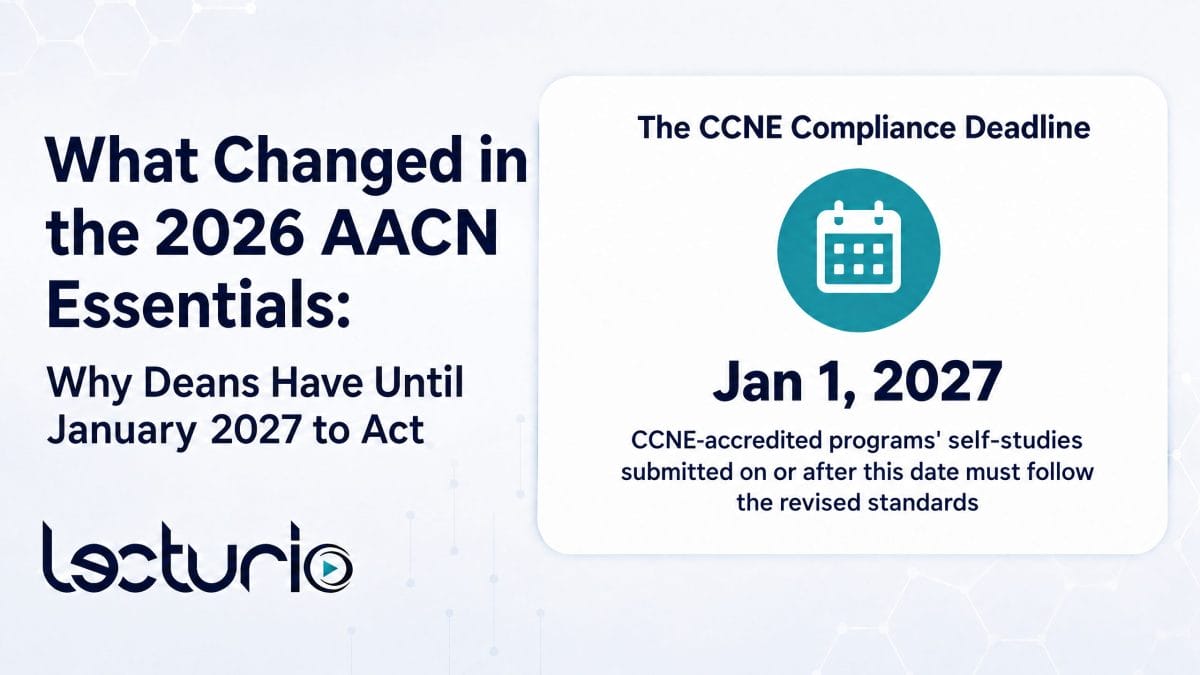
At a glance: The 2026 AACN Essentials retain the ten-domain structure of the 2021 framework while adding Access, Connection, and Engagement (ACE) as a concept integrated across the curriculum. CCNE’s revised 2026 accreditation standards take effect January 1, 2027, making this an immediate curriculum-review and documentation issue for programs preparing self-studies or site visits under the new standards.
When AACN‘s Board endorsed the original Essentials in 2021, they committed to something easy to forget about five years later: revisiting the document at the five-year mark to keep it current as healthcare and nursing education evolve. That revisit happened. The 2026 edition was posted online on April 17, 2026.
This is a targeted rather than structural revision, but it carries practical implications for curriculum mapping, assessment, and accreditation preparation. CCNE, the accrediting body for baccalaureate and graduate nursing programs, has already approved its own revised 2026 Standards in direct response, and set an effective date that’s closer than it might feel. For a Dean managing a program that’s already stretched between faculty shortages, NGN preparation, and everyday curriculum upkeep, a revised accreditation standard landing mid-year can easily read as one more thing competing for the same limited planning time. The good news is that this particular update is narrower than it might sound at first, but the deadline attached to it is real and worth understanding precisely.
This piece walks through what actually changed in the 2026 Essentials, why CCNE’s timeline creates real urgency for Deans right now, and a practical way to update existing curriculum maps without a full rebuild.
The Essentials Were Always Meant to Be Revisited
The 2021 Essentials marked a major shift toward competency-based education, organizing nursing education around ten domains of professional practice and emphasizing what graduates can demonstrate and apply rather than relying primarily on course completion or content coverage as proxies for readiness. That was a genuine structural shift for most programs, touching curriculum design, assessment, and how faculty document student progress. By 2025, that shift had gained broad institutional buy-in, with 95% of college and university leadership and 99% of schools surveyed expressing support (AACN, 2026).
The five-year review was planned from the outset rather than triggered by a failure of the 2021 framework. AACN committed to revisiting the Essentials periodically so the framework could remain responsive to changes in nursing practice, education, and healthcare
What Actually Changed: The ACE Framework
The substantive change in the 2026 edition is the addition of Access, Connection, and Engagement, ACE, into the Concepts for Nursing Practice section. ACE itself was introduced to AACN’s membership in July 2025, before being formally incorporated into the Essentials (AACN, 2026), giving programs roughly nine months of advance notice before it appeared in the formal document.
ACE asks nursing programs to make access to care, connection with individuals and communities, and meaningful engagement with health systems more visible within existing competencies and learning experiences. This includes preparing nurses to recognize and respond to barriers such as geography, affordability, health literacy, trust, continuity of care, and patients’ ability to navigate the health system.
Those aren’t abstractions for a working nurse, they’re the reason a patient misses follow-up appointments, doesn’t fill a prescription, or avoids a clinic altogether until a manageable condition becomes an emergency. ACE asks nursing curricula to treat these as things graduates need to be prepared to address directly, not background conditions somebody else handles.
The Essentials describe ACE as interwoven across existing domains and competencies rather than added as a freestanding new domain (AACN, 2026). Because ACE is integrated across the existing domains rather than introduced as an eleventh domain, most programs will be reviewing and strengthening existing curriculum rather than creating an entirely separate strand. The extent of revision will still depend on how explicitly ACE-related competencies are currently taught, assessed, and documented. A program’s population health course, community clinical placements, and case studies involving underinsured or rural patients likely already touch this territory, the update is really about making that connection explicit and assessable rather than leaving it implicit.
Clinical judgment is also emphasized prominently in the 2026 Essentials and, like ACE, has implications across multiple domains rather than belonging to a single course or assessment. Lecturio has addressed the curricular implications of clinical judgment separately, so this article focuses on the ACE update.
The Accreditation Clock Is Already Running
Here’s where this stops being an academic curiosity and becomes a scheduling problem. CCNE conducted a focused review of its Standards for Accreditation of Baccalaureate and Graduate Nursing Programs specifically in light of the 2026 AACN Essentials updates (CCNE, 2026), and the CCNE Board of Commissioners approved revised 2026 Standards as a result, following a broad-based call for comment from CCNE’s own community of institutions.
The date to actually know: CCNE’s 2026 Standards take effect January 1, 2027. Any program submitting a self-study document to CCNE, or hosting an on-site evaluation, on or after that date must address the revised standards, and the 2024 Standards remain in effect only through December 31, 2026 (CCNE, 2026).
Self-study preparation for a CCNE site visit is a months-long undertaking, not something assembled the week before, it typically involves drafting a full self-study document, gathering supporting evidence across every standard, and coordinating input from faculty, clinical partners, and administration.Programs with self-study submissions or on-site evaluations falling on or after January 1, 2027 should review CCNE’s transition guidance carefully and begin working from the revised standards now. For programs already preparing accreditation materials, the practical implication is simple: the standards used for planning and evidence collection should match the standards under which the program will actually be reviewed.
A Practical Approach to Updating Curriculum Maps
None of this means starting from zero. Programs already have curriculum maps built against the ten domains from the 2021 transition, the job now is targeted revision, not replacement.
A 2025 scoping review synthesized findings from 37 peer-reviewed studies on how nursing programs review and revise curricula to implement competency-based education (Mani, 2025), giving programs a real evidence base to draw on rather than reinventing an approach from scratch. That kind of accumulated evidence matters here specifically because curriculum revision has a way of becoming an open-ended project without some structure to bound it, a program can spend a semester debating scope before a single competency statement gets rewritten.
In practice, that suggests a workable sequence. A practical review should begin by asking where ACE is already represented across three levels: learning outcomes, learning experiences, and assessment evidence. Programs may already address access, trust, health literacy, rural care, care navigation, or community engagement in existing courses and clinical experiences. The task is to determine whether those expectations are explicit, aligned, and assessable.
Where ACE-related learning already exists, the priority may be clearer mapping and documentation. Where it appears in teaching but not in assessment, programs may need to add or revise assessment touchpoints. Where genuine curricular gaps remain, new learning experiences may be necessary. Third, prioritize the revision timeline against each program’s actual CCNE self-study submission or site visit date, not a generic institutional calendar that treats every program’s deadline the same. Programs already stretched thin on administrative bandwidth, the same pressure driving broader conversations about reclaiming faculty time from repetitive curriculum work, have real reason to treat this as a targeted revision rather than a from-scratch project. Revision should also involve the faculty who teach and assess the relevant content, rather than being treated solely as a curriculum-office mapping exercise. Their input is essential to determine whether documented alignment reflects what learners actually experience
From the 2021 Baseline to the 2026 Refinement
| Dimension | 2021 AACN Essentials | 2026 AACN Essentials |
| Overall structure | Ten domains organized within a competency-based framework | Ten-domain structure retained |
| Concepts for nursing practice | Existing concepts integrated across the framework | ACE added and integrated across domains and competencies |
| Curriculum implication | Programs mapped curricula, outcomes, and assessments to the new competency framework | Programs should review where ACE is taught, assessed, and documented, and address genuine gaps |
| Accreditation context | Implementation under prior CCNE standards | Revised CCNE standards take effect January 1, 2027 |
| Immediate priority | Build and operationalize competency-based alignment | Update curriculum maps, assessment evidence, and accreditation documentation where needed |
Programs do not need to assume that the 2026 Essentials require a wholesale curriculum redesign. The more useful starting point is a structured review: identify where ACE is already present, confirm whether it is explicitly reflected in outcomes and assessment, and address the places where meaningful gaps remain.
For programs preparing for review under the revised CCNE standards, beginning that work now allows curriculum changes and supporting evidence to develop intentionally rather than being assembled retrospectively for accreditation.
Ready to see what a structured approach to updating your curriculum map for the 2026 Essentials looks like? Schedule a Demo with the Lecturio team today.
Frequently Asked Questions
What is different about the 2026 AACN Essentials compared to the 2021 version?
The 2026 Essentials retain the ten-domain, competency-based structure introduced in 2021. The principal update is the addition of Access, Connection, and Engagement (ACE) as a concept integrated across the existing domains and competencies, alongside other refinements to the framework.
When do CCNE’s 2026 Standards actually take effect?
CCNE’s revised standards take effect January 1, 2027. Programs preparing self-studies or on-site evaluations under the new standards should review the transition guidance now and ensure that curriculum mapping and supporting evidence are aligned with the standards that will apply to their review.
Does the ACE framework require adding a new domain to our curriculum?
No. AACN describes ACE as interwoven across the existing ten domains and competencies, not as a freestanding eleventh domain, so the work is revision within existing curriculum maps rather than building a new structure from scratch.
Do programs need to fully redo their curriculum maps for this update?
Not necessarily. Programs that already completed substantial mapping to the 2021 Essentials have a strong foundation. For many, the 2026 update will involve targeted revision and clearer documentation, although programs with limited existing coverage of ACE-related competencies may require more substantial curriculum or assessment changes.
How does the 2026 Essentials update relate to clinical judgment requirements?
Clinical judgment remains a prominent concept within the 2026 Essentials and, like ACE, has implications across multiple domains and learning experiences. Programs should review both explicitly, while recognizing that they represent different aspects of professional nursing competence.