Domina Conceptos Médicos

Estudia para la escuela de medicina y tus examenes con Lecturio.

Enfermedad de Blount

La enfermedad de Blount es un trastorno ortopédico de la infancia que se caracteriza por la inclinación hacia fuera de la pierna debido a la osificación anormal de la cara medial de la epífisis tibial. La enfermedad de Blount afecta sobre todo a los LOS Neisseria niños de ascendencia africana y suele aparecer aproximadamente entre los LOS Neisseria 1–3 años de edad. El diagnóstico se realiza mediante los LOS Neisseria hallazgos clínicos y se confirma con la imagenología. El objetivo del tratamiento es corregir la anatomía mediante dispositivos ortopédicos o reparación quirúrgica, según la gravedad y la edad del paciente en EN Erythema nodosum is an immune-mediated panniculitis (inflammation of the subcutaneous fat) caused by a type IV (delayed-type) hypersensitivity reaction. It commonly manifests in young women as tender, erythematous nodules on the shins. Erythema Nodosum el momento del diagnóstico. El pronóstico es excelente si se inicia rápidamente el tratamiento.

Last updated: Dec 15, 2025

Editorial responsibility: Stanley Oiseth, Lindsay Jones, Evelin Maza

Definición y Epidemiología

Definición

La enfermedad de Blount es el arqueo progresivo de las piernas producido por una osificación anormal en EN Erythema nodosum is an immune-mediated panniculitis (inflammation of the subcutaneous fat) caused by a type IV (delayed-type) hypersensitivity reaction. It commonly manifests in young women as tender, erythematous nodules on the shins. Erythema Nodosum la cara medial de la epífisis tibial.

Clasificación

  • Temprana o infantil: se presenta entre los LOS Neisseria 1–3 años de edad
  • Tardía; se subdivide en EN Erythema nodosum is an immune-mediated panniculitis (inflammation of the subcutaneous fat) caused by a type IV (delayed-type) hypersensitivity reaction. It commonly manifests in young women as tender, erythematous nodules on the shins. Erythema Nodosum:
    • Forma juvenil: se presenta a los LOS Neisseria 4–10 años de edad
    • Forma adolescente: se da en EN Erythema nodosum is an immune-mediated panniculitis (inflammation of the subcutaneous fat) caused by a type IV (delayed-type) hypersensitivity reaction. It commonly manifests in young women as tender, erythematous nodules on the shins. Erythema Nodosum niños mayores de 10 años

Epidemiología

  • Mayor incidencia en EN Erythema nodosum is an immune-mediated panniculitis (inflammation of the subcutaneous fat) caused by a type IV (delayed-type) hypersensitivity reaction. It commonly manifests in young women as tender, erythematous nodules on the shins. Erythema Nodosum afrodescendientes
  • Enfermedad de Blount temprana:
    • Niños > niñas
    • Bilateral en EN Erythema nodosum is an immune-mediated panniculitis (inflammation of the subcutaneous fat) caused by a type IV (delayed-type) hypersensitivity reaction. It commonly manifests in young women as tender, erythematous nodules on the shins. Erythema Nodosum el 50% de los LOS Neisseria casos
  • Enfermedad de Blount tardía:
    • Menos común y menos grave que la forma temprana
    • Más probable que sea unilateral
  • Prevalente en EN Erythema nodosum is an immune-mediated panniculitis (inflammation of the subcutaneous fat) caused by a type IV (delayed-type) hypersensitivity reaction. It commonly manifests in young women as tender, erythematous nodules on the shins. Erythema Nodosum las zonas con mayores tasas de obesidad y deficiencia de vitamina D
  • Prevalencia: <1% de la población en EN Erythema nodosum is an immune-mediated panniculitis (inflammation of the subcutaneous fat) caused by a type IV (delayed-type) hypersensitivity reaction. It commonly manifests in young women as tender, erythematous nodules on the shins. Erythema Nodosum los LOS Neisseria Estados Unidos

Etiología y Fisiopatología

Etiología

Se desconoce la causa exacta de la enfermedad de Blount y se cree que es multifactorial o que se debe a una combinación de factores hereditarios y del desarrollo:
  • Susceptibilidad genética
  • Sobrecarga mecánica de la articulación (asociada a la obesidad)

Fisiopatología

  • Bases Bases Usually a hydroxide of lithium, sodium, potassium, rubidium or cesium, but also the carbonates of these metals, ammonia, and the amines. Acid-Base Balance del desarrollo de la enfermedad de Blount:
    • Fuerza excesiva
    • Alteración de la osificación endocondral de la pierna
  • Fuerzas mecánicas (obesidad y deambulación temprana) sobre la fisis medial de la tibia Tibia The second longest bone of the skeleton. It is located on the medial side of the lower leg, articulating with the fibula laterally, the talus distally, and the femur proximally. Knee Joint: Anatomy → retraso del crecimiento
  • Pueden observarse cambios histológicos en EN Erythema nodosum is an immune-mediated panniculitis (inflammation of the subcutaneous fat) caused by a type IV (delayed-type) hypersensitivity reaction. It commonly manifests in young women as tender, erythematous nodules on the shins. Erythema Nodosum la placa de crecimiento tibial:
    • Hipertrofia celular e islas de fibrocartílago
    • Significa que el cartílago está lesionado
  • El cartílago lesionado retrasa el crecimiento del hueso en EN Erythema nodosum is an immune-mediated panniculitis (inflammation of the subcutaneous fat) caused by a type IV (delayed-type) hypersensitivity reaction. It commonly manifests in young women as tender, erythematous nodules on the shins. Erythema Nodosum el lado medial → deformidad en EN Erythema nodosum is an immune-mediated panniculitis (inflammation of the subcutaneous fat) caused by a type IV (delayed-type) hypersensitivity reaction. It commonly manifests in young women as tender, erythematous nodules on the shins. Erythema Nodosum varo
  • El procurvatum Procurvatum Blount’s Disease (flexión hacia atrás de la tibia Tibia The second longest bone of the skeleton. It is located on the medial side of the lower leg, articulating with the fibula laterally, the talus distally, and the femur proximally. Knee Joint: Anatomy) se debe principalmente a que el mayor efecto inhibidor se produce en EN Erythema nodosum is an immune-mediated panniculitis (inflammation of the subcutaneous fat) caused by a type IV (delayed-type) hypersensitivity reaction. It commonly manifests in young women as tender, erythematous nodules on the shins. Erythema Nodosum la cara posteromedial de la metáfisis tibial.
Enfermedad de Blount

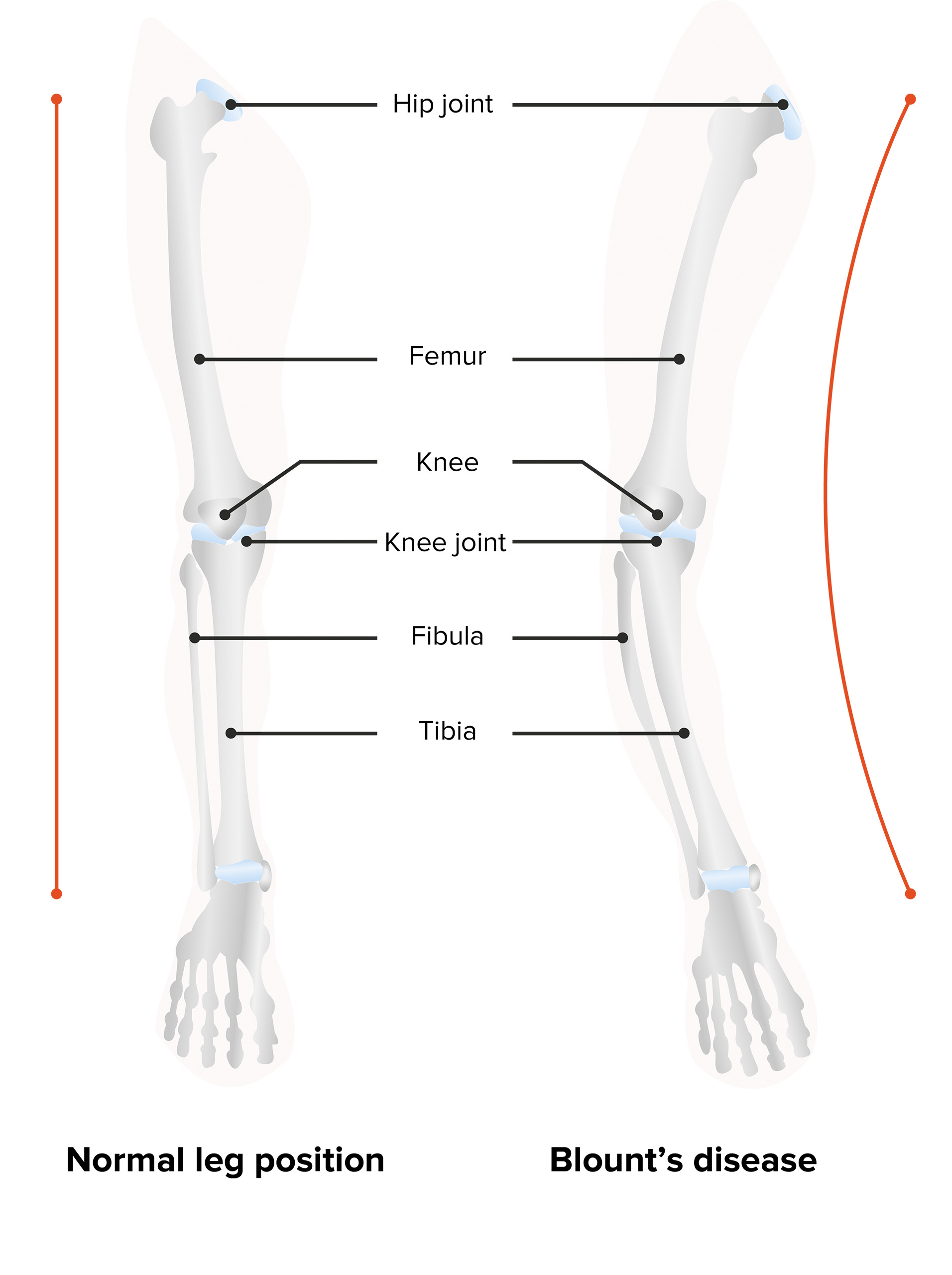
Enfermedad de Blount: deformidad en varo y flexión hacia atrás de la pierna

Imagen por Lecturio.
Presentación Clínica

  • Los LOS Neisseria pacientes generalmente tienen sobrepeso u obesidad.
  • Deformación tridimensional:
    1. Varo (arqueamiento)
    2. Procurvatum Procurvatum Blount’s Disease (flexión hacia atrás de la tibia Tibia The second longest bone of the skeleton. It is located on the medial side of the lower leg, articulating with the fibula laterally, the talus distally, and the femur proximally. Knee Joint: Anatomy)
    3. Rotación interna de la tibia Tibia The second longest bone of the skeleton. It is located on the medial side of the lower leg, articulating with the fibula laterally, the talus distally, and the femur proximally. Knee Joint: Anatomy (que da lugar a la desviación interna de los LOS Neisseria dedos del pie)
  • Discrepancia de longitud en EN Erythema nodosum is an immune-mediated panniculitis (inflammation of the subcutaneous fat) caused by a type IV (delayed-type) hypersensitivity reaction. It commonly manifests in young women as tender, erythematous nodules on the shins. Erythema Nodosum los LOS Neisseria miembros inferiores
  • Protuberancia ósea no sensible en EN Erythema nodosum is an immune-mediated panniculitis (inflammation of the subcutaneous fat) caused by a type IV (delayed-type) hypersensitivity reaction. It commonly manifests in young women as tender, erythematous nodules on the shins. Erythema Nodosum la cara medial de la tibia Tibia The second longest bone of the skeleton. It is located on the medial side of the lower leg, articulating with the fibula laterally, the talus distally, and the femur proximally. Knee Joint: Anatomy proximal
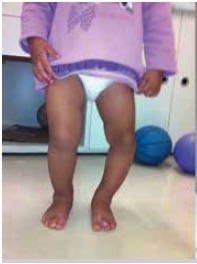
Enfermedad de Blount en un niño

Pierna izquierda con deformidad en varo

Imagen: “Blount’s disease” por Universidade de São Paulo, Faculdade de Medicina, Hospital das Clínicas, Instituto de Ortopedia e Traumatologia, São Paulo, SP, Brazil. Licencia: CC BY 4.0, editada por Lecturio.
Tabla: Características clínicas de la enfermedad de Blount temprana frente a la tardía
Enfermedad de Blount temprana Enfermedad de Blount tardía
No hay dolor Dolor Inflammation Dolor Dolor Inflammation en EN Erythema nodosum is an immune-mediated panniculitis (inflammation of the subcutaneous fat) caused by a type IV (delayed-type) hypersensitivity reaction. It commonly manifests in young women as tender, erythematous nodules on the shins. Erythema Nodosum la zona de la tibia Tibia The second longest bone of the skeleton. It is located on the medial side of the lower leg, articulating with the fibula laterally, the talus distally, and the femur proximally. Knee Joint: Anatomy
Bilateral Unilateral
Deformación significativa Deformación leve
Asociada a la deambulación temprana Asociada a la obesidad

Diagnóstico

El diagnóstico de la enfermedad de Blount se realiza a través de los LOS Neisseria antecedentes médicos, el examen físico y la confirmación mediante la imagenología.

Imagenología

  • Radiografía completa de la pierna:
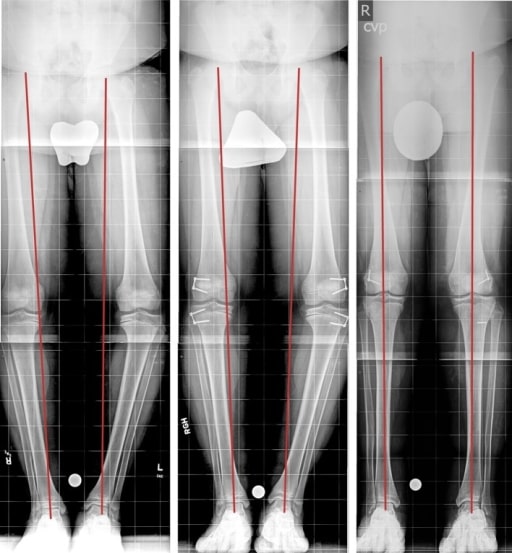
    • Angulación en EN Erythema nodosum is an immune-mediated panniculitis (inflammation of the subcutaneous fat) caused by a type IV (delayed-type) hypersensitivity reaction. It commonly manifests in young women as tender, erythematous nodules on the shins. Erythema Nodosum varo e inclinación en EN Erythema nodosum is an immune-mediated panniculitis (inflammation of the subcutaneous fat) caused by a type IV (delayed-type) hypersensitivity reaction. It commonly manifests in young women as tender, erythematous nodules on the shins. Erythema Nodosum la epífisis tibial con arqueo asimétrico
    • Deformidad medial en EN Erythema nodosum is an immune-mediated panniculitis (inflammation of the subcutaneous fat) caused by a type IV (delayed-type) hypersensitivity reaction. It commonly manifests in young women as tender, erythematous nodules on the shins. Erythema Nodosum pico: fragmentación de la epífisis medial de la tibia Tibia The second longest bone of the skeleton. It is located on the medial side of the lower leg, articulating with the fibula laterally, the talus distally, and the femur proximally. Knee Joint: Anatomy
    • Osificación irregular y ensanchamiento en EN Erythema nodosum is an immune-mediated panniculitis (inflammation of the subcutaneous fat) caused by a type IV (delayed-type) hypersensitivity reaction. It commonly manifests in young women as tender, erythematous nodules on the shins. Erythema Nodosum la epífisis medial
  • Resonancia magnética (RM): se utiliza sobre todo en EN Erythema nodosum is an immune-mediated panniculitis (inflammation of the subcutaneous fat) caused by a type IV (delayed-type) hypersensitivity reaction. It commonly manifests in young women as tender, erythematous nodules on the shins. Erythema Nodosum los LOS Neisseria casos de enfermedad de Blount infantil para evaluar los LOS Neisseria tejidos extratibiales

Gravedad

La gravedad se basa en EN Erythema nodosum is an immune-mediated panniculitis (inflammation of the subcutaneous fat) caused by a type IV (delayed-type) hypersensitivity reaction. It commonly manifests in young women as tender, erythematous nodules on the shins. Erythema Nodosum el ángulo metafisario-diafisario:
  • Mide el ángulo formado por una línea que pasa por los LOS Neisseria picos metafisarios y una línea perpendicular que pasa por el eje longitudinal de la tibia Tibia The second longest bone of the skeleton. It is located on the medial side of the lower leg, articulating with the fibula laterally, the talus distally, and the femur proximally. Knee Joint: Anatomy.
  • El ángulo metafisario-diafisario > 16 grados es diagnóstico de la enfermedad de Blount.
  • El ángulo metafisario-diafisario entre 11 y 15 grados es un diagnóstico probable y justifica el seguimiento.
  • El ángulo metafisario-diafisario <10 grados es probablemente fisiológico y resolverá espontáneamente.
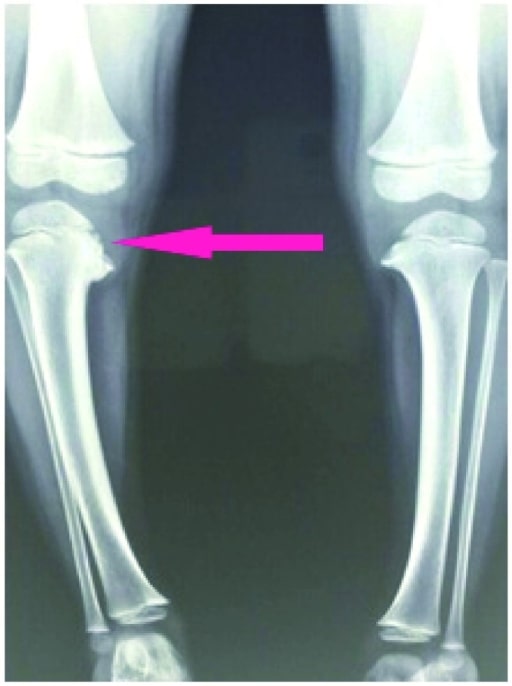
depresión de la meseta tibial medial

La radiografía de la rodilla muestra una depresión de la meseta tibial medial con un deformidad en pico de la fisis tibial posteromedial (flecha rosa).

Imagen: “X-ray” por US National Library of Medicine. Licencia: CC BY 4.0

Tratamiento y Pronóstico

Tratamiento

La edad del paciente y la gravedad de la deformidad determinan el tipo de tratamiento.
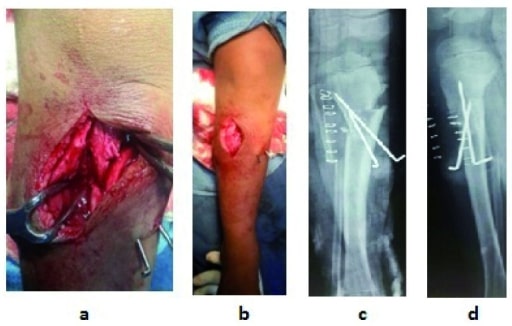
  • Dispositivos ortopédicos:
    • Indicados si es menor de 3 años
    • Solo se utilizan en EN Erythema nodosum is an immune-mediated panniculitis (inflammation of the subcutaneous fat) caused by a type IV (delayed-type) hypersensitivity reaction. It commonly manifests in young women as tender, erythematous nodules on the shins. Erythema Nodosum pacientes no obesos
    • Se usan principalmente por la noche
  • Tratamiento quirúrgico:
    • Indicado en EN Erythema nodosum is an immune-mediated panniculitis (inflammation of the subcutaneous fat) caused by a type IV (delayed-type) hypersensitivity reaction. It commonly manifests in young women as tender, erythematous nodules on the shins. Erythema Nodosum casos graves cuando la enfermedad progresa a pesar de los LOS Neisseria dispositivos ortopédicos
    • La osteotomía se realiza antes de los LOS Neisseria 4 años en EN Erythema nodosum is an immune-mediated panniculitis (inflammation of the subcutaneous fat) caused by a type IV (delayed-type) hypersensitivity reaction. It commonly manifests in young women as tender, erythematous nodules on the shins. Erythema Nodosum niños con una deformidad significativa.
    • La hemiepifisiodesis (corrección angular gradual) se realiza a partir de los LOS Neisseria 4 años.
    • Los LOS Neisseria métodos de fijación (métodos de corrección gradual) son los LOS Neisseria preferidos en EN Erythema nodosum is an immune-mediated panniculitis (inflammation of the subcutaneous fat) caused by a type IV (delayed-type) hypersensitivity reaction. It commonly manifests in young women as tender, erythematous nodules on the shins. Erythema Nodosum casos más graves o recurrentes.

Pronóstico

  • Enfermedad de Blount infantil/temprana:
    • Debe tratarse para evitar una deformación permanente
    • Con tratamiento oportuno → excelente pronóstico con raras recidivas
    • La forma leve puede remitir espontáneamente.
  • Enfermedad de Blount adolescente tardía:
    • Buen pronóstico con tratamiento
    • Menos probabilidades de tener una deformidad severa
  • La recurrencia es más común en EN Erythema nodosum is an immune-mediated panniculitis (inflammation of the subcutaneous fat) caused by a type IV (delayed-type) hypersensitivity reaction. It commonly manifests in young women as tender, erythematous nodules on the shins. Erythema Nodosum pacientes obesos.

Diagnóstico Diferencial

  • Genu varo fisiológico: los LOS Neisseria niños menores de 2 años presentan un arqueo fisiológico, simétrico e indoloro con desviación interna de los LOS Neisseria dedos del pie que remite espontáneamente con el crecimiento natural. El seguimiento generalmente se realiza para garantizar que la afección no siga progresando o tenga una patología subyacente.
  • Raquitismo: distorsión y reblandecimiento de los LOS Neisseria huesos debido a la deficiencia o resistencia a la vitamina D. Los LOS Neisseria pacientes generalmente presentan un arqueo de las piernas. Puede distinguirse de la enfermedad de Blount a través de los LOS Neisseria análisis de sangre y de la ausencia de deformación en EN Erythema nodosum is an immune-mediated panniculitis (inflammation of the subcutaneous fat) caused by a type IV (delayed-type) hypersensitivity reaction. It commonly manifests in young women as tender, erythematous nodules on the shins. Erythema Nodosum pico en EN Erythema nodosum is an immune-mediated panniculitis (inflammation of the subcutaneous fat) caused by a type IV (delayed-type) hypersensitivity reaction. It commonly manifests in young women as tender, erythematous nodules on the shins. Erythema Nodosum las radiografías.

Referencias

  1. Canale, S. T. (2017). Osteochondrosis or epiphysitis and other miscellaneous affections. In F. M. Azar MD, J. H. Beaty MD & S. T. Canale MD (Eds.), Campbell’s operative orthopaedics (pp. 1175-1248.e11). https://www.researchgate.net/publication/301058530_Osteochondrosis_or_Epiphysitis_and_Other_Miscellaneous_Affections
  2. Janoyer, M. (2019). Blount disease. Orthopaedics & Traumatology: Surgery & Research, 105(1), S111-S121. doi:http://dx.doi.org/10.1016/j.otsr.2018.01.009
  3. Montgomery CO, Young KL, Austen M, Jo CH, Blasier RD, Ilyas M. Increased risk of Blount disease in obese children and adolescents with vitamin D deficiency. J Pediatr Orthop. 2010;30(8):879–882. DOI:10.1097/BPO.0b013e3181f5a0b3
  4. S DMTS, Taqi M, De Leucio A. Blount Disease. [Updated 2024 Jan 9]. In: StatPearls [Internet]. Treasure Island (FL): StatPearls Publishing; 2025 Jan-. Available from: https://www.ncbi.nlm.nih.gov/books/NBK560923/
  5. LaMont, L., Fragomen, A. T., & Rozbruch, S. R. (2023, September 12). Blount disease (Tibia Vara). eMedicine. Retrieved January 13, 2025, from https://emedicine.medscape.com/article/1250420-overview#a1
  6. Skelton, J. A., & Klish, W. J. (2024, November 1). Overview of the health consequences of obesity in children and adolescents. UpToDate. Retrieved January 13, 2025, from https://www.uptodate.com/contents/overview-of-the-health-consequences-of-obesity-in-children-and-adolescents
  7. Rosenfeld, S. B. (2023, October 17). Approach to the child with bow-legs. UpToDate. Retrieved January 13, 2025, from https://www.uptodate.com/contents/approach-to-the-child-with-bow-legs

¡Crea tu cuenta gratis o inicia una sesión para seguir leyendo!

Regístrate ahora y obtén acceso gratuito a Lecturio con páginas de concepto, videos médicos y cuestionarios para tu educación médica.

User Reviews

Que tengas una sesión de estudio alegre y navideña 🎁 Ahorra 50% en todos los planes >>

Details