

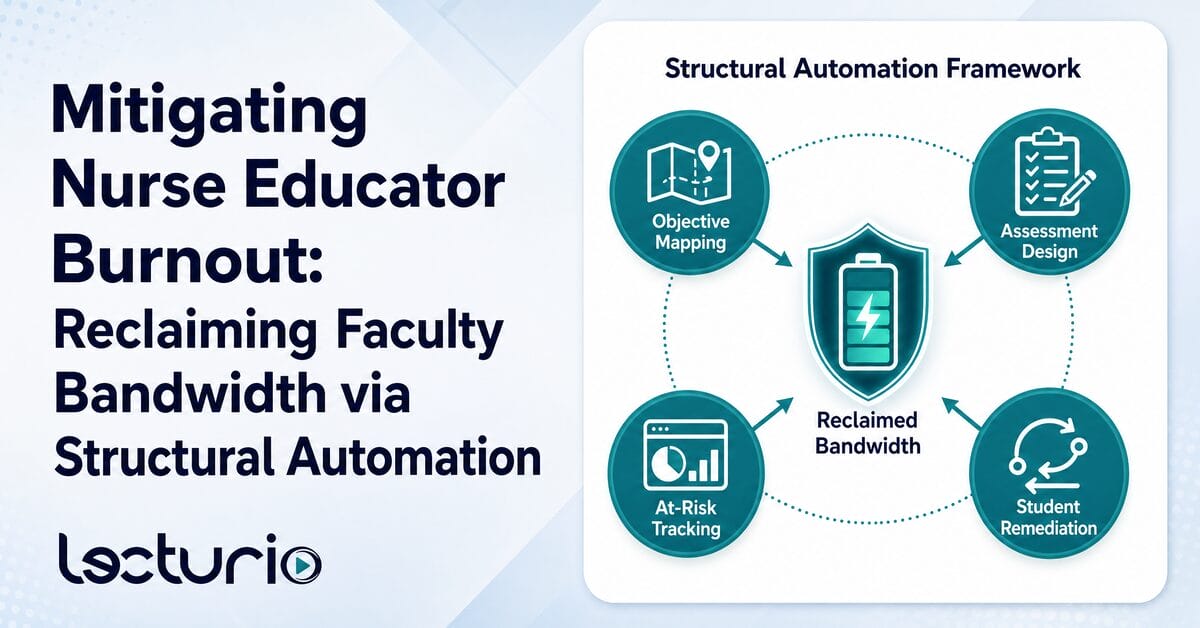
At a glance: Curriculum automation in nursing education is the strategic deployment of digital solutions to standardize instructional layout, mapping, and assessment design. By transitioning away from manual curriculum administration and tracking, curriculum automation reduces invisible workload inflation—not to reduce faculty positions, but to reinvest reclaimed capacity into peer collaboration, student mentoring, curriculum review, and participation in communities of practice that sustain long-term educational quality.
Introduction: The Institutional Numbers Crunch of 2026
Academic nursing leadership faces a high-stakes climate during fiscal year 2026, where chronic workforce shortages and intense recruitment pressures threaten institutional stability. Deans and program directors must directly confront the macro vacancy problem: the national vacancy rate for nursing faculty stands at 7.2% as of the 2025 AACN Vacancy Survey Report—down from 7.9% the prior year, though still historically elevated. This retention crisis is severely amplified by structural retirement waves; historical data compiled by Braud, Goodrich, and Martin (2025) showed one-third of all nursing faculty were projected to retire by 2025. This timeline aligns with broader workforce shifts highlighted in the Nurse.org 2026 State of Nursing Survey, which reveals that 44% of nursing respondents are currently 55 or older. Resolving this crisis requires a comprehensive faculty retention strategy that touches culture, leadership, and compensation. Within that broader framework, reducing administrative burden via curriculum automation serves as an essential operational catalyst—reclaiming the mental bandwidth and hours educators need to engage in high-value academic pursuits. Reclaimed faculty time directly fuels peer collaboration, student mentorship, curriculum innovation, scholarship, and participation in vibrant communities of practice—the very activities that sustain educational quality but are routinely squeezed out by administrative demands.
Compounding this emergency is a steep clinical-to-academic salary friction point that inherently constrains recruitment. There is a wide financial divide between clinical practice and academia: Master of Science in Nursing (MSN) faculty average an annual salary of $87,324 compared to $120,000 for Advanced Practice Registered Nurses (APRNs) working clinically, leading to a reality where over 50.8% of current faculty express profound dissatisfaction with their salaries. Because tightening budget lines and rigid institutional salary structures cannot be altered overnight, deans must aggressively manage the variables they can control: operational workflow inefficiency and administrative workload inflation.
The Core Driver of Attrition: Overwork and the “Invisible” Workload
To reverse faculty turnover and protect institutional reputation, leadership must directly target the unrecorded demands driving educator exhaustion. In-depth data indicates that systemic faculty dissatisfaction and career fatigue stem heavily from excessive workloads, multiple role expectations, insufficient time, and a lack of structured institutional mentoring. A comprehensive systematic review by Hosseini et al. (2022) highlights that these unmanaged organizational pressures require immediate structural workflow interventions to successfully mitigate widespread burnout.
While actual workload varies considerably across institutional settings and appointment types, empirical literature frequently highlights a pattern where compounding demands—such as student advising, instructional prep, and required meetings—can push workweeks to 56 hours or more during active academic terms. Broader tracking demonstrates that faculty working over 45 hours per week and teaching 3–4 courses are significantly more likely to report high burnout than those teaching lighter course loads. According to empirical data published by Boamah et al. (2023), these heavy teaching and administrative requirements stand as primary predictors of educator attrition across academia.
Furthermore, a national survey by Boamah et al. (2023) underscores that chronic work-life interference and workplace cultural strain are significant, driving predictors of faculty turnover intentions and a negative professional outlook. This matches findings by Watson (2023), which established a direct statistical correlation between acute psychological distress and a massive 94% burnout rate among active faculty members.
Structural Automation as an Institutional Stabilizer
While addressing faculty burnout and retention requires a comprehensive institutional approach—encompassing supportive leadership, fair compensation, peer mentoring, and recognition—curriculum automation provides a critical, immediate lever for reducing administrative friction. Crucially, the objective of curriculum automation is not position reduction or faculty consolidation, but the protection and enhancement of academic bandwidth. Standardizing digital curriculum platforms offers a systematic buffer against sudden staff vacancies by streamlining routine instructional tasks and administrative tracking. Rather than relying on complex artificial intelligence configurations, institutional leaders can achieve immediate stability through foundational platform time-savers. Implementing these automated safeguards helps shield programs from operational interruptions during personnel transitions, preserving institutional continuity while broader retention initiatives take root.
For a broader exploration of how digital solutions and advanced technological strategies can augment higher education spaces, institutional leaders can review our companion article on AI Faculty Augmentation in Medical & Nursing Education. By embedding structural curriculum automation today as one component of a holistic retention strategy, nursing programs safely align with AACN Essentials Domain 8 requirements for effective curricular design while optimizing operational efficiency.
The Automation Roadmap: Shaving Off the 56-Hour Work Week
Nursing faculty responsibilities extend far beyond classroom instruction—spanning clinical coordination, student advising, committee governance, scholarship, institutional service, accreditation reporting, and mentoring junior faculty. When routine curriculum management and manual assessment design consume faculty workweeks, these vital institutional pillars are forced into off-hours or left under-resourced.
By deploying an integrated curricular architecture—aligned with established instructional design models like ADDIE, SAM, or AVIDesign—program leadership can systematically offload routine administrative burdens. Automating course mapping, assessment creation, and remediation tracking directly reclaims bandwidth, allowing faculty to reallocate hours toward active scholarship, peer mentoring, clinical partnerships, and participation in professional communities of practice.
The table below illustrates how transitioning from manual curricular tasks to automated workflows reclaims critical operational capacity across key faculty roles:
| Curricular Phase | Manual Faculty Burden (Legacy State) | Automated Faculty State (Optimized Outcomes) |
| Objective Mapping & Alignment | Manually writing and tracking lesson targets across shifting curricula—consuming hours needed for scholarship, clinical partnerships, and accreditation reporting. | Access to pre-built Video Lecture Objectives that drop straight into active assignments, preserving faculty bandwidth for strategic curriculum evaluation. |
| Assessment Design | Spending off-hours building, validating, and grading formative test items instead of engaging in committee work or mentoring junior faculty. | Ready-to-use repository containing 35,000+ recall questions and 9,800+ clinical cases, shifting faculty focus toward assessment refinement and clinical judgment. |
| Early At-Risk Tracking | Shuffling multiple spreadsheets to identify struggling or failing students, leaving minimal time for structured advising. | Live Admin Dashboard tracking student competence, confidence, and typical mistakes automatically, enabling targeted, high-impact student advising. |
| Student Remediation | Hours spent in repetitive, manual 1:1 remedial coaching sessions that crowd out clinical coordination and institutional service. | Fully configurable, pre-mapped Learning Paths and adaptive spaced-repetition review algorithms that handle baseline remediation automatically. |
| Educational Decision-Making | Limited time for curriculum review, peer collaboration, and educational innovation due to constant administrative overhead. | Reclaimed capacity for ongoing curriculum evaluation, assessment refinement, interprofessional collaboration, research, and scholarly growth. |
Furthermore, this structural transition provides comprehensive flipped classroom and integration support designed to augment—not replace—educator expertise. While digital tools function as a high-capacity teaching assistant by plugging ready-made concept notes and video libraries directly into existing LMS configurations (including Canvas, Blackboard, and Moodle), human faculty judgment remains indispensable. Educators retain full authority over strategic curriculum design, assessment interpretation, personalized learner support, and the nuanced work of professional formation. Digital automation simply removes the manual friction, ensuring faculty never have to rebuild a course from scratch while elevating their role as scholars and mentors.
Conclusion: Protecting the Expert Educator Core
Mitigating the nurse educator vacancy crisis requires treating faculty time as a precious, finite institutional resource. By deploying robust curriculum automation, deans can substantially reduce the operational friction contributing to faculty turnover, lower weekly workloads closer to sustainable levels, and help clear a path for high-impact mentorship and professional identity formation. Ultimately, this structural shift serves as a direct investment in faculty retention by clearing a path for peer collaboration, meaningful student mentorship, rigorous curriculum review, and participation in communities of practice. Protecting faculty bandwidth protects the human core of nursing education and secures the long-term quality of healthcare programs
Ready to protect your program’s sustainability and reclaim critical faculty hours? Schedule a Demo with the Lecturio team today.
Frequently Asked Questions
How does curriculum automation reduce the risk of nurse faculty burnout?
Curriculum automation reduces burnout by offloading routine administrative tasks, objective mapping, and manual grading from educators. Reclaiming these hours lowers the weekly workload below the exhaustion threshold, allowing faculty to focus on impactful clinical mentorship.
How do automated platforms improve student retention in nursing programs?
Automated platforms provide live admin dashboards that track student competence and identify at-risk learners early. Pre-mapped learning paths and adaptive review algorithms offer immediate remediation, supporting student success without adding to faculty workloads.
Can curriculum automation integrate with existing Learning Management Systems (LMS)?
Yes, modern curriculum automation platforms provide seamless integration support with widely used setups including Canvas, Blackboard, and Moodle. This integration prevents faculty from having to rebuild courses from scratch and preserves institutional data continuity.