
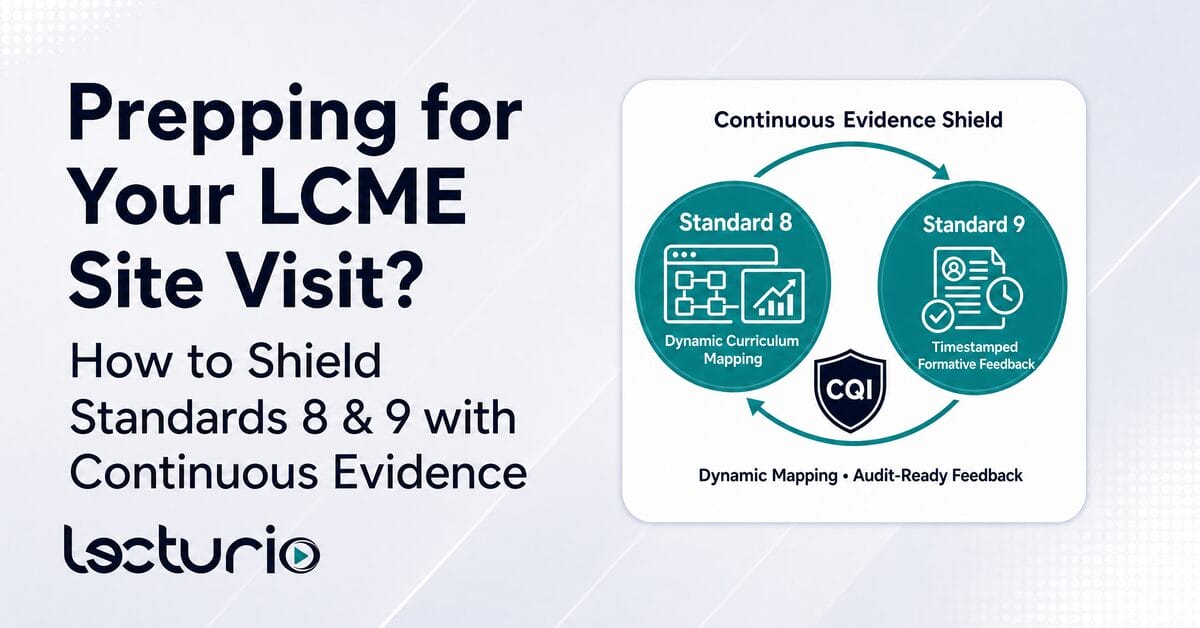
At a glance: Medical school accreditation compliance is a continuous quality assurance process that ensures allopathic medical programs satisfy strict national standards across curriculum management, assessment, and institutional resources, requiring ongoing strategic monitoring to optimize student outcomes and prevent standard compliance deterioration between formal reviews.
Introduction: The Shifting Paradigm of Allopathic Accreditation
The operational lead-up to a formal Data Collection Instrument (DCI) submission and its subsequent LCME site visit represents one of the most resource-intensive operational challenges in academic medicine. For deans and faculty accreditation leads (FALs), compiling clear documentation is historically synonymous with immense administrative burden.
As detailed in a commentary by Prober, Porwal, Woolliscroft, and Kolars (2025) published in Academic Medicine, preparing for an LCME review imposes an immense financial and administrative burden on medical schools. Prober et al. (2025) argue that balancing rigid compliance frameworks can conflict with innovative educational practices, creating an overhead that frequently diverts critical institutional resources away from core educational delivery.
In response to this administrative crunch, the accrediting body has initiated a comprehensive “Strategic Visioning” process. According to the official Liaison Committee on Medical Education Secretariat Briefing (2025), substantive updates across multiple elements were enacted to better align medical school accreditation with modern healthcare complexities. Driven by feedback from the Council of Deans (COD) and Medical Education Senior Leaders (MESL) advisory groups, these updates include sweeping structural changes to Standard 7 (Curricular Content). the LCME opened a public comment period (October 7, 2025–January 7, 2026) on a new nutrition element (7.3) being added to the restructured Standard 7, which — as approved in principle in February 2025 — already includes new language mandating explicit instruction in the appropriate use of artificial intelligence in diagnosis and patient management.
To survive this evolving landscape, a college of medicine accreditation strategy cannot rely on manual, retroactive data gathering. Forward-thinking deans are deploying a strategy of “Continuous Accreditation Readiness”—transitioning from reactive, point-in-time patchwork documentation to proactive data pipelines that actively empower faculty governance. By integrating educational platforms that passively capture programmatic data, institutions provide curriculum committees with a continuous stream of longitudinal evidence. This ensures that when the formal DCI review begins, leadership isn’t just presenting passive compliance documentation, but rather proving a history of active, data-driven continuous quality improvement.
Standard 8 Compliance: Eliminating “Static Data Fatigue” and Reclaiming the Curriculum
Under LCME accreditation standards, Element 8.3 (Curricular Design/Review) and Element 8.4 (Program Outcomes) require curriculum committees to maintain central authority over the content and sequencing of the educational program. However, many institutions fall into the “Static Document Trap”. Schools routinely invest hundreds of hours constructing elaborate Excel maps that look pristine during an audit but instantly become obsolete.
While evaluated within a dental education framework, a 2026 study by Manickam, Al Ismaili, Chidambaram, Radhakrishnan, and Chadwick (2026) in Cogent Education underscores a universal challenge across complex health science programs: traditional manual spreadsheet-based tracking methods remain static, resource-intensive, and fail to handle multi-faceted data or reveal hidden sequence gaps in learning trajectories. Manickam et al. (2026) emphasize that while manual mapping efforts are extensive, their flat, non-intuitive outputs are rarely actionable for ongoing quality assurance—leaving curriculum committees functionally blind to real-time student trajectories.
Concurrently, a major risk to curriculum management is the “Parallel Curriculum” crisis. This institutional phenomenon occurs when medical students feel traditional lectures are disconnected from high-stakes board preparation, leading them to seek out unmonitored third-party board preparation platforms, review books, and flashcard tools to manage their learning independently. When a cohort leaves official channels for unsanctioned software, the medical school loses its centralized ability to evaluate content delivery.
This visibility gap directly threatens compliance with national performance benchmarks established under Element 8.4. In an analysis of the LCME’s updated regulatory landscape, Grichanik and Stone (2025) in Medical Science Educator detail how the accrediting body utilizes a structural self-reflection framework to flag colleges whose aggregate outcomes fall below specific minimum national thresholds:
- A first-attempt USMLE Step 1 pass rate below 85%.
- A USMLE Step 2 Clinical Knowledge (CK) pass rate below 89%.
- An institutional student attrition rate of 5% or greater.
- An initial residency Match rate falling below 83%.
Grichanik and Stone (2025) note that failing to report these metrics dynamically across subgroups in DCI Tables 8.4-3 and 8.4-4 invites immediate regulatory scrutiny. By deploying an LMS-integrated solution via LTI 1.3, institutions resolve this visibility gap, providing curriculum committees with the baseline insights necessary to exercise their central oversight. Instead of staring at flat, obsolete spreadsheets, governance bodies can utilize dynamic visual maps that track performance directly against national cohorts. This allows committees to actively identify hidden sequence gaps, adjust curricular sequencing in real time, and systematically evaluate whether pedagogical interventions are successfully driving student outcomes.
Standard 9 and the Midpoint Feedback Trap: Automating Formative Verification
Element 9.7 (Formative Assessment and Feedback) stands as one of the most frequent areas of non-compliance during an LCME site visit. The standard dictates that a medical school must provide formal, documented formative feedback early enough in a course or clerkship to allow sufficient time for remediation. Schools often fail this metric not due to an absence of feedback , but because their manual tracking workflows are vulnerable to human omission—leaving no verifiable audit trail that proves every student received structured feedback by the exact midpoint of a block.
While the ideal delivery modality depends heavily on the specific educational context, the critical determinants of success are timeliness, clear structure, and actionable insights. Relying on unstructured oral critiques can compromise student outcomes primarily because they lack standardization. For example, a single-institution comparison across academic-year cohorts by Goodwin and Nathaniel (2023) found that providing formal, structured written rationales optimized subsequent performance on summative examinations compared to unstructured, in-person discussions. This suggests that the true driving factor is not the elimination of spoken dialogue, but rather the integration of clean, distinct, and well-structured feedback mechanisms that align with the specific learning environment. However, the study also revealed an important operational nuance: the combined written-and-oral feedback group actually performed worse on subsequent summative tests than either method did standalone. This indicates that clean, distinct written justifications help students develop a superior cognitive grasp of clinical vignette structures, which is critical when navigating a standard passing threshold of 70%.
Furthermore, while the evidence base for technology-driven assessment systems remains an area of active, developing research, a critical narrative review of medical school curricula by Reddi and Javidi (2025) in Cureus highlights a growing curricular emphasis on evolving teaching methods, assessment strategies, and technological integration to systematically monitor and support final competency outcomes.
Advanced institutional portals address the midpoint trap by automatically logging and timestamping every formative interaction. When students engage with board-aligned question banks, the platform records completion metrics, delivers instant answer rationales, and pushes automated performance logs directly to faculty dashboards. This continuous tracking equips curriculum leaders with immediate visibility into student progression, allowing them to intervene precisely when a student requires academic remediation. By automating the logistical tracking of mid-block logs, the institution elevates the compliance asset into a functional quality assurance mechanism—ensuring no student slips through the cracks and that faculty time is spent on targeted educational support rather than manual administrative auditing.
Continuous Quality Improvement (CQI) and the ISA Protection Loop
Element 1.1 requires medical schools to engage in ongoing strategic planning and continuous quality improvement (CQI) processes. A frequent point of operational failure for deans is the “Independent Student Analysis (ISA) Disconnect”. A school can have immaculate internal paperwork, but if students report on their independent ISA survey that they are dissatisfied with curriculum management, feedback timeliness, or learning resources, reviewers will issue a citation.
Data trends indicate a growing academic focus on evaluating the institutional climate. A 2026 bibliometric analysis by Alblooshi et al. (2026) published in Frontiers in Medicine maps the global expansion of literature surrounding the medical school learning environment, documenting a massive surge in research volume and international citation networks dedicated to tracking student perceptions. This structural monitoring is frequently optimized when aligned with validated climate assessment tools like the Dundee Ready Education Environment Measure (DREEM).
Crucially, while the DREEM index acts as an essential diagnostic gauge to uncover student perceptions, an active technological learning infrastructure like Lecturio serves as the direct operational mechanism to resolve those student grievances. To insulate the institution from standard compliance slippage between review cycles, a 2025 scoping review by Girotto, Machado, Moreira, Martins, and Tempski (2025) in The Clinical Teacher explores the conceptual impact of undergraduate medical school accreditation, emphasizing that continuous quality improvement (CQI) frameworks are designed to drive permanent organizational and governance transformations rather than just transient, point-in-time results.
The following table contextualizes these operational shifts across core milestones:
| Curricular Pillar | Legacy Compliance Workflow | Optimized Institutional State (Governance-First) |
| Curriculum Mapping (Element 8.3) | Static, manual spreadsheets that are extensive to compile but difficult to operationalize (Based on Manickam et al., 2026). | Active faculty oversight fueled by dynamic visualization frameworks; instant identification and correction of learning trajectory gaps. |
| Formative Feedback (Element 9.7) | Brittle manual mid-block logs prone to human tracking errors (Based on Goodwin & Nathaniel, 2023). | Systematic, timely remediation driven by automated verification dashboards; faculty instantly flag and support struggling students. |
| Program Outcomes & CQI (Elements 8.4 & 1.1) | Unmonitored “parallel curriculum” where students disengage from institutional tracking; frantic point-in-time data crunches right before site reviews (Based on Alblooshi et al., 2026; Girotto et al., 2025). | A continuous CQI loop where integrated analytics inform longitudinal curriculum updates and align student study behaviors with national board benchmarks. |
Integrating student-valued learning tools with centralized administrative dashboards helps bridge the ISA gap by supporting—rather than replacing—an authentic continuous quality improvement (CQI) framework. While student perceptions captured through the ISA reflect a broad, multifaceted educational experience—including institutional culture, faculty engagement, and the learning environment—providing high-yield, mobile-friendly clinical resources directly targets critical areas of student academic frustration. Ultimately, accreditation is not a rubber-stamp exercise in efficient data collection; it evaluates how actively an institution uses evidence to identify educational deficiencies, implement curricular changes, and monitor longitudinal improvement. When an institution leverages tracking data to actively fuel this quality assurance loop, student satisfaction on the ISA is far more likely to mirror those positive backend trends, proving to reviewers that leadership is systematically responding to student needs.
The Dean’s Checklist: Deploying Your Strategic Compliance Shield
Technology can seamlessly capture compliance data, but true continuous quality improvement is driven by faculty governance, not software alone. To ensure your data serves meaningful educational decision-making rather than just retroactive audit reporting, embed these automated tools into an active committee workflow:
Ultimately, sustainable accreditation is never achieved through frantic, periodic data collection right before an LCME site review. It requires cultivating an institutional culture of continuous quality improvement—one where robust evidence routinely informs day-to-day educational decisions. While visionary institutional leadership and active faculty engagement remain the true drivers of meaningful change, technology serves as a powerful enabler. By lifting the operational burden of manual compliance data pipelines, advanced infrastructure allows faculty to step away from exhausting spreadsheet maintenance and return to what matters most: data-driven governance, impactful teaching, and student success.
Ready to empower your faculty governance with the real-time insights they need to drive true quality assurance? Discover how Lecturio can support your institution’s educational vision and streamline your path to continuous compliance. Contact our team today to schedule an exploratory consultation.
Frequently Asked Questions
How do the new LCME norms affect college of medicine accreditation?
As highlighted by Grichanik and Stone (2025), the norms established under Element 8.4 enforce concrete minimum national performance thresholds for Step 1 pass rates (85%), Step 2 CK pass rates (89%), student attrition (under 5%), and initial residency Match rates (83%). Programs falling below these absolute targets face adverse status classifications, making continuous data-driven monitoring a core requirement for compliance.
What is the impact of a student-directed parallel curriculum on Standard 8 compliance?
The widespread use of supplementary third-party learning platforms is a normative feature of modern medical education rather than an inherent sign of curricular weakness. The real challenge is whether institutions maintain visibility into how students integrate these tools into their study workflows. When student learning happens entirely in unmonitored silos, curriculum committees lose the centralized insights required to coordinate and evaluate content delivery under Elements 8.3 and 8.4. As Grichanik and Stone (2025) emphasize, maintaining continuous, proactive visibility into cohort trajectories is essential to identify and remedy performance drops before they breach national thresholds. By integrating these student-valued resources directly into the institutional ecosystem, schools bridge this visibility gap, ensuring that independent study habits and faculty milestones actively reinforce one another.
How does automated formative feedback improve student retention and board pass rates?
While cohort outcomes can vary, institutional data from Goodwin and Nathaniel (2023) indicates that standalone written explanations are associated with higher summative exam performance compared to oral feedback alone. Providing clear, immediate justifications allows learners to reprocess complex clinical vignettes independently, strengthening their cognitive grasp before high-stakes blocks.