

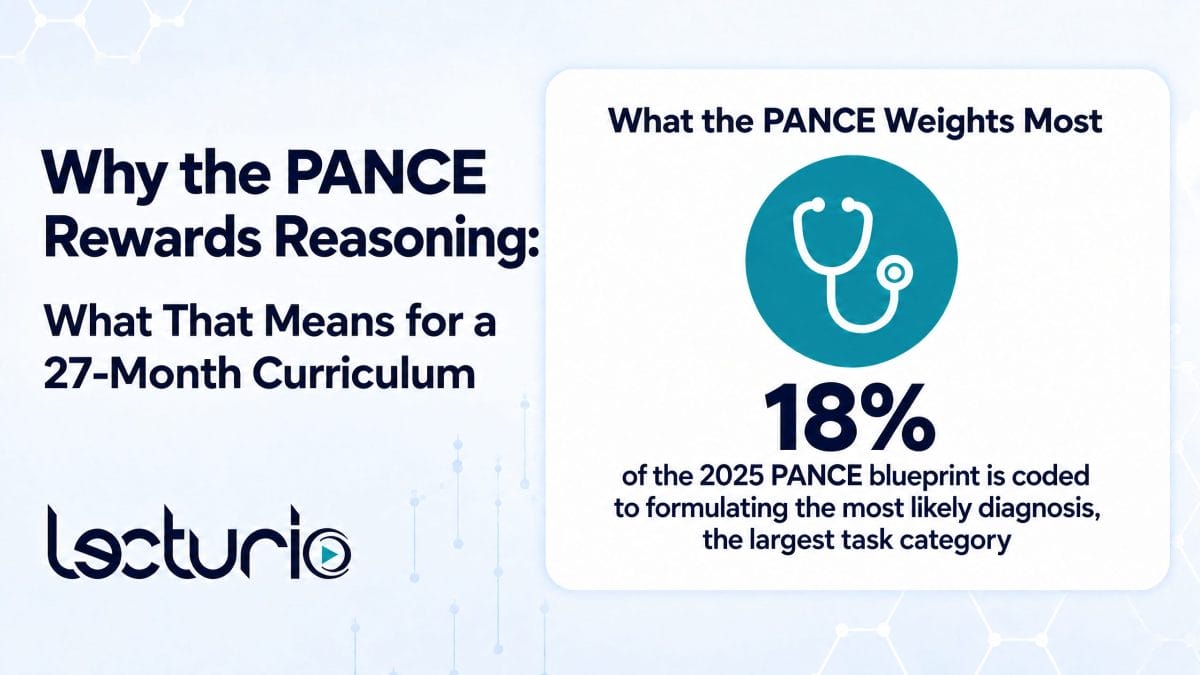
At a glance: The PANCE blueprint is the NCCPA’s official breakdown of what the Physician Assistant National Certifying Examination tests, by medical content and by clinical task. Its single largest task category is formulating the most likely diagnosis (18%), not recall. For PA programs compressed into 24 to 28 months, reasoning must be taught deliberately and early.
Students preparing for the PANCE have far less time than their medical school counterparts. That compression does not lower the bar, and the PANCE blueprint shows exactly where that bar sits. The exam still has to answer the question every licensing board asks: does this future provider have the breadth and depth of medical knowledge to practice safely and competently under the supervision of a physician?
Can a shorter runway reach the same altitude? No peer-reviewed study compares PANCE and USMLE performance head to head; the exams differ in scale, scope, and purpose. But two recent UK studies placed physician associate (PA) students and medical students in front of the same material. When Drew-Hill and colleagues (2025) analyzed 88 identical progress-test items, graduating PA students performed comparably to medical students and first-year junior doctors, and many met or exceeded final-year medical student performance. In a simulated-patient study, Thorpe and colleagues (2025) found that PA and medical students gathered data, revised their differentials, and landed on relevant final diagnoses at similar rates, despite the PA students having trained for a fraction of the time. Both studies are small and UK-based, so read them as encouraging signals rather than settled verdicts.
Now picture the student living inside that compression. It is 11:40 on a Tuesday night in the didactic year. Cardiology wrapped on Friday, pulmonology began Monday, and renal arrives next week whether anyone is ready or not. Two highlighters have run dry, the flashcard app reports 1,142 cards due, and somewhere between the heart murmurs and the acid-base disorders it becomes clear that material medical students meet across two preclinical years is arriving in little more than one. The coffee goes cold. Then the question arrives, quietly at first, then louder: How can I possibly know everything I need to know to pass the boards?
In that moment, students reach, almost reflexively, for the habit that carried them through prerequisites and into PA school: active recall. Make the card. Flip the card. Repeat until the answer arrives before the question finishes.
Recall has its place. But the PANCE blueprint, the document thousands of students search every month for its topic list, tells a different story about what the exam actually rewards. Below, I break down the full 2025 PANCE blueprint, which remains in force for 2026 and 2027 administrations, then show the task-category data that reveals its emphasis on diagnostic reasoning, and explain why that emphasis matters more in a 27-month PA program than in a four-year medical school.
What’s Actually on the PANCE Blueprint (2025–2026)
The PANCE is a 300-question, multiple-choice exam, and the NCCPA blueprint spells out exactly how those questions are distributed. The current PANCE Content Blueprint took effect in January 2025 for all PANCE administrations and is the version 2026 test-takers will sit for.
The blueprint codes every question two ways: by medical content (which body system or topic it covers) and by task (what the question asks the candidate to do with that content). Medical content makes up 94% of the exam. Professional Practice makes up the remaining 6% and is the only category not also coded to a task. Across the exam, surgical topics account for 8% to 10% of questions and pediatric conditions for 12% to 15%.
Medical content categories (14 organ systems plus Professional Practice)
| Content category | 2025 weight | Approx. questions (of 300) | 2019 weight |
|---|---|---|---|
| Cardiovascular System | 11% | 33 | 13% |
| Pulmonary System | 9% | 27 | 10% |
| Gastrointestinal System/Nutrition | 8% | 24 | 9% |
| Musculoskeletal System | 8% | 24 | 8% |
| Infectious Diseases | 7% | 21 | 6% |
| Neurologic System | 7% | 21 | 7% |
| Psychiatry/Behavioral Science | 7% | 21 | 6% |
| Reproductive System | 7% | 21 | 7% |
| Endocrine System | 6% | 18 | 7% |
| Eyes, Ears, Nose, and Throat | 6% | 18 | 7% |
| Professional Practice | 6% | 18 | 5% |
| Hematologic System | 5% | 15 | 5% |
| Renal System | 5% | 15 | 5% |
| Dermatologic System | 4% | 12 | 5% |
| Genitourinary System | 4% | 12 | 5% |
Task categories (seven clinical tasks, covering the 94% medical content)
| Task category | 2025 weight | Approx. questions (of 300) | 2019 weight |
|---|---|---|---|
| Formulating the Most Likely Diagnosis | 18% | 54 | 18% |
| History Taking and Performing Physical Examination | 16% | 48 | 17% |
| Managing Patients: Clinical Intervention | 16% | 48 | 14% |
| Managing Patients: Pharmaceutical Therapeutics | 15% | 45 | 14% |
| Managing Patients: Health Maintenance, Patient Education, and Preventive Measures | 11% | 33 | 10% |
| Using Diagnostic and Laboratory Studies | 10% | 30 | 12% |
| Applying Foundational Scientific Concepts | 8% | 24 | 10% |
Sources: 2025 weights from the NCCPA PANCE Content Blueprint; 2019 weights as summarized by Hippo Education. Question counts are approximate; NCCPA notes that allocations may vary slightly from exam to exam.
The Task Category Most Study Guides Undersell
Here is the number that should reorganize how we think about PANCE preparation: 18%. Formulating the Most Likely Diagnosis is the single largest task category on the exam, roughly 54 of 300 questions. That outweighs every organ system (Cardiovascular tops the content list at 11%), Pharmaceutical Therapeutics (15%), and Clinical Intervention (16%).
Tasks and systems are cross-coded, so this is not a strict apples-to-apples ranking. As a signal of what the exam prizes, though, it is hard to miss. Read how NCCPA defines the task: formulating differential diagnoses, incorporating history, examination findings, and diagnostic data into medical decision-making, recognizing the need for referral, and selecting the most likely diagnosis in light of the data presented. That is not a recall task. It is a synthesis task.
The 2025 revision leaned further in the same direction. Clinical Intervention rose from 14% to 16% and Pharmaceutical Therapeutics from 14% to 15%, while Applying Foundational Scientific Concepts fell from 10% to 8% and Using Diagnostic and Laboratory Studies from 12% to 10%. Put plainly, the newest blueprint moved weight away from explaining mechanisms and toward deciding what to do.
Yet most PANCE study guides are still organized by body system: cardiology this week, pulmonology the next. That structure is easy to build and easy to drill with flashcards and question banks. It is also out of step with the exam’s own architecture. Body-system guides answer the question What do I need to know? The blueprint is asking a different one: What will you do with it?
Why Buzzwords Won’t Carry You Anymore
There is another reason medical reasoning matters so much, and NCCPA understands it well: the buzzword. Every PA student knows the type, a pathognomonic keyword so tightly welded to one diagnosis that the answer arrives before the question stem ends. “Rice-water stools” means cholera. A student spots the phrase, recalls the match, and collects the point.
But what did that point actually measure? Not an understanding of cholera. When that student walks into clinical practice, no patient will announce that they have rice-water stools. What exactly does a rice-water stool look like at the bedside, and what does the patient actually say? Herein lies the problem: a buzzword rewards recognizing a label, while practice demands recognizing a patient.
NCCPA’s own item-writing guidelines, shared with PA educators at a March 2025 workshop, draw exactly this line. Application items use detailed clinical vignettes to assess whether an examinee can apply knowledge to a realistic patient, and NCCPA describes them as the right tool for testing diagnosis and management. Recall items test an isolated fact. The same guidelines train item writers to strip out “test-wise” clues, the cues that let an examinee who does not understand the content guess the answer anyway. NCCPA even names clinical reasoning in its mission statement.
In my experience, the result is a PANCE that leans far less on buzzwords, keywords, pathognomonic clues, trigger phrases, test-taking cues, and recognition cues. That leaves students with the real task: reasoning their way to cholera from descriptions grounded in reality. A patient recently back from a region with an active outbreak. Sudden, profuse, painless watery diarrhea. Liters of fluid lost in hours, with the dry mucosa, tachycardia, and hypotension of severe volume depletion. Not a phrase to match, but a picture to assemble.
Buzzwords have not been banned outright; even NCCPA’s 2025 workshop includes a sample item describing a sunburst pattern on x-ray. But as a crutch, strawberry tongues, target lesions, water-bottle-shaped cardiac silhouettes, sunburst patterns, swan-neck deformities, cherry-red spots, and currant-jelly sputum and stools are a thing of the past. Clinical reasoning is here to stay.
Why This Matters More in 27 Months Than in Four Years
Medical school has roughly four years to let reasoning develop. Some of it is taught deliberately; much of it is absorbed through sheer time in the clinical environment, the hundredth patient and the fifth attending who asks, “What else could this be?”
A PA program has about 27 months. That is both the mean and the median across 273 accredited programs in PAEA’s Curriculum Report 6, and some programs run as short as 24 months. The didactic year alone compresses into roughly one year what medical students spread across two.
Now put the pieces together. If the exam rewards diagnostic reasoning as heavily as the blueprint shows, and reasoning is built through deliberate practice rather than passive exposure, then waiting for it to develop on its own is not a viable strategy on a 27-month calendar. There simply are not enough Tuesdays. Deliberate, explicit reasoning instruction from the first semester is not a pedagogical nicety in PA education. Given the math, it is structural.
The broader case for why explicit instruction outperforms implicit exposure is laid out in Cognitive Apprenticeship: A Practical Framework for Teaching Clinical Reasoning From Day One [internal link]. Here, the point is narrower: the shorter the runway, the less a program can afford to leave reasoning to chance.
You Are No Longer Students
So what do we tell the student at 11:40 on that Tuesday night? The same thing I drive into every cohort I teach:
“You are no longer students. You are providers in training. Make the shift in perspective, and the information will occur to you differently.”
What I mean is that the information stops presenting itself as something to memorize and starts presenting itself as a piece of a puzzle, something to reason with. The statement is simple; the shift it asks for is not. It moves students away from memorization and rote recall and toward understanding.
Once they make that shift, they no longer need to memorize everything there is to know to pass the PANCE. They have absorbed the crucial pieces and developed the ability to reason medically within the accepted medical model. That reasoning is what the PANCE is truly looking for. A student who can reason through a question, anchored by a solid core of fundamental medical knowledge, is not cramming against an impossible clock. With that combination, 27 months of training is absolutely doable.
I would go one step further. Once students overcome their imposter syndrome and genuinely believe they are providers in training rather than simply students, they begin exercising their diagnostic and clinical reasoning far more effectively. That, in my experience, is the shift that lifts PANCE scores and, with them, pass rates.
What Deliberate Reasoning Instruction Looks Like in a PA Curriculum
A mindset needs a curriculum to live in. One of the most practical PA-specific models comes from the University of Sheffield, where Gray, Darling-Pomranz, and Jackson (2021) describe building clinical reasoning into a two-stage PA course on purpose, rather than hoping it emerges on rotations. Several of their choices translate directly to U.S. programs:
- Name the reasoning, then teach it. Nine dedicated sessions introduce dual process theory (fast pattern recognition alongside slower hypothetico-deductive reasoning), bounded rationality, and illness scripts, running alongside the biomedical lectures rather than after them.
- Treat the differential as a moving target. Their illness-script session frames the differential not as a static list produced at the end, but as hypotheses formed and discarded as each new piece of information arrives.
- Remember that patients present with symptoms, not diseases. Condition-based lectures are paired with small-group sessions built around the presenting complaint, such as the differential for breathlessness or low energy.
- Make preceptors ask why. On placement, supervisors use the one-minute preceptor model to draw out the reasoning behind what students have just observed.
- Sequence rotations by reasoning load. Hospital medicine comes first, then emergency medicine, then family medicine, so students meet progressively less pre-digested information about each patient.
- Assess what you value. Quality assurance favors higher-order questions and removes low-order items that simply test recall, while Mini-CEX assessments across placements explicitly look for interpretation of findings.
That last point deserves underlining, because assessment drives learning. If our exams reward buzzword matching, students will learn buzzwords, no matter how often we tell them to reason.
Where a Tool Like Healer Fits
A compressed program’s scarcest resource is repetition. Rotations deliver patients on their own schedule, and no student can count on seeing enough undifferentiated chest pain, let alone cholera, in 24 to 28 months to build a reliable reasoning habit by chance.
This is where a structured clinical reasoning platform earns its place. Healer, originally developed by NEJM Group and now part of Lecturio, is a virtual patient platform built to teach and assess clinical reasoning. Learners interview, examine, order tests, prioritize interventions, and watch patients respond to therapy. Along the way they build illness scripts, prioritize a differential, and commit to a management plan, then receive feedback with expert rationales.
The honest framing matters: no platform closes a calendar gap on its own. What it can supply is the thing time cannot, namely frequent, low-stakes, structured practice in exactly the skill the blueprint weights most, at a volume no single set of rotations can guarantee. For faculty, Lecturio’s learning analytics make reasoning visible and measurable, which is the first step toward remediating it. For more on measuring reasoning readiness, see Quantifying Clinical Reasoning [internal link].
Body-System Study Guide vs. Reasoning-Structured Curriculum
| Dimension | Body-system-organized approach | Reasoning-structured approach |
|---|---|---|
| Primary organizing principle | What to know, by organ system | How to think, applied across systems |
| Fit with the blueprint’s largest task category | Indirect, at best | Direct (Formulating the Most Likely Diagnosis, 18%) |
| Time efficiency in a compressed program | Requires broad content coverage before reasoning begins | Builds a transferable skill that applies across content |
| Typical practice format | Recall-oriented questions and flashcards | Differential-building and committed-reasoning cases |
| Risk if used alone | Strong recall, weaker judgment when a presentation is atypical | Reasoning without enough content to reason with |
The answer is not one column or the other. Content is the raw material, and reasoning is what turns it into a diagnosis. The programs that pair the two deliberately, from the first semester, are the ones building graduates the PANCE was designed to find.
Teach Reasoning on a 27-Month Clock
Your students are providers in training. Give them a curriculum that trains them like it. Ready to see what a structured approach to teaching clinical reasoning looks like in a compressed PA curriculum? Schedule a demo with the Lecturio team today.
Frequently Asked Questions
What’s on the current PANCE blueprint?
The blueprint effective January 2025 covers 14 organ-system content categories plus Professional Practice (6%), and seven clinical task categories. Formulating the Most Likely Diagnosis carries the largest single task weight at 18%; Cardiovascular is the largest content area at 11%.
Does the PANCE test clinical reasoning or medical knowledge?
Both. Medical content makes up 94% of the exam, and every one of those questions is also coded to a clinical task. Within that coding, formulating a diagnosis is the largest single category, and NCCPA’s item-writing guidance favors vignette-based application questions over isolated recall.
What is the PANCE pass rate?
NCCPA reported a 92.4% pass rate for first-time test-takers in 2024, up slightly from 92.0% in 2023. NCCPA re-set the passing standard in 2024, and the new standard took effect in 2025 alongside the updated blueprint.
How long is a typical PA program?
PAEA data across 273 accredited programs put the typical PA program at 27 months, both the mean and the median. Programs range from 24 months at the short end to longer dual-degree and part-time tracks.
Why does program length matter for how clinical reasoning gets taught?
A compressed timeline leaves little room for reasoning to develop implicitly through repeated exposure, the way it might over four years of medical school. That makes deliberate, early, explicit reasoning instruction a structural necessity rather than an optional enhancement.
Are PA students as well prepared as medical students?
No study compares PANCE and USMLE performance head to head. However, two 2025 UK studies found that PA students performed comparably to medical students on identical knowledge items and showed similar clinical reasoning processes on simulated patient cases.
What does PA-specific research say about teaching clinical reasoning?
Documented approaches, such as the University of Sheffield’s, show PA programs can embed reasoning deliberately: teaching named reasoning frameworks, building sessions around presenting complaints, training preceptors to probe reasoning, and assessing reasoning explicitly rather than assuming it develops on rotations.