

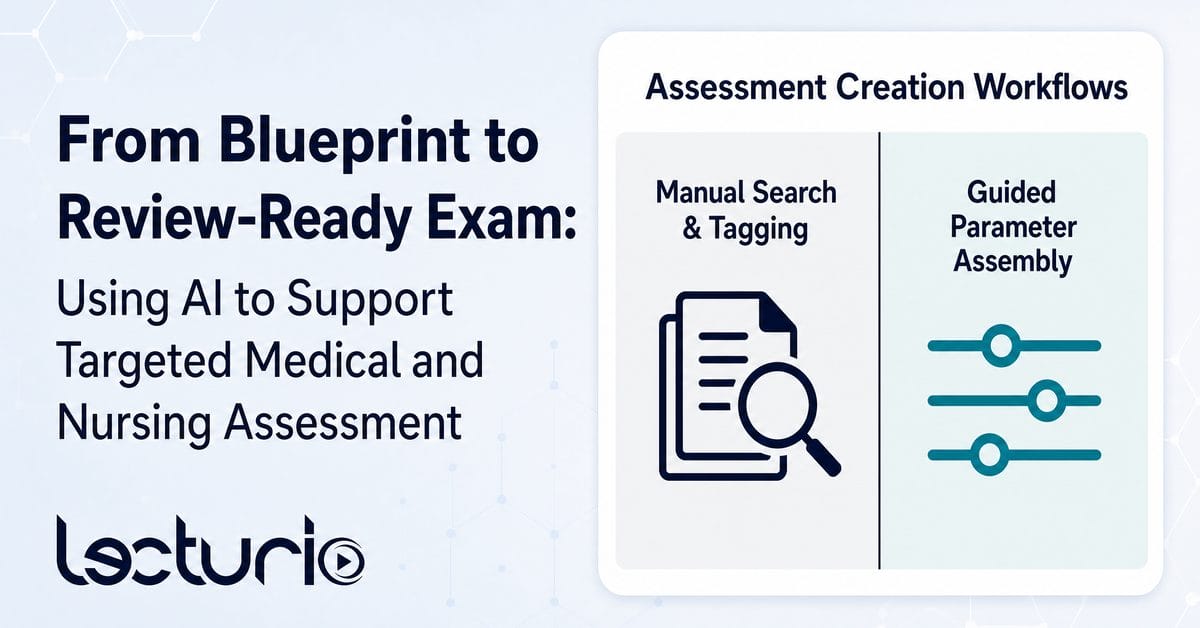
At a glance: An AI test generator can help medical and nursing educators assemble targeted assessment drafts through guided parameter workflows rather than complex prompt engineering. By drawing from verified content libraries and incorporating faculty review, these tools can reduce repetitive search and assembly work while supporting blueprint alignment and assessment governance.
The High Administrative Friction of Manual Exam Assembly
Building high-quality examinations across medical and nursing curricula requires substantial faculty expertise and time. Course directors and assessment committees must define the assessment purpose, develop or select appropriate items, review content accuracy and cognitive level, ensure blueprint coverage, and prepare examinations for administration and quality review.
These tasks are essential, but some parts of the workflow, particularly item search, tagging, formatting, and initial assembly, are repetitive and may be supported by digital tools. Reducing this administrative burden can create more faculty capacity for higher-value assessment work, including blueprint design, standard setting, learner feedback, and post-exam item review.
This workload reflects a structural capacity challenge rather than a lack of faculty effort. When educators spend hours sifting through item banks and manually editing distractors, less time remains for direct clinical teaching, active student mentoring, and small-group feedback. Educational measurement literature demonstrates that traditional, manual MCQ construction creates severe item-bank bottlenecks in healthcare education. Large-scale assessment programmes can require very substantial item banks. For example, progress-testing models may draw on thousands of items over repeated administrations, illustrating the resource demands associated with maintaining sufficient breadth, security, and quality (Wrigley et al., 2012, as cited in Kıyak & Kononowicz, 2025).
Achieving operational maturity across the 4 dimensions of an AI-ready health professions institution requires providing faculty with administrative force-multipliers that streamline high-stakes tasks like exam authoring without compromising pedagogical rigor.
Guided Parameter Assembly: Zero Prompt Engineering Required
Unlike consumer AI tools that force educators to learn tedious “prompt engineering” or navigate unpredictable generative outputs, purpose-built institutional assessment platforms utilize a guided parameter workflow. Faculty do not need to spend time crafting complex text prompts. Instead, educators simply set core course parameters, selecting organ systems, clinical topics, cognitive levels, question volume, and target difficulty within an intuitive administrative interface.
Once these parameters are set, the platform can identify relevant subtopics and retrieve matching items from a verified question bank to create an initial assessment draft for faculty review. This can substantially reduce search and assembly time, although final approval still requires expert review of blueprint coverage, item quality, difficulty balance, and local curricular relevance. Research on AI-assisted item generation also suggests meaningful efficiency gains. Kıyak and Kononowicz (2025), for example, reported substantial reductions in template-development time within the workflow they studied. These findings support the broader potential of AI-assisted assessment authoring, although time savings will vary by task, platform, and level of faculty review
Guided Parameter Execution Across Disciplines
Medical Education (USMLE Step 1 / Step 2 CK Parameter Setup):
- Selected Topic: Renal Pathophysiology (Focus: Acute Kidney Injury)
- Cognitive Level & Difficulty: Application / Analysis (Medium Difficulty)
- Format & Blueprint: Single Best Answer (SBA) Clinical Vignettes + Detailed Rationales
- Draft generated for faculty review: The Lecturio AI engine pins down targeted sub-topics and instantly indexes matching verified Qbank items into a 20-question review exam.
Nursing Education (NCLEX / NGN Parameter Setup):
- Selected Topic: Adult Med-Surg (Cardiovascular Care)
- Cognitive Level & Difficulty: Clinical Judgment (Application Level)
- Format & Blueprint: Next Generation NCLEX (NGN) Scenarios aligned with the NCSBN model
- Draft generated for faculty review: The Lecturio AI engine assembles a targeted 15-question formative assessment complete with clinical decision-making rationales.
Filling Coverage Gaps In-Flow: AI-Powered Question Generation
Even extensive institutional item repositories can occasionally lack coverage for a newly updated clinical guideline, unique institutional learning objective, or emerging niche topic. Even extensive institutional item repositories may have gaps when new guidelines, local learning objectives, or emerging topics are introduced. In these situations, educators may use an in-workflow AI question generator to create an initial item draft for expert review rather than beginning from a blank page
Directly within the assessment drafting workflow, faculty can generate new, highly specific items complete with plausible distractors, detailed clinical rationales, and explicit learning objective mappings. Some studies suggest that AI-generated items can approach faculty-written items on selected quality dimensions when reviewed and refined by educators. Cox, Hunt, and Hill (2023), for example, found favourable faculty ratings for AI-generated NCLEX-RN items in several comparisons. These findings are promising, but they do not remove the need for expert review, blueprinting, and post-administration psychometric analysis
Protecting Psychometric Quality: Why Faculty Review Still Matters
General-purpose generative AI can produce useful item drafts, but unreviewed outputs may contain factual inaccuracies, implausible distractors, ambiguous stems, uneven cognitive demand, or unintended cueing. These risks are particularly important in high-stakes assessment, where item quality must be evaluated systematically rather than assumed from surface plausibility
The emerging evidence is encouraging but mixed. Law et al. (2025) identified higher rates of factual and difficulty-related problems in unedited AI-generated questions than in human-authored items. By contrast, Linde et al. (2026) found no statistically significant differences in selected psychometric properties between GPT-4o-generated and human-authored items when AI generation was structured and followed by human screening. Together, these findings suggest that the quality of the workflow, including grounding, prompting, expert review, and post-hoc analysis, matters as much as the generation technology itself
In high-stakes assessment, institutions remain responsible for the quality, appropriateness, and defensibility of the examination process. A human-in-the-loop workflow can support that responsibility by ensuring that subject-matter experts review, revise, and approve AI-assisted items before use. In this grounded model, AI performs initial indexing and drafting, while subject-matter expert educators retain 100% control to review, refine, and approve every question before publication. A 2026 single-institution study found that a fine-tuned LLM, trained specifically on anesthesiology course material, produced MCQ items with psychometric properties comparable to faculty-written items in that specialty, an encouraging but narrow finding that has not yet been replicated across specialties or institutions. Faculty oversight should continue after exam assembly. High-stakes assessments also require appropriate standard setting, monitoring of item performance, review of discrimination and difficulty indices, examination of potentially flawed or biased items, and revision of the item bank based on post-administration evidence
Institutional Impact: Expanding Formative Practice and Targeted Support
Faster assessment assembly can make it easier for educators to create additional low-stakes practice opportunities without increasing authoring effort proportionally. For example, faculty may generate short follow-up quizzes around commonly missed concepts and then review the resulting patterns with learners.
Law et al. (2025) reported substantial reductions in person-hours for AI-assisted item generation under expert review. Such efficiency gains may create capacity for more frequent formative assessment, although institutions still need faculty involvement in interpretation, feedback, and decisions about remediation. More frequent low-stakes assessment can shorten feedback cycles and help learners and faculty identify areas requiring additional review earlier in the learning process
Comparative Analysis Table & Executive Conclusion
Assessment Creation Workflows
| Operational dimension | Predominantly manual workflow | AI-augmented workflow |
| Question search and assembly | Manual filtering and tagging across item repositories | Guided parameter selection can accelerate retrieval and initial exam assembly |
| User experience | Faculty navigate databases and manually combine item sets | Guided interfaces can reduce reliance on prompt engineering |
| Coverage gaps | New items are drafted manually from a blank page | AI can generate initial item drafts for expert review |
| Assessment quality | Depends on item-writing expertise, blueprinting, review, and psychometric analysis | AI-assisted items may reach comparable quality in some settings when structured workflows and faculty review are used |
| Authoring time | Item development and assembly can require substantial faculty time | Some studies report meaningful reductions in drafting and assembly time |
| Content currency | Faculty manually identify and update outdated items | Grounded systems can make relevant source material easier to retrieve, but clinical currency still requires expert verification |
| Faculty oversight | Faculty retain responsibility for item selection, review, approval, and exam governance | Faculty retain the same responsibility, with AI supporting repetitive drafting and search tasks |
Executive Takeaway
AI-assisted test generation is not about asking educators to become prompt engineers or replacing faculty expertise. Its most credible role is to reduce repetitive search, assembly, and drafting work so faculty can focus on blueprinting, clinical accuracy, standard setting, item review, feedback, and learner support.
Ready to simplify assessment creation across your medical or nursing program while protecting psychometric rigor? Explore Lecturio’s AI Test Generator and Schedule a Demo with the Lecturio team today.
Frequently Asked Questions (FAQ)
How does an AI test generator build exams without complex prompts?
Rather than requiring complex text prompts, an institutional AI test generator can use a guided parameter workflow. Educators select their topics, target cognitive levels, difficulty, and question count, allowing the AI engine to automatically pull matching, verified Qbank items into a draft for faculty review.
Can AI question generators build Next Generation NCLEX (NGN) item types?
Yes, AI question generators can support drafting of NGN-aligned item types including Matrix/Grid, Bow-Tie, and Drop-Down Cloze items. These drafts still require nurse-educator review to ensure alignment with the NCSBN Clinical Judgment Measurement Model, clinical accuracy, appropriate difficulty, and sound item construction.
Why is unedited consumer AI risky for assessment authoring in healthcare?
Unedited AI-generated items may contain factual errors, ambiguous wording, implausible distractors, or inappropriate difficulty. Expert review is therefore essential before use. For high-stakes assessment, institutions should also apply their usual blueprinting, standard-setting, and post-exam psychometric quality processes.
How much time can faculty save using an AI practice test generator?
Studies suggest that AI-assisted workflows can reduce some aspects of item-development and assembly time. For example, Kıyak and Kononowicz (2025) reported substantial time savings within the workflow they studied. The actual benefit will depend on the assessment purpose, platform, complexity of the items, and level of faculty review required.