

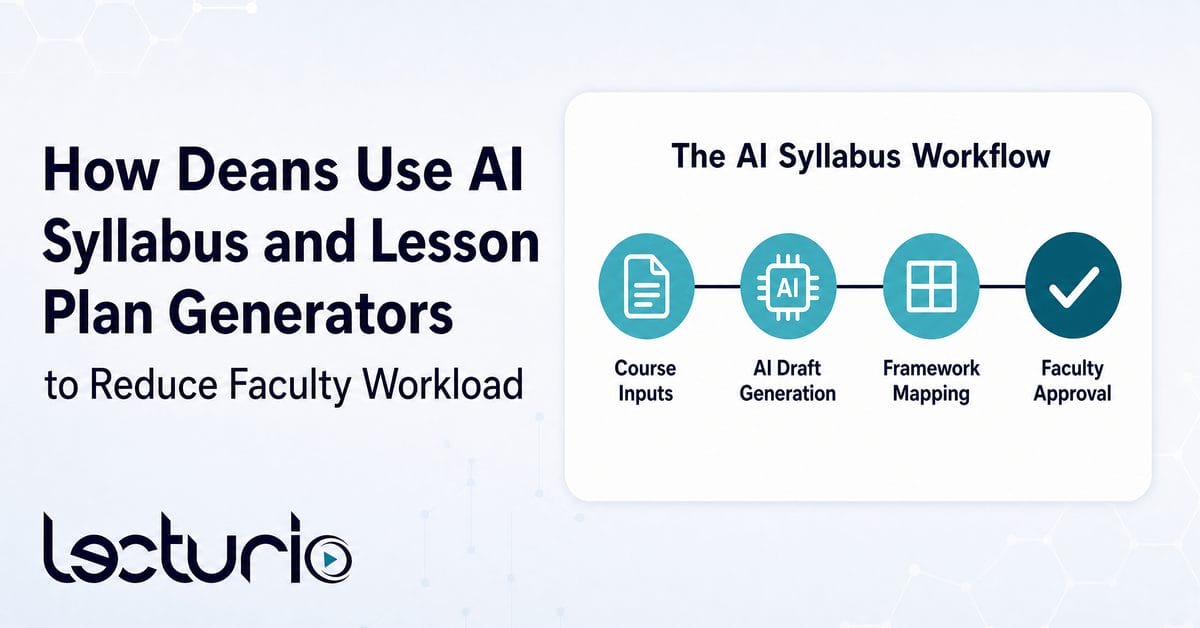
At a glance: An AI syllabus and lesson plan generator is a course-planning tool that can help medical and nursing faculty draft competency-aligned syllabi, multi-week course structures, and session plans using verified educational content. By reducing some repetitive preparation work, these tools may create more faculty capacity for teaching, mentoring, curriculum review, and scholarship while preserving institutional governance
The Pre-Semester Capacity Bottleneck
Pre-semester administrative preparation represents one of the most severe operational barriers to institutional productivity and faculty retention in medical and nursing education. Every academic year, deans and department chairs watch experienced educators manage substantial administrative prep demands—spending dozens of hours manually mapping learning objectives, structuring weekly lectures, and aligning syllabi with evolving clinical frameworks before a single student enters the classroom. This annual prep crunch strains institutional resources, delays course launches, and makes maintaining consistent multi-section alignment labor-intensive across large program cohorts.
Effective faculty workload management requires recognizing that course prep is not merely an individual faculty task, but a systemic capacity bottleneck. Heavy administrative demands directly impact nursing faculty workload and medical faculty retention, leaving educators with insufficient bandwidth for active clinical teaching, research, and student mentorship. Research on higher education health science faculty confirms that workload demands — including course preparation and administrative responsibilities — are a leading driver of burnout, compounded by insufficient institutional support. When substantial faculty time is repeatedly devoted to drafting, formatting, resource selection, and curriculum mapping, less capacity remains for teaching, mentorship, scholarship, and educational improvement.
To support accreditation expectations concerning curricular objectives, design, management, and evaluation, leaders need workflows that improve efficiency without weakening faculty oversight. While establishing an institutional strategy for reclaiming the faculty hour through AI-powered faculty augmentation is essential to combatting the workforce crisis, operational time-reclamation must begin weeks before students step into the classroom.
The Hidden Risks of Unvetted Consumer AI in Course Design
General-purpose generative AI tools may create risks when used without clear institutional guidance, verified source material, or expert review. Outputs can include inaccurate references, outdated information, or learning objectives that do not align with local curricula and assessment frameworks.
Academic leadership must distinguish between unvetted consumer tools and institutional course planning software for higher education. Relying on ungrounded AI exposes programs to unverified clinical inaccuracies or accreditation misalignment.
When selecting AI tools for lesson planning, deans and program directors require purpose-built solutions that operate strictly on verified, pre-vetted medical and nursing content libraries. Grounding an AI system in an expert-reviewed medical or nursing content library can reduce these risks and make outputs easier for faculty to verify. It does not eliminate the need for expert review, local contextualization, or institutional approval.
Macro-Planning: Transforming Course Architecture with the AI Syllabus Generator
Deploying an institutional AI syllabus generator transforms time-intensive course construction into an efficient, structured drafting workflow. Rather than starting with a blank page, educators input high-level course themes, credit requirements, and targeted cognitive domains. The AI syllabus generator can produce an initial multi-week draft containing proposed module descriptions, topic sequencing, learning objectives, and assessment touchpoints. Faculty then review the structure, refine the educational logic, confirm clinical accuracy, and align it with institutional requirements.
This macro-level automation provides immediate strategic benefits for institutional leadership:
- Supports more consistent syllabus structures across multi-section courses while allowing faculty to adapt content to their learners and context.
- Provides adjunct and clinical faculty with a structured starting point for course development.
- Helps faculty map learning objectives and resources to relevant competency and assessment frameworks.
- Creates clearer documentation that may support curriculum review and accreditation preparation.
Implementing a dedicated syllabus AI workflow allows institutions to support more consistent documentation and curriculum alignment while shortening course development timelines.
Micro-Planning: Building Curriculum-Aligned Daily Lessons
Beyond macro-level course outlines, daily instructional execution requires granular, session-by-session lesson planning. An AI lesson plan generator can help translate high-level course objectives into an initial session plan. Based on a topic, intended outcomes, learner level, and teaching format, it can suggest a sequence of activities and link relevant educational resources for faculty review.
Faculty can adapt these drafts for lectures, flipped classrooms, tutorials, or clinical-skills teaching. The value lies in reducing blank-page work and resource-search time, not in replacing instructional design expertise
Creating curriculum-aligned lessons no longer requires hours of manual resource curation. Educators receive pedagogically sound, interactive lesson paths tailored to classroom lectures, flipped classrooms, or clinical skills labs. A 2026 systematic review of 28 studies found that AI supports nursing education across several domains, including personalized learning, simulation training, automated assessment, and curriculum management, though effects on higher-order clinical reasoning remain mixed.
Institutional Governance: Keeping Educators in Control of AI Workflows
Adopting artificial intelligence in academic healthcare requires rigorous governance to protect educational integrity and institutional accreditation. Deans and academic leaders appropriately voice concern over automated content creation that lacks expert oversight. Address these concerns by implementing a strict human-in-the-loop governance framework. Institutions should also define who is accountable for reviewing outputs, which approved sources the system may use, how version control is maintained, and how generated materials are checked for bias, accessibility, clinical currency, and alignment with local policies
|
Lecturio AI Engine (Drafting Assistant) |
Faculty & Deans (Subject Matter Experts) |
|---|---|
|
|
Lecturio’s architecture positions AI strictly as an administrative drafting assistant. Faculty retain final responsibility for reviewing, revising, and approving all generated materials before use. This process reduces risk and helps ensure that outputs are clinically accurate, educationally appropriate, and aligned with institutional expectations. This safeguard reflects a broader pattern in the research: independent testing of generative AI on curriculum and syllabus generation found that no model could reliably produce a complete, accurate course structure without substantial human correction. Human-in-the-loop research on educator-facing AI tools reaches a consistent conclusion — structured faculty oversight, not full automation, is what allows these tools to be adopted safely and effectively.
Comparative Analysis: Course Prep Transformation
The table below contrasts traditional, manual course preparation with an optimized, AI-augmented institutional workflow:
| Operational dimension | Common manual workflow | Potential contribution of an AI-augmented workflow |
| Syllabus development | Faculty begin with a blank document and manually assemble objectives, schedules, and resources | AI can generate a structured first draft for faculty review and refinement |
| Curriculum alignment | Objectives and resources are mapped manually across multiple frameworks | AI-assisted mapping can provide an initial crosswalk that faculty verify locally |
| Lesson planning | Faculty search across multiple sources and build each session independently | Suggested lesson sequences and linked resources may reduce planning and search time |
| Content accuracy | Materials may become outdated or inconsistent across sections | Grounded content libraries and faculty review can reduce, but not eliminate, accuracy risks |
| Faculty capacity | Repetitive preparation competes with teaching, mentorship, scholarship, and service | Reduced administrative drafting may create more time for higher-value educational work |
Conclusion: Reinvesting Faculty Hours into Teaching Excellence
Reducing avoidable pre-semester preparation work is not only an efficiency goal. It can create greater capacity for faculty to focus on teaching, feedback, mentorship, curriculum evaluation, and scholarship.
AI-assisted planning tools can provide a useful starting point for syllabus development, objective mapping, and lesson design when they are grounded in reliable content and governed through expert review. Their value lies not in automating education, but in helping educators spend less time on repetitive drafting and more time on the work that requires professional judgment and human connection.
Ready to bring trusted, accredited AI workflows to your medical or nursing program before the upcoming semester? Discover how Lecturio fits your institutional needs and Schedule a Demo with the Lecturio team today.
Frequently Asked Questions
How does an AI syllabus generator reduce faculty workload?
An AI syllabus generator can reduce some of the repetitive work involved in drafting course structures, schedules, objectives, and resource lists. Faculty still need to review the output, confirm accuracy, adapt it to local needs, and approve the final syllabus
How do AI lesson plan generators ensure alignment with LCME and AACN accreditation standards?
Purpose-built tools can help map proposed learning objectives and resources to relevant competency frameworks. This may streamline documentation, but accreditation alignment still requires faculty verification, curriculum-committee oversight, and evidence that the intended curriculum is implemented and evaluated
Why is human-in-the-loop oversight essential for AI tools in health professions education?
Human-in-the-loop oversight keeps educators accountable for accuracy, relevance, sequencing, inclusivity, and final approval. It reduces the risks associated with AI-generated content while preserving faculty authority over educational decisions
What educational activities can faculty prioritize when routine planning work is reduced?
Time saved on repetitive drafting and resource curation can be redirected toward learner feedback, mentorship, active-learning design, curriculum evaluation, scholarship, and individualized support. The exact benefit will depend on how the institution redesigns workload rather than on the technology alone