

At a glance: Ethical recruitment of international medical graduates (IMGs) requires more than attracting qualified professionals into a new health system. It requires transparent pathways, realistic expectations, equitable access to preparation, and sustained institutional support after arrival. Digital learning environments can help IMGs understand local clinical, linguistic, and assessment expectations while enabling faculty to identify learning needs early and respond with targeted, individualized support. The primary goal is safe practice, professional belonging, and long-term integration. While secondary goals include retention rates, and health workforce organisation.
International Mobility Is More Than a Workforce Solution
Many health systems depend on internationally trained physicians, who bring expertise, resilience, and clinical experience to the systems they join. Their value, however, cannot be reduced to filling vacancies or closing enrollment gaps.
That distinction matters because of what it implies about institutional responsibility. When IMG recruitment is framed primarily around workforce shortages or enrollment targets, institutions tend to ask: How do we recruit more IMGs? A more accountable question is: How do we recruit responsibly and create the conditions in which IMGs can succeed?
Recruitment without adequate preparation and follow-up places a disproportionate burden of adaptation on the individual IMG. That burden does not end when a contract is signed, an offer letter arrives, or a visa is approved.
Ethical Recruitment Begins Before Arrival
The WHO Global Code of Practice on the International Recruitment of Health Personnel, adopted by the World Health Assembly in 2010, provides a voluntary ethical framework for the international recruitment of health workers. The Code was developed with the rights and expectations of source countries, destination countries, and migrating health personnel in view. Its purpose is to guide international recruitment in ways that support health-system sustainability and reduce the risk of unfair or exploitative recruitment practices (World Health Organization, 2010).
The Code is a useful anchor for medical education as well as health workforce policy because many of the same principles apply: fairness, transparency, non-exploitation, reciprocity, and institutional accountability.
For medical schools and training institutions, those principles translate into concrete commitments made before recruitment, not after:
- Transparent information about licensing pathways and assessment requirements
- Realistic descriptions of job or training expectations, including timelines
- Clarity about language requirements, supervision structures, and progression criteria
- Honest disclosure of costs, immigration requirements, and employment conditions
- Avoidance of misleading promises about outcomes, placement, or pass rates
- Awareness of how recruitment affects the health workforce of the IMG’s country of origin
Ethical recruitment means ensuring that IMGs understand the full educational, professional, financial, and regulatory pathway they are entering, including its risks and uncertainties.
Clinical Communication Is Context-Specific, Not a Deficiency
One of the main entries for IMGs into a new health system is language proficiency. Although vital for practice, it is often the case to treat language-proficiency scores as a proxy for clinical readiness. They are not. Standardized general-language examinations do not fully capture clinical handovers, documentation conventions, patient-centred explanation, interprofessional escalation, local idioms, or the language clinicians use to express uncertainty.
This distinction matters ethically as well as pedagogically. It is inaccurate and unfair to describe IMGs as inherently lacking communication skills. Verma et al. (2016) explored cultural and linguistic influences on IMG performance in postgraduate clinical assessments and identified culturally shaped differences in information-sharing, rapport-building, and communication expectations as possible contributors to differential attainment.
Woodward-Kron et al. (2014) proposed a more useful framing when developing the Doctors Speak Up communication resource: IMGs may be understood as “expert novices”—clinically experienced professionals who are nevertheless new to a particular model of patient-centred communication and workplace interaction.
Cross and Smalldridge (2011) similarly emphasized that the communication challenges encountered by IMGs may reflect differences in medical culture, ward organization, professional hierarchy, and documentation practices across health systems rather than a simple deficit in individual competence.
The more accurate description is that IMGs are adapting existing communication expertise to a new clinical and cultural environment. Support for that adaptation may include guided practice, simulated encounters, structured feedback, observation, reflection, and repeated exposure to local clinical language.
A recent mixed-model communication programme for newly arrived IMGs in the NHS reported strong engagement and improved self-rated communication confidence, suggesting that targeted, adaptation-focused support is both acceptable and potentially valuable (Birgi et al., 2025).
Bridging Educational and Assessment Cultures
The same reframing applies to assessment. IMGs may be highly experienced clinicians who are unfamiliar with how competence is demonstrated in a new system, including OSCEs, workplace-based assessment, particular styles of clinical reasoning, documentation conventions, reflective practice, or evidence-based-medicine expectations.
Difficulty with a new assessment format should not automatically be interpreted as evidence of limited clinical ability. It may reflect a gap between prior training and local expectations, a gap that can often be addressed through appropriate preparation.
Orientation to assessment blueprints, worked examples, formative practice, examiner expectations, and structured feedback can make the implicit rules of a new assessment culture more visible. This helps learners understand not only what is being assessed, but how competence is expected to be demonstrated in the destination system.
The Role of Structured Digital Preparation
Digital learning tools can play a legitimate but limited role in this transition by providing accessible, structured preparation.
A platform such as Lecturio can offer IMGs a low-stakes environment in which to identify their own learning needs, become familiar with local terminology at their own pace, and practise unfamiliar assessment formats before entering high-stakes evaluation. This may include multilingual explanations of difficult concepts, clinical reasoning cases, Clinical English practice, question banks, and formative feedback that helps learners identify areas for further review.
The distinction is important: digital preparation is one input into a much larger system of support. It is not a substitute for transparent recruitment, faculty mentorship, appropriate supervision, or institutional accountability, and it should not be presented as though it were.
Learning Analytics as a Trigger for Support, Not Surveillance
Learning platforms may also help faculty recognize patterns earlier, including persistent knowledge gaps, difficulty with particular question formats, repeated misconceptions, or changes in platform engagement that may warrant contextual exploration.
These data must be interpreted carefully. Reduced platform activity does not always indicate disengagement or academic difficulty. A learner may be studying through other resources, managing clinical responsibilities, or using the platform selectively.
Analytics should never be used to stereotype or surveil IMGs as a group, and data should not substitute for professional judgment. Used appropriately, learning data prompts a conversation, not a judgment.
It may trigger individualized outreach, such as a coaching conversation, shared goal-setting, targeted resources, additional observation, or referral to relevant support. Used poorly, analytics can become a mechanism for labelling learners according to nationality or prior training background, reproducing the deficit framing this approach is intended to avoid.
Faculty Development and Institutional Readiness
Supporting IMGs effectively is more complex than assigning additional content. It also requires faculty development in culturally responsive supervision, bias awareness, feedback across cultural contexts, and recognition of prior expertise.
Faculty may need support to distinguish between gaps in local-system familiarity and concerns about underlying competence. They may also need opportunities to examine how institutional norms, assessment practices, and supervisory cultures affect IMG participation and progression.
Institutions should therefore ask whether the local system is ready to support IMGs fairly, instead of only assessing whether IMGs are ready for the local system.
Adaptation is reciprocal. IMGs learn the system, while institutions must also become more inclusive and responsive.
From Adaptation to Belonging
Academic and clinical performance are only part of the transition. IMGs may navigate professional isolation, loss of prior professional status, unfamiliar hierarchies, discrimination, and pressure to demonstrate competence they have already established in another system.
Hall et al. (2004) found that internationally trained physicians and programme leaders identified a need for structured, individualized support that extended beyond generic language training. This included practical orientation to the health system, communication development, and support tailored to the individual learner’s circumstances.
Mentoring, peer networks, communities of practice, protected time for reflection, wellbeing support, and genuine opportunities to contribute prior expertise can help transform successful progression into professional belonging.
Belonging is not an optional addition to competence. It affects whether learners feel able to ask questions, disclose uncertainty, seek feedback, and participate fully in clinical teams.
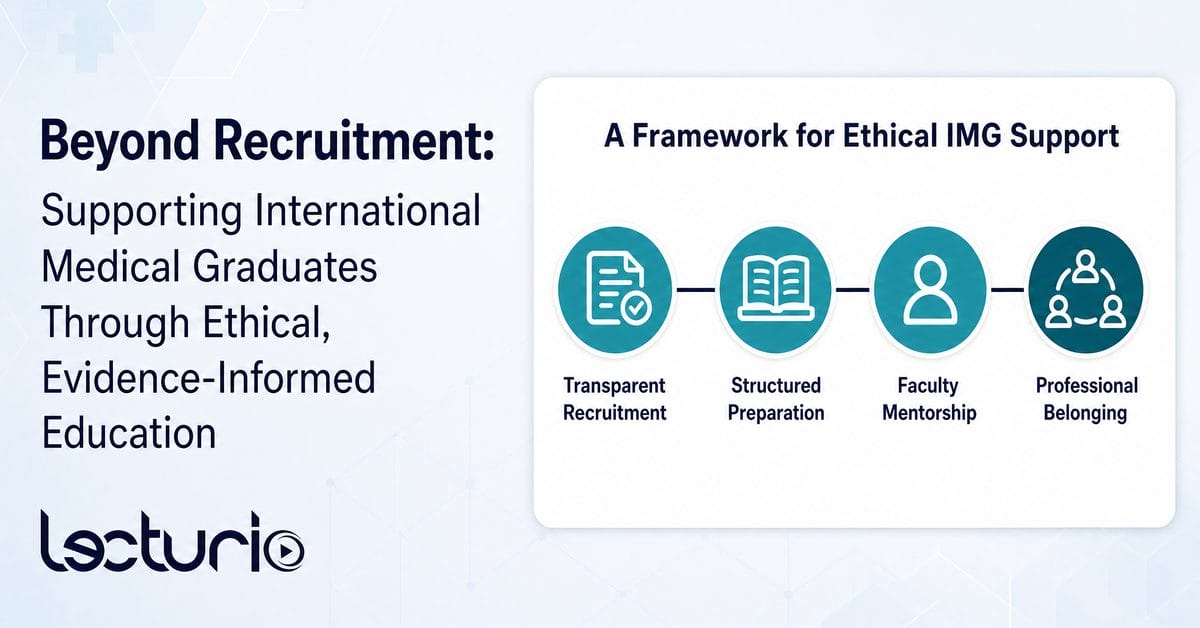
A Framework for Ethical IMG Support
| Stage | Institutional responsibility | Potential role of digital learning |
| Before recruitment | Provide transparent information about licensing, training, cost, timelines, progression, and expectations | Offer orientation modules and introductory learning pathways |
| Before arrival | Offer opportunities for learners and institutions to identify preparation and support needs collaboratively | Provide baseline self-assessment and self-paced preparation |
| Early transition | Support clinical communication, documentation, local systems knowledge, and assessment orientation | Provide Clinical English, terminology support, cases, and assessment familiarization |
| Ongoing training | Review progression and respond to emerging learning or support needs | Use formative assessment and learning analytics to identify patterns for discussion |
| Faculty follow-up | Provide coaching, contextualized feedback, and individualized development plans | Support data-informed conversations and targeted resource selection |
| Professional integration | Support belonging, mentorship, identity development, wellbeing, and participation in professional communities | Complement face-to-face support through shared resources and online learning communities |
Conclusion: Ethical Recruitment Ends in Belonging
Recruitment is only ethical when institutions remain accountable for what happens after arrival. Ethical IMG recruitment is not measured solely by the number of professionals attracted. It is reflected in whether those professionals receive a fair opportunity to prepare, adapt, contribute, and thrive.
Digital learning can make preparation and support more accessible and responsive, but it must sit within a wider system of mentorship, inclusive supervision, transparent progression, faculty development, and institutional accountability.
Platforms such as Lecturio can contribute to that ecosystem through structured preparation, multilingual learning support, Clinical English resources, formative assessment, and data that help faculty identify where more personalized support may be useful. These tools are most valuable when they strengthen professional relationships and informed educational decision-making rather than attempting to replace them.
Frequently Asked Questions (FAQ)
If IMGs are not lacking communication skills, why do they show lower pass rates on some clinical communication assessments?
Lower pass rates should not automatically be interpreted as evidence of lower clinical ability. Differential attainment may reflect several factors, including unfamiliar assessment conventions, culturally shaped communication norms, unequal access to preparation, bias, and features of the learning and assessment environment.
Verma et al. (2016) identified cultural and linguistic influences on communication performance, including differences in information-sharing and rapport-building expectations. These are learnable conventions rather than fixed indicators of clinical competence. Framing the gap as a personal deficiency risks misdiagnosing what may instead be an unmet educational or institutional support need.
Does focusing on ethics and belonging make the institutional case for supporting IMGs harder to justify?
Ethics, belonging, and institutional outcomes are not opposing priorities. Transparent recruitment and appropriate support create the conditions in which progression, safe practice, professional integration, and positive learner experiences are more likely.
Institutions are more credible and sustainable when they meet their educational responsibilities rather than treating IMGs primarily as workforce solutions or financial assets. Ethical practice is therefore not separate from institutional quality; it is part of it.
What is the single most important thing an institution can do differently, starting now?
Ask a different question.
Instead of asking, “How do we recruit and retain more IMGs?” ask, “Are we prepared to support the IMGs we recruit before, during, and after they arrive?”
That shift in framing can begin immediately, but meaningful implementation may require investment in faculty development, mentoring, learner support, protected time, and inclusive institutional processes.