

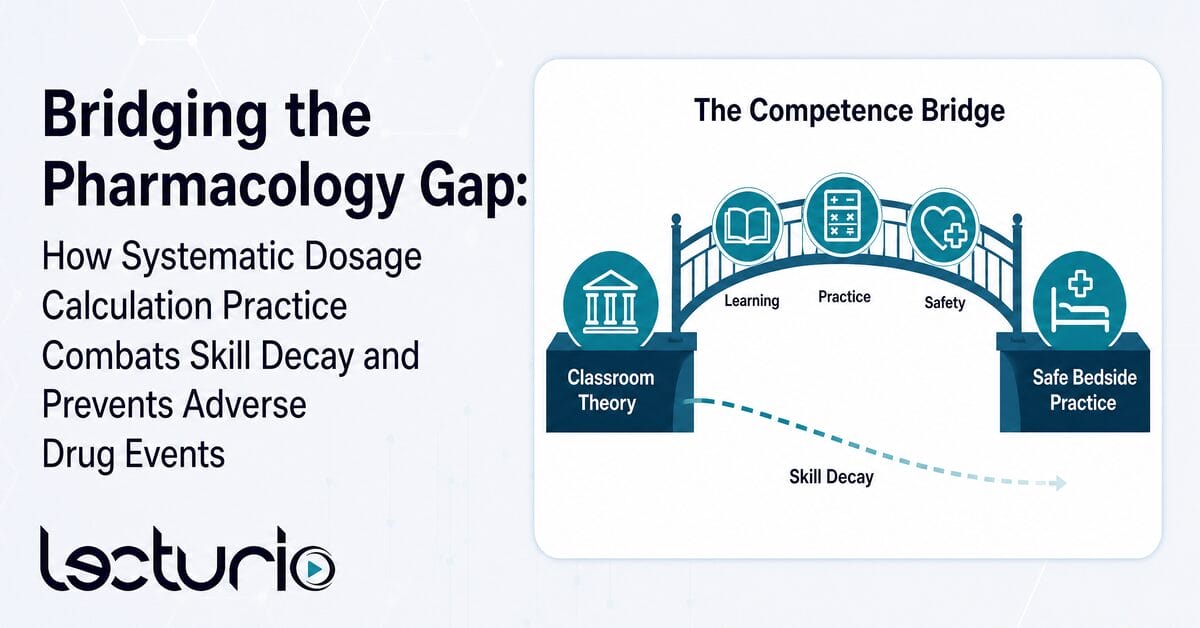
At a Glance: Maintaining student clinical math proficiency requires moving away from intermittent, high-stakes testing toward continuous, retrieval-based practice. By integrating consistent dosage calculation exercises throughout the curriculum, nursing programs can mitigate pharmacology skill decay, ease faculty remediation workloads, and ensure pre-licensure students achieve safe clinical readiness.
Introduction: The High Stakes of Clinical Readiness
Every nursing dean and program director handles the invisible operational friction of clinical onboarding. We all know that medication administration represents the ultimate clinical gauntlet—a high-stakes environment where a student acts as the final line of defense against a catastrophic medical error.
Unfortunately, the transition from classroom safety to independent bedside practice remains a profoundly vulnerable milestone. Landmark clinical data indicates that less experienced nurses with under three years of practice bear a massive share—74.9%—of medication-related safety incidents, with first-year novices accounting for nearly 38.5% of those errors.
In fact, clinical data shows a powerful connection between a new graduate’s medication safety competence and their overall readiness for independent bedside practice. When students encounter long gaps in calculation practice, a predictable cognitive drop-off quickly erodes that hard-earned baseline. When students experience long gaps in active calculation practice, a predictable cognitive drop-off quickly erodes their mastery of nursing dosage calculations.
To further reinforce student confidence and long-term mastery, many nursing programs are enhancing traditional, point-in-time calculation exams with continuous, supportive practice throughout the curriculum. Instead, they are finding immense success by integrating continuous, structured dosage calculation practice directly into the fabric of every semester.
The Cognitive Psychology of Skill Decay
We have all witnessed it: students who achieve flawless scores on a dosage calculation exam in December often return in spring struggling with basic metric conversions. This isn’t a failure of intellect; it is the predictable reality of cognitive skill decay.
A pre/post comparison at one nursing school found that dosage calculation scores dropped significantly between second and fourth year of study (mean scores fell from 21.0 to 17.97), consistent with skill decay over unstructured academic gaps. While digital platforms present an intuitive fix to these multi-semester gaps, the underlying architecture of the digital tool matters just as much as its presence. Traditional, linear online courses that operate as passive video repositories or static slide decks show an incredibly limited impact on long-term retention. To truly stick, digital learning must transition from passive consumption to active, interactive emulation. Comparative data shows that while passive lecturing and traditional content delivery have a negligible statistical impact on dosage exam pass rates (p = 0.477), transitioning to an interactive testing environment generates an exceptional upward shift in first-attempt student mastery (t(188.48) = -9.15, p < 0.001).
Furthermore, one single-institution survey study found that only 62% of nursing students agreed they could recall drug names, side effects, and contraindications — the weakest of the self-rated pharmacology domains studied. We can actively combat this boundary by keeping neural pathways open over long breaks; implementing structured pharmacology review over summer intersessions yields a measurable rebound in long-term student test scores. To successfully reduce adverse drug events, we must replace passive lecture reviews with active, year-round dosage calculation practice problems.
The Limitations of Formula Memorization under Clinical Pressure
To survive high-stakes entry exams, many students rely heavily on memorizing specific algebraic formulas, most commonly the traditional “Desired over Have” equation. While this formula works perfectly for simple, single-step calculations, rote memorization frequently fractures under clinical pressure. When students face complex pediatric weight-based dosing or multi-step IV titrations, their cognitive load skyrockets.
Comprehensive reviews of student clinical cohorts note error rates spanning from 6% down to 1.1% during clinical placements, spanning calculation errors, wrong-medication administration, omitted doses, and patient misidentification, pointing directly to calculation and unit conversion slips as leading drivers of clinical risk. Cultivating true safety habits requires building deep self-awareness; standardized metrics prove that students with stronger evidence-based competencies display higher clinical error awareness and practice caution (β = 0.24, p < 0.001).
To foster this clinical caution, forward-thinking programs are leveraging Dimensional Analysis (DA) not merely as a math trick, but as a systematic safety framework. While traditional formulas are highly effective for foundational, single-step math, introducing a systematic safety framework like Dimensional Analysis alongside them provides a consistent, universal methodology that scales effortlessly to more complex equations.
By training students to focus on the units of measurement before calculating any numbers, Dimensional Analysis provides an inherent error-trapping mechanism. If the remaining units do not align with the intended clinical route, the student catches the error upfront. This shifts the student’s focus from abstract algebra to conscious, deliberate critical thinking at the patient’s bedside.
Aligning with Current NCLEX® Standards
This curricular evolution is no longer optional; it is essential for programmatic success and board readiness. Under current NCLEX-RN® standards, traditional multiple-choice math questions have largely disappeared. The licensing board now heavily utilizes fill-in-the-blank calculation questions embedded directly within complex clinical case studies.
To succeed, students must demonstrate genuine clinical judgment rather than test-taking deduction. For faculty, however, this testing shift introduces a major logistical challenge. Manually drafting, grading, and providing meaningful remediation for hundreds of multi-step, fill-in-the-blank math problems adds a demanding administrative burden to an already packed teaching schedule.
Most programs fully recognize the value of repeated, scaffolded math practice. The barrier isn’t a lack of desire—it is a lack of time. To bridge this gap without accelerating faculty burnout, nursing programs require an automated platform that provides high-quality, exam-aligned practice while handling the grading and remediation heavy lifting.
Product Spotlight: Streamlining Dosage Calculation with Lecturio
Medication math does not have to be the hurdle that prevents capable students from reaching clinical placements. To support busy educators and help students transition step-by-step from calculation anxiety to clinical readiness, Lecturio has introduced an expanded suite of Dimensional Analysis and Fill-in-the-Blank Calculation features—a focused, high-value addition to our broader dosage calculation and board readiness offerings.
Led by Dr. Rhonda Lawes, a highly rated nurse educator celebrated for making complex topics highly approachable, this resource functions as a comprehensive learning and practice ecosystem:
- The Learning Layer: Students master a clear, repeatable method through a dedicated Dimensional Analysis course and downloadable workbooks featuring nearly 100 supporting practice questions.
- The Practice Layer: Our adaptive Qbank provides 200 progressive calculation practice problems that mirror current board formatting, complete with interactive unit-cancellation overlays that show students exactly how equations resolve step-by-step.
Scaffolded Mastery: Lecturio’s 5 Progressive Levels
| Curriculum Level | Focus | Key Competency Tested |
| Level 1 | Basic Weight Conversions | Foundation-building and base transitions (e.g., kg to lb) |
| Level 2 | Metric Conversions | Core competency, decimal precision, and safety margins |
| Level 3 | Multi-step Conversions | Intermediate conversions and complex critical thinking |
| Level 4 | Volume Conversions | Metric & household calculations for clinical application |
| Level 5 | Medication Calculations | Advanced clinical scenarios and weight-based infusions |
Curriculum Transformation: Partnering for Nursing Excellence
Deploying an interactive, automated math system does more than change daily student study habits—it modernizes the operational baseline of an entire department. When transitioning from a legacy teaching framework to an optimized digital ecosystem, the shift in institutional outcomes is immediate:
| Institutional Metric | Traditional & Manual Review Framework | Integrated & Automated Practice Ecosystem |
| Faculty Workload | High; manual drafting, grading, and individual remediation of calculation exams. | Low; automated grading, robust clinical item banks, and adaptive visual remediation paths. |
| Student Progression | Variability in pass rates; potential clinical placement delays due to math anxiety. | Secured; scaffolded, self-paced learning builds math confidence and first-attempt success. |
| Medication Safety & Clinical ROI | Standard clinical risk; reliance on observational clinical oversight to catch errors. | Maximum safety; clinical readiness and safety competence are directly reinforced through active practice (r = 0.731). |
| NCLEX® Pass Rates & Reputation | Opportunity to align traditional multiple-choice questions with current board expectations. | Secured; exam-aligned fill-in-the-blank items prepare students directly for real entry boards. |
Conclusion: Build Competence, Not Just Test Survival
Protecting patient safety requires moving beyond short-term formula memorization. By giving students systematic dosage calculation practice problems paired with a single, repeatable methodology, we can help them transition step-by-step from calculation anxiety to clinical readiness, protecting cohorts from intersemester skill decay.
Investing in interactive, exam-aligned platforms is a critical curricular upgrade—one that directly supports your faculty’s workload while securing your program’s board pass rates and clinical reputation.
Ready to eliminate student math anxiety and streamline your program’s remediation workflow? Contact Lecturio’s clinical partnership team today to explore our expanded math resources and request a custom program walkthrough.
Frequently Asked Questions
How does dosage calculation practice improve clinical reasoning?
Dosage calculation practice utilizing a systematic framework forces students to focus on unit relationships and clinical context rather than numbers alone. This directly supports the interpreting and planning phases of clinical judgment, which are heavily linked to a novice nurse’s independent decision-making.
Why do nursing students experience rapid skill decay in pharmacology?
Mathematical and pharmacological applications are highly complex and decay quickly when they are not actively used. Spaced, retrieval-based digital practice over academic breaks is essential to maintain these neural pathways and preserve clinical competence.
How do interactive testing platforms reduce student test anxiety?
Interactive platforms simulate real clinical environments—like reading a Medication Administration Record (MAR)—rather than using abstract text problems. This contextual familiarity builds student self-efficacy, which statistically lowers test anxiety and improves first-attempt pass rates on dosage exams.