Parkinson’s disease is a complex neurological condition that significantly impacts a person’s movement, cognition, and overall quality of life. Understanding the relevant nursing diagnoses is essential for providing effective and holistic care of persons affected by Parkinson’s. Keep reading to gain a comprehensive understanding of the condition, its impacts, and the necessary interventions to promote optimal health and well-being.
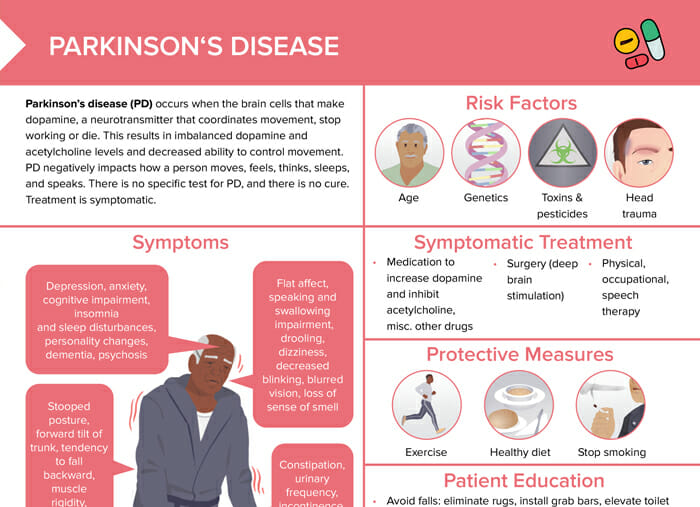
Parkinson’s disease (PD) is a chronic, progressive neurodegenerative disorder. It occurs when the brain cells that make dopamine, a neurotransmitter that coordinates movement, stop working or die. This results in imbalanced dopamine and acetylcholine levels and decreased ability to control movement. PD negatively impacts how a person moves, feels, thinks, sleeps, and speaks. There is no specific test for PD, and there is no cure. Treatment is symptomatic.
What causes Parkinson’s disease?
The exact cause of Parkinson’s disease is unknown, but likely to involve genetic as well as environmental factors.
Risk factors associated with Parkinson’s disease include age, exposure to toxins and pesticides, head trauma, genetics, and a history of depression, anxiety, cognitive impairment, insomnia, and sleep disturbances.
What are the signs of Parkinson’s disease?
Parkinson’s disease is typically characterized by a combination of motor and non-motor symptoms.
Motor symptoms
Tremor: often starts in a single hand, most noticeable at rest
Bradykinesia (slowness of movement)
Rigidity of limbs/trunk
Postural instability (falls)
Reduced facial expressions (hypomimia), a stooped posture, decreased arm swing while walking, and changes in speech and handwriting
Non-motor symptoms
Mental health issues (depression, anxiety, apathy)
Cognitive changes (mild cognitive impairment to potentially dementia later on)
Sleep problems
Autonomic dysfunction (constipation, urinary problems, sexual dysfunction, low blood pressure upon standing [orthostatic hypotension], and excessive sweating)
Sensory changes (reduced sense of smell, pain, and altered vision)
It’s important as a nurse to remember that symptoms can vary widely among individuals and may progress at different rates. The management and care of clients with Parkinson’s disease should be tailored to their unique set of symptoms and challenges.
How long can you live with Parkinson’s?
Parkinson’s disease is not directly life-threatening. It may slightly reduce affected individuals’ life expectancy due to complications like falls or pneumonia. Disease progress is highly individual and the goal of nursing care is to improve clients’ quality of life over the course of the disease and their life as much as possible.
What are the stages of Parkinson’s disease?
The Hoen-and-Yahr scale is a common way to describe Parkinson’s disease progression and severity:
Stage 1: mild symptoms only on one side of the body
Stage 2: bilateral symptoms, but intact balance
Stage 3: loss of balance, slowness of movement, falls
Stage 4: noticeable incapacitation, assistance required for daily living
Stage 5: around-the-clock nursing care needed
Note: The progression of Parkinson’s disease is highly individual, and not every affected person will go through every stage.
What is the treatment for Parkinson’s disease?
There is no cure for Parkinson’s disease, so treatment aims to alleviate symptoms and improve quality of life. Management of Parkinson’s needs to be tailored to the individual symptoms the client experiences, disease severity, age, and lifestyle.
Medical treatment
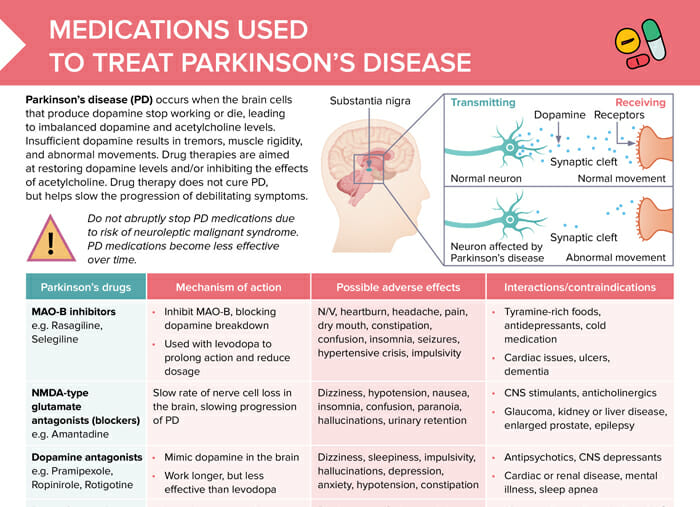
Goal: increase dopamine levels or mimic dopamine effect in the brain
Most common drugs: levodopa/carbidopa
Also used: dopamine agonists, MAO-B inhibitors, COMT inhibitors
Recommended protective measures for fall-prevention
To prevent falls in individuals with Parkinson’s, it is recommended to:
Eliminate rugs
Install grab bars
Elevate toilet seat
Ensure adequate lighting
Wear supportive and sturdy low-heeled shoes
Utilize a rolling walker or cane when walking
Maintain proper posture
Consciously lift feet when walking
Avoid prolonged sitting
Client education and lifestyle modifications
Encourage clients and make sure to:
Avoid monoamine oxidase inhibitors
Inform clients that effects of levodopa/carbidopa diminish over time
Avoid high-protein foods with levodopa/carbidopa
Encourage high-fiber soft diet, increase fluids
Maintain regular bowel elimination
Use adaptive silverware and cups with lids
Use thickeners with liquids, as appropriate
Other measures
Physical, occupational and speech and language therapy
Parkinson’s disease: nursing diagnosis and nursing care plan
Nursing diagnoses for Parkinson’s disease are individualized based on the client’s specific symptoms, the stage of the disease, and other factors like their overall health status. Here are some potential nursing diagnoses that might be relevant:
Impaired physical mobility:
Related to rigidity, bradykinesia, and postural instability
Care plan: maintain as much mobility and independence as possible through physical therapy and other interventions
Impaired verbal communication:
Due to voice and speech changes
Care plan: Speech therapy can be beneficial.
Risk for falls:
Due to postural instability and gait disturbances
The plan may involve safety measures in the home and use of assistive devices as needed.
Activity intolerance:
Related to fatigue and the energy-consuming effort of daily activities
Care plan: might include energy conservation techniques and scheduled rest periods
Constipation:
Due to slower gut motility
Care plan: dietary adjustments, increasing fluid intake, regular exercise, and potentially stool softeners or laxatives
Chronic confusion/impaired memory:
Care plan: strategies to support memory and cognitive function